Blog Article 2022 (11)

How to Add Biller for SIP Transactions in Kotak Mahindra Bank?

STEP 1: Log into Your Account & Click on BillPay/Recharge

Log in to your account using your credentials to initiate the bill payment process through net banking. Once you have successfully logged in, navigate to the top of the screen and click on the BillPay/Recharge tab. Refer to the image below where the BillPay/Recharge section is highlighted in yellow.

Youtube Background (12)

STEP 2: Click on Add a Biller

Upon clicking on the BillPay/Recharge section, a new screen will appear with a prompt to add a biller. Simply click on the "Click here to add a biller" option to proceed. Refer to the image below where the prompt is highlighted in yellow.

Youtube Background

STEP : 3 Add URN & Other Details

After clicking on "Continue," a new screen will appear where you must enter the URN provided. After entering the required information, click on the "Add Biller" button. Refer to the image below where the URN and Add Biller options are highlighted in yellow.

Youtube Background (1)

STEP 4: Verify URN Summary & Confirm

This is the second-last step in the process, where you will be prompted to verify the URN details you have entered. If the details are correct, click on "Confirm." If not, you can click on the "Go Back" option and rectify the errors.

Youtube Background (2)

Step 5: Final Confirmation

In the final step, you will receive a confirmation message stating that the biller has been added successfully. You can refer to the image below for sample confirmation.

Youtube Background (11)

We hope that this article has been informative. If you have any questions or concerns, please do not hesitate to contact us at iplan@wealthcafe.in. 

Blog Article 2022 (6)

How to Add Biller for SIP Transactions in HDFC Bank?

Step 1: Log in to your account and click on the BillPay & Recharge option

To begin the process of adding a biller for SIP transactions in HDFC Bank, you will first need to log in to your bank account. Once you have successfully logged in, navigate to the top of the screen and click on the BillPay & Recharge tab. This will open a new screen that displays various bill payment options that you can add to your account. To proceed, click on the Continue button at the bottom of the screen.

Youtube Background (7)

Step 2: Click on Register New Biller

After clicking on the Continue button, you will be redirected to a new screen. Here, you need to search for the option "Register New Biller" and click on "Click here to add a button" to proceed.

Youtube Background (5)

Step 3: Select Mutual Funds & BSE Limited

Once you have clicked on "Click here to add a button," a new screen will appear. Here, you need to select the Mutual Funds option from the list of available options. Once you have selected Mutual Funds, a drop-down menu next to it will become enabled, select the Mutual Fund House in which you are investing.

Youtube Background (6)

Step 4: Add the URN & Other Options & Select Continue

After selecting BSE Limited as your biller, you will be taken to a new screen where you need to add your URN. Along with the URN, you will also need to select other options such as AutoPay, Pay Entire Bill Amount, and Payment Mode. Once you have entered all the necessary information, click on the Continue button.

Youtube Background (8)

Step 5: Confirmation Page

After clicking on the Continue button, a new screen will appear displaying all the details that you have entered. Review the details carefully and click on the Confirm button to proceed.

Youtube Background (9)

Step 6: Final Confirmation

After clicking on the Confirm button, you will receive a confirmation message stating that the biller has been added successfully. Congratulations! You have successfully added a biller for SIP transactions in HDFC Bank.

Youtube Background (12)

We hope that this article has been informative. If you have any questions or concerns, please do not hesitate to contact us at iplan@wealthcafe.in. 

Blog Article 2022 (5)

What is a Revised Return?

I hope you have already filed your Income Tax Return. Generally, you need to file your Income Tax Return by July 31 of any year unless extended by the government. However, at times in order to meet the deadline, we may forget to disclose some income or may make unintentional mistakes like a mistake in claiming any deduction.

In such a situation, you can always file a revised return. 

What is a Revised Return?

A revised return is a return that is filed u/s 139(5) as a revision for the original return. It is a revision for any omission or mistake made in the filing of that original return. In order to meet the deadline, a person may forget to disclose some income or may make any other mistake like a mistake in claiming any deduction.

For example: If a Return of Income is filed by the assessee for the Financial Year 2020-21 i.e. Assessment Year 2021-22 and he later discovers some mistake, he can file a Revised Return of Income Tax anytime up to 31st March 2019 or before the completion of the assessment whichever is earlier.

Return eligible for revision

  • The original return filed u/s 139(1).
  • The belated return filed u/s 139(4) can also be revised now.

Points to keep in mind while filing a revised return:

  • ITR form can be changed while revising of return.
  • No penalty can be levied by the department for bonafide mistakes (unintentional)
  • If the assessing officer discovers that the error/ omission was intentional/fraudulent return revision of the return is not allowed and a penalty may be levied.
  • Interest under sections 234B and 234C will be recalculated under every revised return.
  • If the taxpayer has revised the return after the survey/search and it was has found that the mistake in the original return was not bonafide then the levy of penalty is justified.

Time Limit

Revised Return of Income Tax can be filed by an assessee at any time

  • Before the end of the relevant assessment year; or
  • Before completion of the assessment

whichever is earlier.

For example: If an assessee files the return for F.Y. 2020-21 (A.Y. 2021-22) on 8th July 2021. And later on, if he discovers some mistake, then he can file a revised return of Income Tax anytime up to 31 March 2022 or before the completion of the assessment, whichever is earlier.

Here is how to file a Revised Income Tax Return:

  • Visit the Income Tax website, now login into the Income Tax e-filing portal by entering PAN/ Aadhar/ other user ID.
  • After logging in, you need to select your assessment year and select ITR Form Number.
  • After that after under ‘Filing Type’ select ‘Revised’
  • Now under the ‘General Information tab, choose the ‘return filing section’ as ‘revised return’ under Section 139(5) and the ‘return filing’ type as ‘revised’.
  • Now enter the acknowledgement Number and Date of filing of the original return. (It is compulsory to enter the 15-digit acknowledgement number when filing a revised ITR).
  • Carefully fill in or correct relevant details of the online ITR form and then submit the ITR.
    Finally, e-verify the returns for faster processing and a quicker refund.

Wealth Cafe Advice: 

Usually, mistakes/errors take place when you sit to file your ITR during the deadline period. Make sure you are ready with all the documents and be prepared to file it well in advance  - this will also help you to get your refund on time. However, if you still discover a mistake after filing the original return, rectify it yourself by filing a revised return or consult your accountant rather than waiting for the Govt to send a notice.

Blog Article 2022 (4)

All about First Installment of Advance Tax Payment

Advance tax means income tax that should be paid in advance instead of lump sum payment at year-end. It helps the Govt. to receive a constant flow of tax receipts throughout the year so that the Govt can incur its expenses timely rather than receiving all tax payments at the end of the year. This keeps the government rolling

Who is liable to pay Advance Tax?

The eligibility criteria you will have to fulfill in order to pay advance tax are:

  • Your tax liability should be INR 10,000 and above.
  • You should be a salaried or a self-employed individual.
  • Income received via capital gains on shares.
  • Interest earned on fixed deposits.
  • Winnings are earned from a lottery.
  • Rent or income earned from house property.

Exemption in Advance Tax Payments

  • Senior citizens aged 60 years and above are exempted from paying the advance tax.
  • Salaried individuals falling under the TDS net are exempted from paying the advance tax.
  • However, any earnings from sources such as interest, capital gains, rent, and other non-salary income will attract advance tax.
  • If TDS deducted is more than the tax payable for the year, then one does not have to pay the advance tax.

Payment of Advance Tax:

You can choose to pay advance tax by any of the following modes:

  • Offline Mode: You can pay advance tax using Challan 280 just like any other regular tax payment at bank branches authorized by the Income Tax Department.
  • Online Mode: You can also pay it online through the official website of the Income Tax department.

In case you fail to pay advance tax, you will be liable to pay 3% of the shortfall - if the advance tax is more than 12% of tax).

However, it is important to note that no interest(penalty)  is payable if the advance is tax paid on or before 15th June. Also, if the advance tax is less than 12% of the tax due for the year.

WealthCafe Advise

Advance tax is a good means to check your income, evaluate it and understand if you need to pay any taxes. Where you do come under the provisions of advance tax, best to consult the same professional for advice on the same.


    Get your weekly dose of Money Masala from us.


    Blog Article 2022

    All about Advance Taxation

    Advance Tax Payment is a set up to pay a share of your taxes in installments on due dates decided by the income tax department. It is also known as the ‘Pay as you earn scheme’.

    What is Advance Tax Payment?

    Advance tax means income tax that should be paid in advance instead of lump sum payment at year-end. It helps the Govt. to receive a constant flow of tax receipts throughout the year so that the Govt can incur its expenses timely rather than receiving all tax payments at the end of the year. This keeps the government rolling

    Who is liable to pay Advance Tax?

    The eligibility criteria you will have to fulfill in order to pay advance tax are:

    • Your tax liability should be INR 10,000 and above.
    • You should be a salaried or a self-employed individual.
    • Income received via capital gains on shares.
    • Interest earned on fixed deposits.
    • Winnings earned from a lottery.
    • Rent or income earned from house property.

    Exemption in Advance Tax Payments

    • Senior citizens aged 60 years and above are exempted from paying the advance tax.
    • Salaried individuals falling under the TDS net are exempted from paying the advance tax.
    • However, any earnings from sources such as interest, capital gains, rent, and other non-salary income will attract advance tax.
    • If TDS deducted is more than the tax payable for the year, then one does not have to pay the advance tax.

    Payment of Advance Tax:

    You can choose to pay advance tax by any of the following modes:

    • Offline Mode: You can pay advance tax using Challan 280 just like any other regular tax payment at bank branches authorized by the Income Tax Department.
    • Online Mode: You can also pay it online through the official website of the Income Tax department.

    Due date and Penalty on late payment

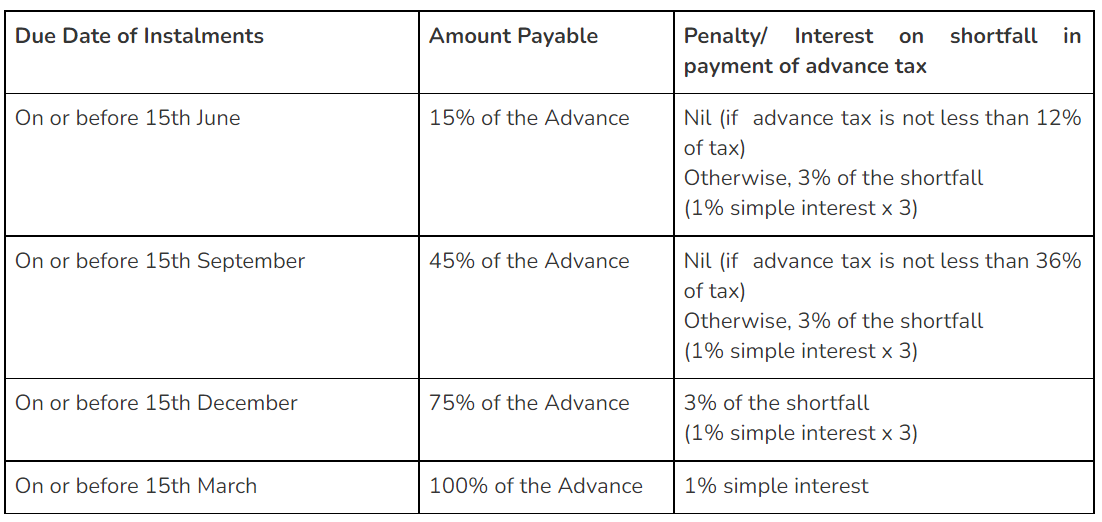
    Computing the exact advance tax liability sometimes gets very difficult and therefore the Income Tax Dept has released an Income Tax Calculator which is free to use by everyone. If your tax liability is more than INR 10,000- you should pay your taxes on or before the dates mentioned below. Also, you will need to pay a penalty in case you miss paying it.

    Screenshot 2022-03-09 220142

    Interest on late payment of Advance Tax is applicable as follows

    1. Interest under section 234C – Interest @ 1% per month is payable if the tax is not paid as per the above schedule i.e. for Deferment in Instalments of Advance Tax
    2. Interest under section 234B – Interest @ 1% is payable if 90% of the tax is not paid before the end of the financial year i.e. for Default in Payment of Advance Tax
    3. For computing Interest u/s 234A/B/C and any other Interest, Income Tax shall be rounded off to nearest hundred and fraction of hundred shall be ignored

    Refund in Advance Tax Payment

    At the end of the year, if the Income Tax Department finds out that you have paid more tax than you should have paid, then it will refund the excess amount. Taxpayers can claim a refund by filling out and submitting Form 30. They have to make the claim within a period of one year from the last year of the assessment year

    Wealth Cafe Advise

    Where you are earning any income on which taxes could be more than INR 10,000 and the same is not deducted as TDS, then you must compute the same and pay it as advance taxes. It is best to consult a chartered accountant before 31 March so in case there are any advance taxes to be paid, you can do so without levying any penalty.

      Get your weekly dose of Money Masala from us.


      All about Tax Deducted at Source (TDS)

      An individual can earn income from various sources. Income tax is a direct tax that they need to pay, depending on which tax bracket their total income falls in. According to the Indian tax system, Tax Deducted at Source (TDS) is an essential term in taxation that has a significant bearing on the taxpayers. It is a means of collecting income tax by the government and offers convenience to the deductee as it is deducted automatically.  

      What is TDS?

      The TDS full form is Tax Deducted at Source (TDS). The system was introduced by the Income Tax Department of India. In this, people who are responsible for making payments like salary, commission, professional fees, interest, or rent are liable to deduct a specified percent of tax before making the full payment. In simple words, the system allows tax deduction right at the source.

      To understand the TDS better, consider the following example.

      Assume that the nature of payment is professional fees on which the rate specified for TDS is 10 percent (To know more - click here). An ABC organization pays INR 50,000 as professional fees to Ms. XYZ. In this case, the ABC organization is liable to deduct INR 5000 and make a net payment of INR 45,000 to Ms. XYZ. The INR 5000 deducted by the company will be deposited directly to the credit of the government.

      What are the rules for Tax Deducted at Source?

      There are rules concerning not just income tax return filing but also concerning TDS. If an individual or organization meets these rules adequately, they will be able to avoid penalties, fees, or interest. The main rules related to TDS are:

      1. One of the first essential rules is that Tax Deducted at Source needs to be deducted at the time when the payment either gets due or when the actual amount is made, whichever is earlier
      2. Delay in deduction of TDS will attract interest @ 1% per month until the tax is deducted [2]
      3. Every person, whether an employer or otherwise, needs to credit the tax deducted to the government’s account by the 7th day of the following month
      4. In case of late or non-payment of TDS, an interest @ 1.5% per month will be levied until the tax has not been deposited

      How to apply for a TDS refund?

      A major misconception that many individuals have is that an excess TDS refund is different from that of an income tax refund. However, according to the Indian Tax System, there is only one type of return that you claim at the time of filing your annual income tax return.

      For filing your TDS refund, it is compulsory to quote bank account details such as account number and IFSC code. Failing to do so will not generate a valid file for you. In case if someone deducts more tax than he should have deducted, then there will be an income tax refund, which can be claimed upon the filing of the annual income tax return (ITR).

      For example, you own a transport agency, and yours is a proprietorship firm. You presented an invoice for Rs. 20,000/- and the person paying freight paid you a net amount of Rs. 19,600/- (after deducting tax of Rs. 1,000/- @ 2% under section 194C). In this case, the tax will be deducted at 2% instead of 1% and hence deducted excess TDS by Rs. 200/-. This excess TDS of Rs. 200 will arise as a refund in the income tax return, according to the Income Tax Act, 1961.

      Ensure Proper TDS Deduction

      Tax Deducted at Source is an essential legal obligation for everyone earning an income. It ensures that there is no tax evasion as it is levied at the source itself. Every employer, as well as individuals, should give proper attention to meeting with this deduction. It is because non-filing or late filing of Tax Deducted at Source will attract penalties and fines.

      Along with being aware of how to file ITR, Individuals at their end should share proper documentation with the employer as well as check online for any updates in TDS provisions. It will ensure that your employer makes the right Tax Deducted at Source declaration from your salary income.

      Wealthcafe Advice

      There is only a single refund i.e. Income Tax Refund which is an excess of tax already paid by way of TDS, TCS, advance tax or self-assessment tax less tax on your total income. You can get a refund of additional tax only after filing your income tax return for that particular year.

      In other words, there is no other method to get a refund other than by filing an Income Tax Return.

      Income-tax Rates FY 2021-22 (AY 2022-23)

      Before knowing the tax rates, it is very important to understand the terms Financial year (FY) and Assessment Year (AY).

      The below-mentioned tax rates/ slab is on the income earned for the period 1 April 2021 to 31 March 2022. FY stands for the ‘financial year’ which is from 1 April 2021 to 31 March 2022. AY stands for Assessment year which is 1 April 2022 to 31 March 23.

      For individuals, the due date to file the income tax return for the income earned from 1 April 2021 to 31 March 2022 is 31 July 2022. 

      Income tax Rates 

      1. Income Tax Rate & Slab for Individuals & HUF:
        1. Individual (Resident or Resident but not Ordinarily Resident or non-resident), who is of the age of less than 60 years on the last day of the relevant previous year & for HUF:


      Taxable income Tax Rate

      (Existing Scheme)

      Tax Rate

      (New Scheme)

      Up to Rs. 2,50,000 NIL NIL
      Rs. 2,50,001 to Rs. 5,00,000 5%  5% 
      Rs. 5,00,001 to Rs. 7,50,000 20% 20%
      Rs. 7,50,001 to Rs. 10,00,000 20% 15%
      Rs. 10,00,001 to Rs. 12,50,000 30% 20%
      Rs. 12,50,001 to Rs. 15,00,000 30% 25%
      Above Rs. 15,00,000 30% 30%


      1. Resident or Resident but not Ordinarily Resident senior citizen, i.e., every individual, being a resident or Resident but not Ordinarily Resident in India, who is of the age of 60 years or more but less than 80 years at any time during the previous year:
      Taxable income Tax Rate

      (Existing Scheme)

      Tax Rate

      (New Scheme)

      Up to Rs. 2,50,000 Nil Nil
      Rs. 2,50,001 to Rs. 3,00,000 Nil 5%
      Rs. 3,00,001 to Rs. 5,00,000 5% 5%
      Rs. 5,00,001 to Rs. 7,50,000 20%  10%
      Rs. 7,50,001 to Rs. 10,00,000 20%  15%
      Rs. 10,00,001 to Rs. 12,50,000 30%  20%
      Rs. 12,50,001 to Rs. 15,00,000 30%  25%
      Above Rs. 15,00,000 30%  30%


      1. Resident or Resident but not Ordinarily Resident super senior citizen, i.e., every individual, being a resident or Resident but not Ordinarily Resident in India, who is of the age of 80 years or more at any time during the previous year:


      Taxable income Tax Rate

      (Existing Scheme)

      Tax Rate

      (New Scheme)

      Up to Rs. 2,50,000 Nil NIL
      Rs. 2,50,001 to Rs. 5,00,000 Nil 5%
      Rs. 5,00,001 to Rs. 7,50,000 20% 10%
      Rs. 7,50,001 to Rs. 10,00,000 20% 15%
      Rs. 10,00,001 to Rs. 12,50,000 30% 20%
      Rs. 12,50,001 to Rs. 15,00,000 30% 25%
      Above Rs. 15,00,000 30% 30%


      1. Surcharge:
        a) 10% of Income-tax where total income exceeds Rs.50 lakh
        b) 15% of Income-tax where total income exceeds Rs.1 crore
        c) 25% of Income-tax where total income exceeds Rs.2 crore
        d) 37% of Income-tax where total income exceeds Rs.5 crore
      2. Note: The enhanced surcharge of 25% & 37%, as the case may be, is not levied, from income chargeable to tax under sections 111A, 112A, and 115AD. Hence, the maximum rate of surcharge on tax payable on such incomes shall be 15%.
      3. Education cess:4% of income tax plus surcharge
      4. Note: A resident or Resident but not Ordinarily Resident individual is entitled to a rebate under section 87A if his total income does not exceed Rs. 5, 00,000. The amount of rebate shall be 100% of income tax or Rs. 12,500, whichever is less. rebate under section 87A is available in both schemes I.e. existing scheme as well as the new scheme.


      1. Income Tax Rates for AOP/BOI/Any other Artificial Juridical Person:
      Taxable income Tax Rate
      Up to Rs. 2,50,000 Nil
      Rs. 2,50,001 to Rs. 5,00,000 5%
      Rs. 5,00,001 to Rs. 10,00,000 20%
      Above Rs. 10,00,000 30%


      Surcharge:

      1. a) 10% of Income-tax where total income exceeds Rs.50 lakh
      2. b) 15% of Income-tax where total income exceeds Rs.1 crore
      3. c) 25% of Income-tax where total income exceeds Rs.2 crore
      4. d) 37% of Income-tax where total income exceeds Rs.5 crore

      Note: Enhanced Surcharge rate (25% or 37%) is not applicable in case of specified incomes I.e. short-term capital gain u/s 111A, long-term capital gain u/s 112A & short-term or long-term capital gain u/s 115AD(1)(b).

      Education cess: 4% of tax plus surcharge


      1. Tax Rate for Partnership Firm:

      A partnership firm (including LLP) is taxable at 30%.

      Surcharge: 12% of Income-tax where total income exceeds Rs. 1 crore

      Education cess: 4% of Income-tax plus surcharge


      1. Income Tax Slab Rate for Local Authority:

      A local authority is Income taxable at 30%.

      Surcharge: 12% of Income-tax where total income exceeds Rs. 1 crore

      Education cess: 4% of tax plus surcharge


      1. Tax Slab Rate for Domestic Company:

      A domestic company is taxable at 30%. However, the tax rate is 25% if turnover or gross receipt of the company does not exceed Rs. 400 crore in the previous year.

      Particulars Tax Rate(%)
      If turnover or gross receipt of the company does not exceed Rs. 400 crore in the previous year 2019-20 25%
      If the company opted section 115BA (Note 1) 25%
      If the company opted for section 115BAA (Note 2) 22%
      If the company opted for section 115BAB (Note 3) 15%
      Any other domestic company 30%


      Note 1: Section 115BA – A domestic company which is registered on or after March 1, 2016, and engaged in the business of manufacture or production of any article or thing and research in relation to (or distribution of) such article or thing manufactured or produced by it and also It is not claiming any deduction u/s 10AA, 32AC, 32AD, 33AB, 33ABA, 35(1)(ii)/(iia)/(iii)/35(2AA)/(2AB), 35AC, 35AD, 35CCC, 35CCD, section 80H to 80TT (Other than 80JJAA) or additional depreciation, can opt section 115BA on or before the due date of return by filing Form 10-IB online. The company cannot claim any brought forward losses (if such loss is related to the deductions specified in the above point).

      Note 2: Section 115BAA – Total income of a company is taxable at the rate of 22% (from A.Y 2020-21) if the following conditions are satisfied:

      – Company is not claiming any deduction u/s 10AA or 32(1)(iia) or 32AD or 33AB or 33ABA or 35(1)(ii)/(iia)/(iii)/35(2AA)/(2AB) or 35AD or 35CCC or 35CCD or section 80H to 80TT (Other than 80JJAA).

      – Company is not claiming any brought forward losses (if such loss is related to the deductions specified in the above point).

      – Provisions of MAT are not applicable to such companies after exercising of option. The company cannot claim the MAT credit (if any is available at the time of exercising section 115BAA).

      Note 3: Section 115BAB – Total income of a company is taxable at the rate of 15% (from A.Y 2020-21) if the following conditions are satisfied:

      – Company (not covered in section 115BA and 115BAA) is registered on or after October 1, 2019, and commenced manufacturing on or before 31st March 2023.

      – Company is not formed by splitting up or reconstructing a business already in existence.

      – Company does not use any machinery or plant previously used for any purpose.

      – Company does not use any building previously used as a hotel or a convention center, as the case may be.

      – Company is not engaged in any business other than the business of manufacture or production of any article or thing and research in relation to (or distribution of) such article or thing manufactured or produced by it. Business of manufacture or production shall not include the business of –

      • Development of computer software;
      • Mining ;
      • Conversion of marble blocks or similar items into slabs;
      • Bottling of gas into the cylinder;
      • Printing of books or production of the cinematographic film; or
      • Any other notified by Central Govt.

      – Company is not claiming any deduction u/s 10AA or 32(1)(iia) or 32AD or 33AB or 33ABA or 35(1)(ii)/(iia)/(iii)/35(2AA)/(2AB) or 35AD or 35CCC or 35CCD or section 80H to 80TT (Other than 80JJAA and 80M).

      – Company is not claiming any brought forward losses (if such loss is related to the deductions specified in the above point).

      – Provisions of MAT are not applicable to such companies after exercising of option. The company cannot claim the MAT credit (if any available at the time of exercising of section 115BAA).

      Surcharge:

      1. a) 7% of Income-tax where total income exceeds Rs.1 crore
      2. b) 12% of Income-tax where total income exceeds Rs.10 crore
      3. c) 10% of income tax where domestic company opted for section 115BAA and 115BAB

      Education cess: 4% of Income-tax plus surcharge.


      1. Tax Rates for Foreign Company:

      A foreign company is taxable at 40%

      Surcharge: 

      1. a) 2% of Income-tax where total income exceeds Rs. 1 crore
      2. b) 5% of Income-tax where total income exceeds Rs. 10 crore

      Education cess: 4% of Income-tax plus surcharge.

      1. Income Tax Slab for Co-operative Society
      Taxable income Tax Rate

      (Existing Scheme)

      Tax Rate

      (New Scheme)

      Up to Rs. 10,000 10%
      Rs. 10,001 to Rs. 20,000 20% 22%
      Above Rs. 20,000 30%


      Surcharge:

      1. a) 12% of Income-tax where total income exceeds Rs. 1 crore
      2. b) In the case of Concessional scheme, the surcharge rate is 10%

      Education cess: 4% of Income-tax plus surcharge.

      Disclaimer: – The articles are for information purposes only. Information presented is general information that does not take into account your individual circumstances, financial situation, or needs, nor does it present a personalized recommendation to you. You must consult a financial advisor who understands your specific circumstances and situation before taking an investment decision.

      Things you must know about the new income tax portal for easy filing of the return for FY 21-22.

      Income Tax Return ITR E-Filing Direct Link

      1. There is a direct link for the e-filing of Income Tax returns. It is the official portal of Income Tax India.
      2. You need to visit – www.incometaxindiaefiling.gov.in to file your income tax return.
      3. Taxpayers can file ITR, verify income tax returns, link Aadhaar with PAN, know Aadhaar-PAN link status, e-pay tax, track status of e-filed Income Tax Return status, know tax deductors across India etc.

      Here are key things to know about filing ITR:


      What are the new options for filing ITR on the new portal?

      The I-T department has encouraged taxpayers to update their profiles to avail accurate pre-filled ITRs and enhanced user experience.

      On the top of the new website, one can find the tab to access individual-based help content. Clicking on the application tab takes an individual to view guidance on how to file ITRs and applicable forms for the same. Deductions, refund status, tax slab and other related information are also present there.

      The department has claimed that the new IT return e-filing portal and the new mobile app will be easy to use for taxpayers.


      What are the additional features of the new portal in terms of ITR filing?

      The new portal has a drop-down menu for taxpayers for checking instructions on ITR filing, refund status, and tax slabs. The new site also has detailed user manuals, FAQs and videos to help taxpayers understand various services available on the portal.


      What are the forms of return prescribed under the income tax law?

      The Income Tax Department has notified 7 forms for filing ITR this year. These forms include Sahaj (ITR-1), Form ITR-2, Form ITR-3, Form Sugam (ITR-4), Form ITR-5, Form ITR-6 and Form ITR-7.


      What are the different modes of filing the return of income?

      The return form can be filed with the Income-tax Department in any of the following ways, -

      (i) by furnishing the return in a paper form;

      (ii) by furnishing the return electronically under digital signature;

      (iii) by transmitting the data in the return electronically under electronic verification code;

      (iv) by transmitting the data in the return electronically and thereafter submitting the verification of the return in Return Form ITR-V;


      How to file the return of income electronically?

      The Income-tax Department has established an independent portal for e-filing of return of income. The taxpayers can log on to https://www.incometax.gov.in for e-filing the return of income.


      What are the benefits of filing my return of income?

      Filing of return earns an individual the dignity of consciously contributing to the development of the nation. Apart from this, income tax returns validate an individual's credit-worthiness before financial institutions and make it possible for him/her to access many financial benefits such as bank credits, etc.

      Article headers (3)

      Car Maintenance Allowance - Tax Benefit

      As you climb up the ladder in your profession, it is commonly seen that the employer provides a car to ensure an easy commute for such employees. Such a car can be owned by the employer or the employee. In addition, the expenses related to the car can be sponsored by the employer or not. The car may be used for personal reasons at times, leading to confusion in the minds of employees in terms of tax liability.

      Here is a list of possibilities and their respective tax liabilities.

      IA .Car owned by the employer – Value of car used exclusively for official purposes

      Irrespective of who owns the car, if the car provided by the employer is used solely for official purposes, no tax liability exists. For this to be non-taxable, the employer must maintain proper records as given below:

      Details of all the official journeys must be maintained including details such as date, destination, mileage, bills, and other expenditures related to it.

      The employer must also issue a certificate stating that the vehicle was used only for official purposes.

      IB. Car owned by the employer – Value of car used for both official and personal purposes
      When the car provided by the employer is used for personal purposes in addition to official ones, the expenditure will be considered under Rule 3(2)(A) and Table II of Value of Perquisites. The table below provides further information on the same.

      Description Cubic Capacity within 1.6 litre Cubic Capacity exceeding 1.6 litre
      Expenses reimbursed by the employer Rs.1,800 + Rs.900 (if a driver is provided by the employer) Rs.2,400 + Rs.900 (if the driver is provided by the employer)
      Expenses directly met by the employee Rs.600 + Rs.900 (if the driver is provided by the employer) Rs.900 + Rs.900 (if the driver is provided by the employer)

      IC.  Car owned by the employer – Value of car used only for personal purposes
      If the car provided by the employer is solely used for personal reasons and if the expenditure is borne by the employer completely, the entire amount will be taxable.

      Taxable Amount = All Expenses + 10% of actual cost/Hire charges + Driver's Salary

      No benefit can be availed by the employee in this regard. The amount reimbursed will be mentioned in the pay slip and can be taxed according to the applicable income tax slab. Any amount recovered by the employer from the employee will be reduced in computing the taxable amount.


      IIA. Car owned by the employee – Value of car used exclusively for official purposes

      As said earlier, irrespective of who owns the car, if the car provided by the employer is used solely for official purposes, no tax liability exists.

      IIB. Car owned by the employee – Value of car used for both official and personal purposes

      Car is used for personal purposes in addition to official ones, the expenditure incurred as reduced by below will be taxable:

      Description Cubic Capacity within 1.6 litre Cubic Capacity exceeding 1.6 litre
      Expenses reimbursed by the employer All Expenses -[Rs.1,800 + Rs.900 (if a driver is provided by the employer)] All Expenses -[Rs.2,400 + Rs.900 (if the driver is provided by the employer)]

      IIC. Car owned by the employee – Value of car used only for personal purposes 

      If the car owned by the employee himself is used for personal reasons and if the expenditure is borne by the employer, the entire amount will be taxable.

      Taxable Amount = All Expenses + Driver's Salary


      Therefore,  if you are among the employees who use personal car or office ones, then make sure you are aware of the tax benefits mentioned above.


      Disclaimer: - The articles are for information purposes only. Information presented is general information that does not take into account your individual circumstances, financial situation, or needs, nor does it present a personalized recommendation to you. You must consult a financial advisor who understands your specific circumstances and situation before taking an investment decision.

      Article headers (1)

      FBP- Flexible Benefit Plan of your Salary Structure

      FBP (Flexible Benefit Plan) is widely used as a tax saving tool by many companies. It allows employees to structure CTC components while offering employee benefits such as Conveyance and Medical Expenses. In other words, there is a basket of allowances from which the employee chooses the component he wants for financial wellbeing.


      For many years now, organizations, whether big or small, have tinkered with the idea of flexible benefit plans.
      A flexible benefits plan (FBP) allows your employees to have more control over their salary and benefits package. They can restructure components accordingly. Let’s see how this is achieved.
      Flexible Benefits Plan Components in India

      These components are broadly divided into two subcategories
      The monthly component which is paid by the HR department on a monthly basis. These components include HRA, vehicle lease, etc.
      The annual component is paid to the employee on a yearly basis, only when the employee claims it. For instance, fuel, telephone, book reimbursements etc.

      Let’s discuss few in details
      ✅Telephone Reimbursements
      INR 30,000 per annum
      Telephone/Internet expenses that you incur for the purpose of your employment can be submitted to your employer and a tax-free reimbursement of the same can be claimed.

      ✅Newspaper & periodicals
      INR 30,000 per annum
      Employees can claim reimbursement of expenses incurred on books, newspaper subscriptions, journals & so on.

      ✅Research allowance
      INR 36,000 per annum
      Allowance given to encourage research, training and other professional pursuits and employees can claim a tax exemption.

      ✅Leave travel allowance
      Allowance given to the employee by employers for travel. The exemption is available only on the actual travel costs i.e., the air, rail or bus fare incurred by the employee. No expenses such as local conveyance, sightseeing, hotel accommodation, food, etc are eligible for this exemption. Availing LTA tax exemption is subject to certain terms and conditions.

      ✅Car maintenance allowance
      It is commonly seen that the employer provides a car to ensure an easy commute for such employees. Irrespective the car is owned by an employee or employer, if the car is used only for business in the performance of office duties, then it will not be taxable. It's tax efficient to get a company owned car to claim full reimbursement for fuel, maintenance and driver’s salary. But, one should keep in mind, when the employer provides the car taxable perquisite, it is only limited to the specified limits.

      How do flexible benefit plans help your employees?

      If you are considering offering your employees flexible benefits, communicating the advantages of the plan is crucial. From the employees’ perspective, flexible benefits is a portion of the salary that can be received against different expenses to primarily save on income tax.
      For example – Conveyance and Medical expenses are non-taxable components of CTC structures. Thus tax exemption can be availed against the productions of relevant receipts.

      Way of Saving Tax

      While implementing a flexible benefit plan requires that the employer implement an additional payroll deduction to cover costs of these benefits programs. This deduction is taken out of employees’ income before tax is calculated. This means that employees will actually save tax and have a larger take home salary.
      How could employees avail Tax Exemption for the Flexible benefit components?
      You can reduce your taxable salary and avail of tax exemption by declaring expenses and producing receipts under the Flexible Benefits head such as House Rents.
      What happens when an Employee does not claim the Flexible Benefit component?
      The amount that is unclaimed by the employee is denoted as Unclaimed. Income Tax would be calculated as applicable.


      When does this amount get paid to the employee?

      Some employers pay the Flexible Benefit Plan amount upfront and ask for receipts of the same at the financial year end. On not submitting the receipt, Income tax is deducted.
      On the other hand, employers can deduct the Benefit amount from your monthly salary and it is reimbursed to you after you submit the receipts at the financial year end.

      Conclusion

      Every employee is unique, and so are their needs.Flexible Benefit Plan enables the admin as well as the employee to exercise a better experience of dispatching and structuring salaries. With a good FBP, both the parties are entitled to easy functioning and hassle-free customization.

      [mc4wp_form id="2150"]

      WCafe Financial Services Pvt Ltd (formerly known as Wealth Cafe Financial Services Pvt Ltd) is a AMFI registered ARN holder with ARN-78274.

      WCafe Financial Services Pvt Ltd (formerly known as Wealth Cafe Financial Services Pvt Ltd) is a SEBI registered Authorised Person (sub broker) of Sharekhan Limited with NSE Regn AP2069583763 and BSE Regn AP01074801170742.

      Copyright 2010-20 Wealth Café ©  All Rights Reserved