8bfedc1901692a67b64a52a6937bdfdd_accounting-balance-banking-159804-3504-c-90

Should I pause/stop my SIP?

The tides may appear to have calmed down for now but we never know what is in store for us next. Some relaxations have definitely come out and some more are expected. However, this does not cure COVID 19, it just prepares us for the new normal of living with Covid as we begin to resume our old routines.

While there are many uncertainties looming over us, including pay cuts and job loss, some of you guys asked us if they should discontinue/pause their SIPs under these circumstances?

Like always my answer to this will depend upon how much extra cash you have left each month and if there is an Emergency Fund (equal to 4/6 months of your monthly expenses) in place to take care of these uncertain times.

  • If you have not been affected by pay cuts, you must continue your SIPs as before. Additionally, since you are spending less than before, the savings again must get channeled into your investment portfolio.
  • If your pay has been reduced, counter that with the reduced spends, and if your total savings are still the same, continue with your SIPs. If the savings are lower, then you can dip into your Emergency Fund to ensure your SIPs don't stop. If you have not set up an EMergency fund, then you will have to reduce your monthly SIP to match the amount you are able to save each month.
  • If you have lost your job, or your salary has been paused, then you can fall back on your emergency fund to take care of your monthly expenses. SIPs will have to be stopped and will suffer.

What is the point of SIPs right now?

SIPs (known as systematic investment plans) are where you invest a fixed amount of money into a choice of your mutual fund at regular intervals (generally monthly). It is an automated process and the amount is debited from your bank and mutual fund units credited to you.

Buying in a falling market reduces your cost giving you higher benefits when the market goes up. To understand this better, let us run you through this example.

You get more units when the fund's NAV (market price) is lower
You get less units when the fund's NAV (market price) is higher.
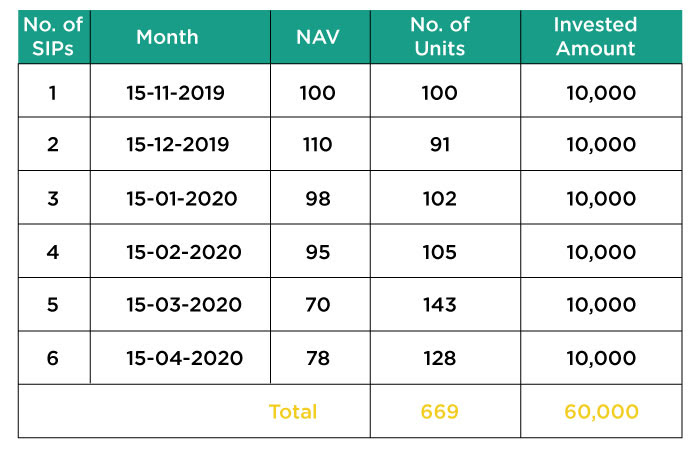
As of 10 May, the NAV is priced at 85, hence the value of your investments will be 54,880 @5% loss.

Instead of doing SIP, had you invested a lump sum of INR 60,000 on 15 November, you would have got only 600 units (as opposed to 669 here) and the value of your investments would be INR 51,000 on 10 May 2020 (at a 15% loss). 

No one knew that the market would fall so drastically and be so volatile in 2020, but your SIPs definitely help you to invest in a staggered and make most of the down market.

Everyone wants to know when we will reach the bottom to buy the maximum number of units. But it is anyone's guess when the markets will reach the bottom or what the bottom price is.  Hence, SIP is your friend in such markets. When you continue your SIPS, your amount keeps buying a varied number of units (more in a down market) and thus, helping you to average your cost of buying.

Do not stop your SIPs now just because the markets are down, for all you know this time may turn out to be a bargain and help you get better returns in the future.


pexels-photo-1246954

How to manage my irregular/business income?

This lockdown seems to be going on forever with no respite in sight and we just have to find a way around it. We are all trying our best to make the most of this time, use this time to read more, catch up on movies, and learn a new skill. Some of us have started new side ventures and blogs.

As a part of this process, many of you have asked us how you should manage your irregular income as a freelancer/entrepreneur. Many business owners feel they do not have good control over their cash flow and it is difficult to plan for their own finances. This email is to help you understand how to manage your cash flows as a business owner.


1) CREATE AN EMERGENCY FUND

This will always be important and becomes critical as a business owner. You must project your expenses and cash requirements for 6 months and have that much funds kept aside in liquid investments like Fixed Deposits or Liquid Mutual Funds.

As your income is erratic but your expenses are regular, the Emergency Fund comes as a great support and you can dig into it to pay your bills in those months where the income has been a bit slow. Always, ensure to refill your Emergency Fund to back to its original value during time or surplus cash.

2) YOU SHOULD HAVE 3 BANK ACCOUNTS

Having separate accounts for your various needs will ensure a smooth flow of cash and you will know where exactly your money is going.

Bank account 1 - Business Account
Bank account 2 - Personal Account
Bank Account 3 - Investments Account

Bank Account 1 - All your business income and expenses must be taken care of from this bank account. This will also help you to file your financial statements and know the exact numbers for your business.

Bank Account 2- You must transfer an amount for your personal basic living expenses to your bank account 2. This is the account from where you will spend on your food, home rent, everyday conveyance, etc.

There are months when you do not have enough from your business to take care of your personal expenses and in such times your rainy-day friend - emergency fund comes to your rescue. Please note that the emergency fund is to be used for basic spends not for parties and shopping!!

Bank Account 3
 - This is the bank account from where you will INVEST. The months in which you make great revenues, you must transfer an amount from your Business Account to Personal Account to Investment Account and Invest that money for your future goals. These goals can be either personal or business.

Having a separate account from where you invest helps you to keep your money in an organized manner (all the extra funds will always be invested) and at the time of redemption, all the redeemed money will flow back to your Investment account. This will help you have control over your investments as well.Today when you have just started to invest, this all may seem like a lot of work, but you must understand that after a few years when you have made investments and business has grown, it will be very difficult to backtrack and put things in place and hence, the same should be done today!!

Use this time to understand how your money is flowing and put a process in place for it. We shall see you soon with more articles on the same.

pexels-photo-669610

How am I investing in current times - Akruti Agarwal

Hoping you all have looked at your investments and decided on your next course of action. I thought it is only fair that I share my investing journey with you at the end of these email series on 'what should you do with your Investments'. I have listed what I have been doing about my investments for the past couple of weeks.
1. I started investing in 2011 with the guidance of my colleagues and newspaper articles. Even for me, this is the first Market Crash where my entire investment portfolio is down by 27%.
It is said that an average investor faces 3 recessions and 1 depression in his life span of 75 years. 
 
We all have to learn how to manage it and make the most of it.
2. This is the time where I can practically put to use everything that I have learnt and read about investments. I am trying my best to deal with the big notional loss in my portfolio, be ok about it and then do my asset allocation.
It is not easy but discussing my money decisions with my family helps me keep my emotions aside and make rational decisions about investing further.
3. Before Investing, let me tell you that I have my term & health insurance in place.  I have my Emergency Fund kept aside in a liquid mutual fund which I am not touching. I also had 2 short term goal funds - Travel Fund (though not a priority for the next 1 year, but untouched) and my father's health fund (important right now, so untouched and safe)
4. How am I doing my Asset Allocation?
After ensuring my goals are secured, I set out to do my Asset Allocation.
As per my Risk Profile, I am a Balanced Profile, my Debt: Equity ratio is 50:50
As you can see from the above table, my Equity ratio is down to 36% and to rebalance my portfolio back to 50%, I have sold 14% of my total investments in Debt and started investing them in Equity in a staggered manner. Given that my Risk Profile is a Balanced Profile,  I am investing in the Equity market to the extent I am comfortable as per my risk profile and investing it in a staggered manner given the uncertainty in the market.   Also, I have been sticking to investing in Large Cap companies and good businesses rather than small-cap companies as I do not want to compound the risk exposure I have in equities. However, where you are an Aggressive Risk Profile, you could invest in small-cap & mid-cap Equity Mutual Funds to take advantage of the beaten-down markets.
'Be greedy when the times are fearful and be fearful when the markets are greedy'
Maintaining my asset allocation is making it easier for me to invest comfortably in the markets right now without letting the emotions take the best of me.
Lots of courage to every investor out there. Keep your cool and think rationally before you make any decisions.
calculator-calculation-insurance-finance-53621

Should you sell your Existing Investments in Equity?

Hello fellow investors

In one place, where investors are planning to invest more money because there is a downfall in the market, there are some investors who are really worried and are asking us if they should sell their existing investments in Equity Mutual Funds/Equity stocks, book their losses and try to move on.

For the ones who are checking their portfolio every day and abusing their stars for investing in Equity, please read through.

Equity investing was always about 'Long Term - Goals' for more than 3 years.

Don't forget the reasons for which you started investing in the first place.

Think Equity - Think Long Term 

Your Asset allocation and goal setting will always be the answer to all these questions.


How does it help to invest in Equity for a long duration?

The way to manage market risk in Equity is by investing for a long period of time.

Historical data from the Sensex proves that if you stay invested in Equity for a longer period your probability of loss reduces. Analysis of BSE Sensex data for the past 29 years shows that the probability of loss diminishes as the investment tenure exceeds 5 years. Data shows that investment for a period of 1-year duration on the first trading day between 1990 and 2018 created a loss probability of 25%. The probability of loss goes down further to 4.55% when the investment tenure goes up to 7 years. The benefits of long term investing are clearly visible as the investment tenure grows beyond 10 years and above.

(this graph & numbers above have been taken from business today article-https://www.businesstoday.in/markets/stock-picks/analysis-why-you-should-be-a-long-term-investor-in-equities/story/267408.html )

In the above graph, you can see that as your number of years of investing in equity increases, your probability of loss reduces.

Having said this, one must always check the quality of shares and mutual funds that they have invested in to ensure that they do not fall under the exceptional cases of this analysis.

Further, note that the analysis presented here is based on historical data, so it is not a true predictor of future outcomes. However, we can gather from this analysis that even with the lack of ability to forecast the future, by investing with a long term horizon, an investor is able to better withstand the detrimental effects of volatility, market downturn and bouts of recession, and achieve a positive ROI.

Hence, if you are planning to sell only because you are worried about what is happening with the markets right now, you should look at your goals & asset allocation and decide accordingly.

Don't try to be speculative right now with the market; just stick to the core values of your investing, do Asset Allocation and long-term investment planning.


pexels-photo-416322

Should You Invest More In Equity Right Now?

Hello Investors


We believe that our first email in this chain would have given you direction on how you should go about investing in current times.

Some of you were asking us if they should invest more money in Equity right now?  Is this the Big Sale we were all waiting for and should we start investing? Will the market fall more so should we wait or invest now?

No one can tell you with certainty whether we have reached hit rock-bottom. Every time one is thinking it cannot go further down, the markets are reaching another lower circuit.

'You can never predict what is going to happen with the markets as that is not in our control. What is in our control is how we react to the market and take actions accordingly.'

You must keep a note of the below mentioned before you start investing all your money into Equity:

1.Always have an Emergency Fund (at least 4 times your monthly expenses) invested in risk-free investment options.

I cannot emphasize enough on how important it is to have that emergency fund in place, especially in times like these. I do not intend to scare you but I am sure everyone is an expert in their fields and are aware of how the near future looks like. Hence, even before you start investing ensure that your emergency fund is enough to help you sail through the worst-case scenarios in the coming months.

Keep some surplus money with you before you go all investing in Equity right now.


2.Have your Health Insurance and Life insurance in place.

With the current pandemic situation, it important to prioritize our life and health. You must have these insurances to ensure your family has something to fall back on. Also, where there is no security about the future, it is not the smartest decision to just rely on your company's health insurance. It is advisable to have one for yourself and your family members. You can read more about it on our blog.


3.Do not forget the goals and reasons for whichyoustarted Investing in the first place.

Remember our entire discussion from the workshop on how to Invest.


For short term goals - less than 3 years - Invest in Debt (Risk-free Investment options)

For long term goals - more than 3 years and beyond - Invest proportionately in Debt and Equity based on your Asset Allocation.

Debt Investments acts as a cushion when the Equity markets are volatile.

Note: Once your long term goal (more than 3 years) becomes a short term goal (you reach closer to that goal), redeemed/ sell off the equity investments and shift the same to secured debt investments so that any change in the equity market while attaining your long-term goal does not impact your investments.

Now do your Asset Allocation that shall determine how much money you should invest in Debt & Equity in the current market scenarios. Your asset allocation will help you invest based on your risk profile and sleep peacefully even where the markets are being volatile.

First-time investors should also invest based on their Asset Allocation and not invest 100% in Equity.

Remember that it is not the stock that determines your exact return from portfolio but your asset allocation which determines over 90% of the return.

This is probably a good time to open your goal- working sheets (shared during the workshop) and review your portfolio.


pexels-photo-590011

How Should You Invest Right Now

Tough times call for tough decisions! Well for us, it is about utilizing our time at home as much as possible and evaluating the action plan what to do now! With COVID 19, the world financial markets are also giving investors quite a scare. While we are all sitting at home and doing our bit to avoid the spread of COVID 19, we at Wealth Cafe decided to share more information on what you as an investor could do to manage your money better.

'Investing is not about avoiding the risk but managing the risk to make maximum returns possible'

 Investing Rule 101 - High Risk = High Returns & Low Risk = Low Returns

Never forget the Rule of Investing.

Only after you have understood and digested this fundamental Rule of Investing that you should read further.

How should you Invest?

- Know your Risk Profile (How much risk can you bear)

- Invest in financial products that match your risk appetite by doing Asset Allocation

How to do Asset Allocation?

- We have attached the asset allocation table based on your Risk profile to help you understand how much you should be investing in debt & equity. Further, we believe that you all remember the Risk profile Questionnaire you took in the Workshop.

- A simpler method is to use your age to determine your asset allocation. If you are in the age bracket of 25- 35 years, invest 30% in Debt and 70% (100 - 30) in Equity. The rationale here is that the younger you are the more risk you can take as you would have a longer investment horizon and have a higher risk-taking appetite. While this appears to be a simple method, this is a crude method and risk profiling is the best way to arrive at your personal risk profile.


What Next?

Once you have determined your investments into Debt: Equity-based your Risk profile. Ensure that you maintain your Asset Allocation Ratio.


For Example:

This is how you begin your investing journey.

Now, given the current volatile markets, if after a month, Equity falls further down (which we are not sure of!), you must do Asset Allocation again.

This action of checking your investments and selling/buying as per your asset allocation is known as re-balancing your portfolio.

How often should you re-allocate/re-balance your portfolio?

You must re-balance your portfolio where your asset allocation varies by more than 5% from the desired Asset Allocation ratio.

How does this help?

By sticking to this rule-based allocation, all sentiment-based investments can be kept aside and you end up buying equities when they are cheap and selling them when they are expensive.


7

Importance of Travel Insurance post COVID

Not many people realize this but travel-related insurance is easily one of the most ignored aspects of international travel and with the entire COVID-19 scenario running roughshod on international travel, it will become all the more important. This kind of insurance has always been essential to cover travel-related risks like missed connecting flights, lost baggage, injury or illness abroad, loss of travel documents, loss or damages caused by weather-related problems, etc. With the evolving Corona Virus situation, however, things will continue to remain exceptionally unpredictable for the foreseeable future, leading to any factors which will lead to increased need and importance of insurance for travel purposes.


Factor 1: The lingering risk of Corona Virus infection:

There will be a few long months, maybe more than a year, before you can expect an effective vaccine for coronavirus infection. News shows that while some medicines have shown promising preliminary results in the treatment of Covid-19, a vaccine is always the best choice because it is a preventive measure and as the old adage goes, prevention is always better than a cure. International travel takes place in planes which are enclosed environments and people are too close for comfort in the planes. Did you know that even if you fly business class, you are still not far enough from other people in a plane for sensible social distancing to be possible? Imagine flying a coach in such a scenario! This means that ​travel ​insurance​ is going to be extremely necessary for everyone.


Factor 2: Airlines services will continue to be shaky

Airlines are trying very hard across the globe to keep their systems operational but the situation was so bad that they were not even able to find enough parking spaces for all the grounded planes. The fact of the matter is that airlines always run at paper-thin margins because of the highly competitive industry and extremely volatile cost structure. Once they are going to get things in the air once more, there will be a lot of turbulence. Many systems were working by duct tape and hammer blows and getting back these systems to operational level in an understaffed and risk-bearing situation will mean many people will miss connections, luggage will get lost many times and all such risks will be very high, creating a strong need for everyone to buy travel insurance online before they fly to anywhere out of the country.


Factor 3: You might get stuck out of India during lock-down

Let there be an assumption that you were able to travel to any country out of India and you landed there all safe and sound, but just before you were supposed to travel back, your host area encountered a sudden rise in infections, making it necessary for the government of that area to suspend all travel activities in and out. In such a situation, you will be stuck in your host country until the government of India can arrange for your return. Travel insurance will be your only help in such a case. It will cover all the extra expenses which you will have to bear during the lockdown.


All things said and done, in the coming few months, international travel will change like never before.

8

What is travel insurance ?

With the increase in travel, one of the important things that travellers need to know about is Travel Insurance. This form of insurance helps cover a whole range of uncertainties and scenarios that can drain out a traveller’s finances. Most countries require mandatory Travel Insurance while applying for a visa. But choosing the right Travel Insurance which covers all the risks of travel is important.


What does Travel Insurance mean?

Travel Insurance is a type of insurance that covers different risks while travelling. It covers medical expenses, lost luggage, flight cancellations, and other losses that a traveller can incur while travelling.

Travel Insurance is usually taken from the day of travel till the time the traveller reaches back to India. Taking Travel Insurance ensures comprehensive coverage in case of any emergency in another country. Travel Insurance is also available for trips taken in the home country of the traveller like Bharat Bhraman & E-Travel, but it is a more popular option for travel abroad.

Some of the risks covered under Travel Insurance are:

  • Personal Accident Cover, which covers:
    • Insured’s Death
    • Permanent Total Disability
  • Accident & sickness medical expense reimbursement
  • Dental treatment relief
  • Emergency evacuation
  • Repatriation of remains in case of death
  • Baggage delay
  • Loss of checked baggage
  • Loss of passport
  • Flight delay
  • Hijack
  • Home burglary
  • Trip curtailment
  • Trip cancellation
  • Missed connection/missed departure
  • Bounced hotel/airline booking.

There may be more risks covered under individual policies depending on the requirements of the traveller. The amounts to which these risks are covered depends on the policy & plan that the traveller opts for. Travel Insurance also covers additional risks at an additional premium. Some of these risks are specific to the traveller or the place the person is travelling to.


Types of Travel Insurance:

There are single trip Travel Insurance policies meant for one journey. But for frequent travellers who travel abroad for business purposes, there is an option to buy a multi-trip Travel Insurance policy. Some policies last for an entire year and cover multiple trips to a particular destination. Opting for such policies is much more cost-effective for businessmen and frequent travellers to a particular destination. We also have student policies which are specially designed for students going abroad for studies at an affordable premium. The maximum trip length can last from 30, 45 and 60 days.

Another type of travel policy is a Group Travel Insurance policy. A group policy covers 7 or more travellers. These policies are cost-effective and offer similar benefits as single trip Travel Insurance policies. Group Travel Insurance policies are based on the age of the travellers which means it works out more cost-effective per traveller. Most travel companies opt for group Travel Insurance policies when they take groups across different countries on tours.

It is easy to pick out a policy once you know the Travel Insurance definition. While planning your trip abroad, pick out a Travel Insurance policy that provides exhaustive coverage with high coverage. It is possible to check the cost of Travel Insurance on insurance aggregators and pick out the best policy. HDFC Bank offers a variety of Travel Insurance policies through the bank’s website like Student Travel Insurance, Domestic, Senior Citizens, Family and even Individual Travel Insurance. You can easily pick out a policy that suits your need and provides the best value for money.


bank-bars-close-up-366551

Gold Monetisation Scheme

Thought that the gold you own is only to wear in high-end weddings and is of no use to you. It is definitely considered as one of the best forms of Emergency Funds but beyond that what. How about we tell you that there is a way to earn interest in a safe way on your gold via Gold Monetisation Scheme. This scheme helps you to monetize the gold that you have and earn interest on the same.

The Gold Monetisation Scheme allows you to earn interest on the gold you own. It also saves the storage cost for gold. To gain benefit from the scheme, you need to deposit gold in any physical form, jewelry, coins or bars. This gold will then earn interest based on its weight. You get back your gold in the equivalent of 995 fineness gold or Indian rupees, as you desire (this option is to be exercised at the time of deposit).

Eligibility -  Restricted for sale to resident Indian entities, including individuals, HUFs (Hindu
undivided families), trusts, universities, charitable institutions

Tenure -  One to three years (short term); Five to seven years (medium-term); 12–15 years (Long term)

Interest: Both principal and interest to be paid to the depositors of gold are ‘valued’ in gold. For example, if a customer deposits 100 gm of gold and gets one percent interest, then, on maturity, he has a credit of 101 gm. The interest rate is decided by the banks concerned.

Minimum Deposit - 30 gram (any form bullion or jewelry)

Interest & Taxation - Interest paid in gold terms. Fully tax-exempt, no capital gains

Remember that since the gold that you deposit will be melted, you won’t get back the gold in the same form as you had deposited.

How to Open an Account - You need to first go to a collection and purity-testing center to ascertain the purity of your gold. You can deposit your gold if it clears the criterion set for gold content. You will be provided with a certificate of purity and gold content. You will need to present the certificate to the bank where you want to open the account.

Redemption - you can take back gold or cash at redemption but the preference must be stated at the time of deposit.

Wealth Cafe Actionable - In the scheme, you give your gold to the bank which is then melted so if its jewelry ensure that you won't get it back. Also, it is bank-specific so be sure to go to a good bank for this scheme to be sure of getting your returns and money/gold back.

[mc4wp_form id="2150"]

WCafe Financial Services Pvt Ltd (formerly known as Wealth Cafe Financial Services Pvt Ltd) is a AMFI registered ARN holder with ARN-78274.

WCafe Financial Services Pvt Ltd (formerly known as Wealth Cafe Financial Services Pvt Ltd) is a SEBI registered Authorised Person (sub broker) of Sharekhan Limited with NSE Regn AP2069583763 and BSE Regn AP01074801170742.

Copyright 2010-20 Wealth Café ©  All Rights Reserved