Taxation of Mutual Funds for FY 2021-22 (AY 2022-23).

First, let us understand what are the factors that determine Mutual Fund Taxation. The three major parts of these are below.

  • Your Residential Status-Resident or Non-Resident (NRI)

Your tax will be based on your residential status. If you are a resident then the taxation rules will be different and if NRI then it differs. Hence, first, you have to make sure of your residential status.

  • Types of Funds-Equity Funds or Non-Equity Funds-

Any fund which invests 65% or more in equity is called an Equity Fund. For example, large-cap funds, multi-cap funds, small and mid-cap funds, or equity-oriented balanced funds (where the equity exposure is 65% or more) are all called equity-oriented funds.

If the equity portion is less than that, then they are all treated as debt funds or non-equity funds. For example liquid funds, ultra-short-term funds, short-term funds, income funds, gilt funds, debt-oriented balanced funds, gold funds, funds of funds or money market funds.

  • Holding periods of Investment–

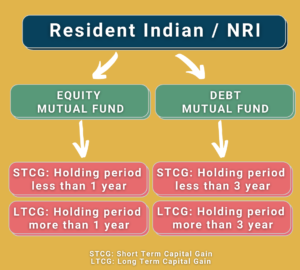
The holding period for Equity and Debt Funds will be different for taxation purposes. For equity funds, if the holding period is more than a year, then it is called the long term. If the holding period is less than a year, then such an equity mutual funds holding period is considered a short term. Whereas in

Whereas in the case of debt funds, a holding period of more than 3 years is considered as long-term. If the holding period of debt funds is less than 3 years, then it is considered short-term and taxed accordingly.

I will try to explain the same from the chart below.

The Capital Gain Mutual Fund Taxation FY 2021-22 / AY 2022-23 will be as per the below table.

Individuals

NRI

Stocks & equity oriented Mutual Funds

LTCG 10% above Rs 1 lakh gain 10% above Rs 1 lakh gain
STCG 15% 15%

Other than Stocks & equity oriented Mutual Funds

LTCG 20% with indexation Listed 20% (with indexation) & unlisted 10% (without indexation).
STCG Based on individual slabs Based on individual slabs


There is no change in Capital Gain Tax Rates from last year. Hence, the old rates will be applicable for FY 2021-22 also.

Note-Surcharge @ 15%, is applicable where the income of Individual/HUF unit holders exceeds Rs. 1 crore. Also, surcharge @10% to be levied in case of individual/ HUF unitholders where the income of such unitholders exceeds Rs.50 lakhs but does not exceed Rs.1 Cr. Further, Health and Education Cess @ 4% will continue to apply on the aggregate of tax and surcharge.

As you may be aware that during Budget 2018, LTCG was introduced again to Equity Funds. Hence, let me explain the same on how to calculate the LTCG on Equity Funds as below.

How to calculate LTCG on tax slabs & Equity Mutual Fund?

LTCG & STCG on Stocks & Mutual Funds (up to 31st January 2018)

Bought before 31st January 2018 10,000 stocks at INR 100
Sold within 365 days 10,000 stocks at INR 130
STCG Profit INR 130 15% STCG = INR 45,000
Sold after 365 days 10,000 stocks at INR 150
LTCG Higher of a) or b)

a)Actual cost (i.e INR 100)

b)Lower of the below

-The highest price of 31st Jan 2018 (Rs 120)

-Actual selling price (INR 150)

(Assumed that the highest price on 31st Jan 2018 is INR 120)

10% LTCG on INR 1,20,000

(10,000*Rs 120) - INR 1,00,000

INR 20,000

LTCG & STCG on Stocks &  Mutual Funds(from 1st February 2018)

Buy on 1st February 2018 10,000 stocks at INR 100
Sold within 365 days 10,000 stocks at INR 130
STCG Profit INR 3,00,000 5% STCG = INR 45,000
Sold after 365 days 10,000 stocks at INR 50
LTCG Profit INR 5,00,000 LTCG = Actual profit- INR 1,00,000

=INR 4,00,000

10% LTCG on INR 4,00,000 

=INR 40,000

Mutual Fund Taxation FY 2020-21 – Dividend Distribution Tax (DDT)

As I pointed above, effective from FY 2020-21, DDT was abolished in the hands of Mutual Fund Companies. Hence, any dividend you receive will be taxable for you as per your tax slab.

At the same time, if your such dividend income is more than Rs.5,000 in a Financial year, then there will be a TDS @ 10%.


Mutual Fund Taxation FY 2021-22: DDT Rates

Individual

NRI’s

Equity Oriented Schemes

As per the Tax slab As per the Tax Slab
Debt Oriented Schemes As per the Tax slab

As per the Tax slab


Security Transaction Tax (STT) for FY 2021-22

Security Transaction Charges or STT is the charges or tax when you buy or sell securities (excluding commodities and currency) through a recognized stock exchange. Therefore,

The definition of securities involves the below products.

  • Shares, scrips, stocks, bonds, debentures, debenture stock or other marketable securities of a like nature in or of any incorporated company or other body corporate;
  • Derivatives;
  • units or any other instrument issued by any collective investment scheme to the investors in such schemes;
  • Security receipt as defined in section 2(zg) of the Securitization and Reconstruction of Financial Assets and Enforcement of Security Interest Act, 2002;
  • Government securities of equity nature;
  • Rights or interest in securities;
  • Equity-oriented mutual funds

Therefore, whenever you buy and sell these securities through a recognized stock exchange, then you have to pay this STT.

Now let us understand the latest Security Transaction Tax (STT) applicable for FY 2021-22.

Security Transaction Tax (STT) Rates for FY-2021-22

Transaction Type Rates

Payable By

Purchase/ of equity shares (delivery Based) 0.1% Purchaser/ Seller
Purchase of units of equity-oriented mutual fund NIL Purchaser
Sale of units of equity-oriented Mutual fund 

(delivery Base)

0.001% Seller
Sale of equity shares, units of business trust, units of equity-oriented mutual fund 

(Non-Delivery Based)

0.025% Seller
Sale of an option in securities 0.05% Seller
Sale of an option in securities, where the option is exercised 0.125% Purchaser
Sale of future in securities 0.01% Seller
Sale of units of an equity-oriented fund to the mutual fund 0.001% Seller

Sale of unlisted equity shares & units of business trust under an initial offer

0.2%

Seller


TDS (Tax Deducted at Source) Rates for NRI Mutual Fund Investors 2021-22

Below are the applicable TDS rates for NRI Mutual Fund investors for FY 2021-22.

STCG Equity-The current TDS of 11.25% which was modified from 14th May 2020 to 31st March 2021 will I think continue for STCG-Equity Funds

STCG Other than Equity-The current TDS of 22.5% which was modified from 14th May 2020 to 31st March 2021 will I think continue for STCG-Other than equity.

LTCG Equity-The current TDS of 7.5% which was modified from 14th May 2020 to 31st March 2021 will I think continue for STCG-Equity Funds.

LTCG Other than Equity-The current TDS of 15% (for listed) and 7.5% (for unlisted) which was modified from 14th May 2020 to 31st March 2021 will I think continue for STCG-Other than equity.


Wealth Café Note: You pay taxes in a Mutual fund only when the gains are realized i.e. you redeem the funds and the proceeds of the same are credited to you. Now if there is a gain then the same is taxed as the taxation of mutual funds.

Hope now you got the clarity related to Mutual Fund Taxation FY 2021-22 / AY 2022-23.

Article Headers (10)-min

What is information bias in investing?

Information bias is the tendency to evaluate information even when it is useless in understanding a problem or issue. Today, investors had much more information than before, however, is it all good information? Can this be used to make smart money decisions?

Through social media, we are now being bombarded with new information almost every hour and sometimes every few minutes. Are you one of those who feel research means checking reels on top 3 funds to buy? Checking Youtube videos to confirm your understanding of various investments? Following twitter handles or paying 199 per month for telegram groups to know what is the next multi-bagger? Social media stalking is not detailed research that provides you all the information you need to make a smart investment decision. 

Where you are following people online who agree with your viewpoints and speak the things you believe in - you are already following an information bias. 

INFORMATION BIAS IN INVESTING
You should ask yourself if some of the information you are getting is relevant at all. Information like daily NAV movement, 52 weeks high or low NAVs, best performing funds of the month, etc. is useless in our view. Should you buy or sell a fund based on its last 7 days or 30 days' performance? However, with interesting captions, they are made to look as if it is very important information that you should pay attention to. But mostly they are irrelevant but excites you into buying a particular fund purely on its return number or performance of the past few months. In many instances, investors will make investment decisions to buy or sell an investment on the basis of short-term movements in the share price. 

Likewise, for mutual fund investors, top stocks bought or sold by fund managers every month is mostly not relevant. When you are investing in mutual funds, you rely on professional fund managers to do the stock selection because you do not have their expertise or experience. Top stocks bought or sold by fund managers can be an interesting article on the internet but should you invest in Direct Equity shares based on what a Mutual Fund manager is buying or selling?

The input of information has increased tremendously, now we have people dancing and explaining financial concepts on the net where capturing that information is easy and fun, we may miss out on the crux of the whole thing when learning about finance i..e it is very personal to you. You need to understand what works for your risk profile and your goals before investing in purely basis blogs/videos and others.

HOW TO AVOID INFORMATION BIAS

  • Financial planning: Financial planning with clearly defined financial goals and investment plans to achieve different goals can help you avoid information bias. Make sure that you are committed to your financial plan.
  • Know the fundamentals of investing: Know what is important and what is not. You need to understand what will make your financial goals successful and filter out the unimportant information.
  • Do not track your portfolio on a daily basis: It is important to monitor your portfolio regularly, but you do not need to track it on a daily basis. Short-term price movements have no impact on long-term portfolio returns. If you track your portfolio on a daily basis, then you are likely to be prone to information biases. Remember why you invested and for what goals. You must invest in equity for the long term - so checking it every day is not going to help get higher returns.
  • Seek counsel before you react to information: Information that you get every day or every hour usually has no bearing on long-term portfolio performance. If you want, you can seek more information about investments, but seek the guidance of a financial advisor before you act on the information you have. We are SEBI registered investment advisors and can help you make sound investment decisions - you can reach out to us at iplan@wealthcafe.in, in order to help you make a financial plan for yourself. A lot of information you get daily may be totally irrelevant and can harm your financial interests, if you act on it without considering other factors.
Common Retirement Planning Mistakes

Retirement planning used to be a lot easier. You worked your whole life for the same company and retired at age 65 with a gold watch and a company pension.

Today it’s more complicated. Most people will change employers many times over the course of their career or work for themselves at some point. At the same time, life expectancy is increasing. On one hand, that means more retirement years to enjoy. But the flip side is that you also have more retirement years to fund.

Living a retired life without enough savings can really be a dreadful experience. If you and your spouse don’t want to be a burden on your children after retirement, it is best to start retirement planning early and stick to the retirement plan by all means.

Don’t make the mistake of relying on others – even if they are your own children – to take care of you when you have reached your twilight years. Why should you rely on others post-retirement when you lived all your life on your own terms?

To live a comfortable retirement life on your own terms, you need proper retirement planning and to achieve that you need to avoid these common mistakes.

IGNORING PRICE RISE
Inflation is a demon that comes down hard on anyone who ignores it. "Since retirement is a long-term goal, it is important to understand the impact of inflation on your financial goal
If you ignored inflation while doing the maths, revisit the numbers. Always take the real rate of return (rate of return minus inflation) while doing the calculation. Also, use a realistic rate of inflation. You can take an average of the past few years. Lastly, don't underestimate inflation. It's better to err on the side of caution.
The only investment that will help you beat inflation and still make a corpus is equity. So you need a part of it in your portfolio. You can not plan for your retirement 20 years away by parking money in FDs only. However, EPF is a great debt portion of your retirement corpus mix.

CASHING OUT EPF MONEY
Many people withdraw money from their provident fund account. This is wrong as instruments such as the Employee Provident Fund (EPF) have been designed to provide financial security after retirement. These are highly useful for retirement planning, especially due to their tax-free status.
It is not good to withdraw money from the EPF, even if it is to make a big-ticket purchase such as a house. Instead, it is better to dip into other savings; EPF should be only for post-retirement years.
Basic of Employee Provident Fund (EPF)
Lesser known facts about Employee Provident Fund (EPF)
Step by Step Process for EPF withdrawal
What Should You Do With Your Old Inactive EPF Account?
When can you withdraw your EPF?

DELAYING HEALTH INSURANCE
Medical expenses rise as a person ages. Many people don't buy individual health plans during their working life as they are covered by employers. This is not advisable as most employers give the cover only till you are employed with them.
You also have the option of porting the employer's policy to individual cover at retirement. But do not depend on group policies after retirement as employers keep changing insurers and so you may miss out on benefits accumulated in the earlier policy such as waiver of waiting period for pre-existing diseases.
It is good to buy an individual health policy early in life. It is not only cheaper but also helps you cover pre-existing illnesses after completion of the waiting period. Moreover, it covers you even after you leave the job or your company curtails the benefits under the group plan to cut costs.
Health Insurance: What You Need To Know During COVID
6 things to note before buying a Health Insurance
Things To Do After You Buy A Health Insurance
Is your employer’s Health insurance sufficient?
Health Insurance: Single Plan or a Family Floater Plan?

NOT PLANNING FOR CONTINGENCIES
Your long-term investments are not for meeting contingencies. Hence, all people, irrespective of age and employment status, must build a contingency fund. Ideally, your savings should guarantee you a lifestyle after retirement which is the same as you enjoyed in your working years. This involves high-level contingency planning as your income streams dry up as you retire.

NOT HAVING ENOUGH MONEY FOR EARLY RETIREMENT
Stress is nowadays burning out people at a young age, making them think of retiring early. We come across many people who want to advance their retirement age. But most of the time we advise them to delay the plan if they do not have enough funds to last their lifetime. Early retirement requires rigorous planning for meeting life's goals.

Compounding is a powerful tool (the longer the period, the more the money will grow). If you think you will start saving later when your income rises, you may not be able to save enough. Therefore, enlist a financial advisor, start immediately, evaluate the available savings and protection instruments, calculate the funds required and get down to executing the plan

NOT HAVING ADEQUATE INSURANCE
When a bread earner dies, the whole family suffers a setback. A life insurance policy can take care of the family's well-being in such a case. The question is, how much cover one should have?

The ideal figure is at least 10 times the annual salary. This will give the family a cushion of ten years to adjust to the new financial reality. For example, if your salary is Rs 12 lakh a year, the cover should be at least Rs 1.2 crore.
Another approach is calculating the human life value, that is, the present value of your future income. Don't forget to factor in liabilities such as home loans while doing the calculation.

Buy a term insurance policy as soon as you can. Buy online to save on premium. And do not forget to increase or decrease the cover as your liabilities change.

Conclusion

Retirement is the next great stage in your life, and it can be just as fulfilling and exciting as your younger years. It’s your opportunity to do what you want when you want, whether that means relaxing at home, traveling the world, or reinventing yourself in a new career.  No matter where you are on the retirement continuum, you have likely made mistakes along the way. By focusing on retirement planning now, you can feel more confident about fulfilling your vision, whatever it may be. If you don’t have enough saved, it is never too late to start planning.

In addition to avoiding the problem areas above, seek advice from a trusted financial advisor to help you stay—or get back—on track. We are SEBI registered investment advisors and can help you make sound investment decisions - you can reach out to us at iplan@wealthcafe.in, to help you make a financial plan for yourself. A lot of information you get daily may be totally irrelevant and can harm your financial interests, if you act on it without considering other factors.
RBI Retail Direct – Invest in Government Bonds online

Using the RBI Retail Direct platform, we can now invest in Government Bonds online. In the month of February 2021, RBI announced that it will allow retail investors to directly buy and sell Government Bonds online. Now through the RBI Retail Direct scheme, we can invest in Government Bonds online.

The launch date of the portal is not yet decided. According to the notification, “the date of commencement of the scheme will be announced at a later date”.

These are the securities which investors can invest: 

  1. Government of India Treasury Bills 
  2. Government of India dated securities 
  3. Sovereign Gold Bonds (SGB) 
  4. State Development Loans (SDLs)

ELIGIBILITY

Retail investors, as defined under the scheme, will be able to register under the Scheme and maintain an RDG Account, if they have the following:

i) Rupee savings bank account maintained in India;

ii) Permanent Account Number (PAN) issued by the Income Tax Department;

iii) Any OVD for KYC purpose;

iv) Valid email id; and

v) Registered mobile number.

Non-Resident retail investors eligible to invest in Government Securities under Foreign Exchange Management Act, 1999 will also be eligible under the scheme. The RDG account can be opened singly or jointly with another retail investor who meets the eligibility criteria.

SCOPE OF THE SCHEME

‘RBI Retail Direct’ is a comprehensive scheme that will provide the following facilities to retail investors in the government securities market through an online portal:

i) Open and maintain a ‘Retail Direct Gilt Account’ (RDG Account)

ii) Access to primary issuance of Government securities

iii) Access to NDS-OM

WHAT ARE THE SERVICES OFFERED?

The registered investors can opt for the following investment services: 

a. Financial Statement: The link provides transaction history and the balance position of securities holdings in the Retail Direct Gilt Account. All transaction alerts will be sent by e-mail or SMS. 

b. Provision for nominations: You can fill up and upload the nomination form in the appropriate format, which must be signed. A maximum of two nominations is allowed. 

c. Pledges and liens: Securities held in the RDG Account will be available for pledge/lien.

d. Transfers of Gifts Retail Direct: Investors will be able to give government securities to other Retail Direct Investors through an online platform. 

e. Grievance redressal: Any query or grievances related to the ‘Retail Direct’ Scheme can be raised on the portal which will be handled/resolved by Public Debt Office (PDO) Mumbai, RBI.

REGISTRATION:

Investors can register on the online portal by filling up the online form and using the OTP received on the registered mobile number and email ID to authenticate and submit the form. On successful registration, a ‘Retail Direct Gilt Account’ will be opened and details will be given through SMS/e-mail to access the online portal. The RDG account will be available for primary market participation as well as secondary market transactions on NDS-OM.

PROCEDURE

After registering on the online portal, retail investors will need to authenticate themselves by using OTP (one-time password) received on their registered mobile number and email address. They will need to submit the KYC document to open the RDG Account.

BUYING AND SELLING

During the bidding, the participation and allotment of securities will be as per the non-competitive bidding scheme of the RBI. The regulator has designed a non-competitive bidding scheme for non-institutional small buyers.

Once investors make the payments, RBI will credit the securities to their RDG Accounts.

To buy and sell securities in the secondary market, the procedure is similar to buying and selling of shares.

Before the start of trading hours or during the day, the investor must transfer funds to the designated account of CCIL (Clearing corporation of NDS-OM) online.

Based on actual transfer, a funding limit (buying limit) will be given to the investor for placing ‘buy’ orders. At the end of the trading session, any excess funds will be refunded.

FEES AND CHARGES

There are no fees charged for opening or maintaining the RDG account nor for Submitting bids in the primary auction. However, the registered investor will have to pay fees for payment gateway, etc. that are applicable.

However, do remember one thing that even though in such Government securities, default or downgrade may not be there, they are highly sensitive to the interest rate movement based on the time horizon of maturity of the bond.


Hence, investing in such Government securities does not mean they are safe. If you buy today and try to sell tomorrow (before maturity), then the risk of interest rate movement will be there. DO REMEMBER THAT INVESTING IN BANK FIXED DEPOSIT IS DIFFERENT THAN INVESTING IN GOVERNMENT BONDS. Understand the features and how they fluctuate and accordingly based on your need, you can buy. 

Where you do not wish to invest directly in government bonds as liquidity can be a concern here. Please note that RBI bonds are not as liquid as equity shares (where you are able to sell your equity shares anytime you'd like), there could be a situation where you do not find a buyer immediately, in that case, you must be ready to hold on to bonds for a longer duration. So where you want exposure to government bonds but not directly, mutual funds are the way forward for you.

How to retire with 5 cr on a salary of 1 lakh a month

We all have our aspirations and dreams for the golden years of our life. We want to have the freedom to do whatever we may want and hope to fulfill all the desires that were not fulfilled during the course of working life. It will only be possible if we have planned it well and enough funds are available to help us live our dreams. Thus, plan today for a beautiful post-retirement life.
You have been saving diligently for retirement. That's good. But in all likelihood, you have just a vague idea about what you want, not a concrete plan.

For example, many of you think that whatever you save during your working life will be sufficient for your sunset years. But have you accounted for the demon that goes by the name of inflation, which nibbles away the value of your money 24X7? Probably not. This means you will not save enough to be able to continue your present lifestyle in old age.
The first question that you may have when it comes to your retirement is

Where to invest for retirement?

When it comes to the accumulation of retirement corpus, people generally play safe and go for fixed interest-bearing risk-free instruments like fixed deposit, or PPF which at best give 8% return (in current market conditions, you are making only 7% there). But as retirement planning is for the longer term, one should take equity exposure to get a better return, which will help you accumulate a bigger corpus by retirement.
Equity can give you a 15% return on an average where you stay invested in it for a longer period of time to reduce the risk of volatility. A portion of the equity in your portfolio is a must. It is where wealth creation happens and it is what will also help you to achieve your corpus. We do not mean to suggest that you should invest 100% in Equity or 100% in Debt, you should invest in asset classes based on your risk profile and goals. Retirement being a long-term goal, one can invest some amount for it in Equity to enjoy the returns and manage the risk of it as well.

Let's understand How do you Invest - Basic Actionable Points?

  • Invest in Debt for Short term goals
  • Invest in a mix of Debt & Equity for long term goals (more than 3 years)
  • Now, this mix of debt and equity is determined based on your risk profile. You can take your risk profile test here - Risk Calculator

This test will help you determine how much risk you are comfortable taking and guide you to invest based on that, rather than investing all your money in equity and having sleepless nights.
You can read more about this here: How should you invest


For the purpose of understanding this working and your goal to achieve a corpus of 5 crores with an income of 1 lakh, let's assume that our investor’s profile is a GROWTH profile and he is going to invest in equity and debt. His Debt-Equity Mix will be 30% debt and 70% equity.

How much you need to invest every month to accumulate Rs 5 crore

Now let's come to the main question - HOW MUCH?
The amount you need to invest to accumulate a corpus of Rs 5 crore will depend on your current age and the age that you want to retire. (i.e. your time to retire)
For example, (where your risk profile is a growth profile) and your current age is 25 years and you want to retire at the age of 55 years then you need to save Rs 11,694 every month for the next 30 years to accumulate Rs 5 crore. This is assuming an annual return of 12.90% (which is derived based on the asset allocation of your risk profile of GROWTH).


The required amount will go up to Rs 13,335 if you start one year later at the age of 26. Similarly, if you delay it by five more years, then you will be required to invest Rs 22,656 every month to accumulate the same amount. The required amount increases drastically with a delay in investment as the effect of compounding reduces.


Here is an illustration of how much you need to save every month to accumulate Rs 5 crore by retirement assuming that your investment grows at an annual rate of 12.90%.

However, if you are young and starting out, it is important to know that you do not need a lot of investments to reach 5 crores - just INR 11,000 is good to begin with, which is not a lot of money - given the time and funds involved. It definitely seems like an achievable goal. 

Worth mentioning here is that you also need to create an emergency fund and your insurance as well as medi claim along with your regular investment for retirement so that your retirement corpus remains untouched in case of emergencies like job loss, hospitalization, or any pandemic that we are witnessing now, which can create potential risk to employment. Also, you may have many goals that may come and go as your life goes o, but your retirement will always be THE MOST important goal.

Do not forget that 'Retirement is that one goal you will never get a loan for, you have to plan for it all by yourself'

What is an IPO ? Difference Between IPO And FPO ?

Now tell me, when you are in need of money what do you do? You either borrow money from your parents/friends or take out a loan.
Exactly in the same way when a company is in need of money it either raises funds via IPO or could raise debt by issuing non-convertible debentures or bonds.

Today, let's focus on what an IPO is?
IPO stands for Initial Public Offering. It is a process in which a private company or corporation sells its shares to the public and in return, it receives capital from the public. In this manner the company raises funds and the investors become shareholders.

Now understand a few facts.
While we buy a share normally the price is decided between the buyer and seller. but in the case of an IPO, the price is decided between the company and the investor. At times, in a few cases, the price of the IPO is overpriced or overvalued. 

For Example:
Recently in Jan 2021, Indigo Paints had issued its IPO. Through IPO, indigo paints had raised Rs 1170 crores and in return diluted promoters' stake from 60% to 54%. This means in return for Rs 1170 crores, Indigo Paints gave the public a share of 6% in their company. Its offer price was Rs 1,290 and got listed at Rs 2,607.50. Yes, a listing gain of approx 50%. 

But this is not always the case, in March 2020 SBI cards offered a price of Rs 755 per share and were listed at Rs 658. This share was meant to be with one of the best financial records but still had to face a loss of 13% due to the prevailing market condition then. So one should have 360-degree research before investing.

Now, what does FPO mean?
FPO stands for Follow on Public Offer. It is a process by which a company, which is already listed on an exchange, issues new shares to the investors or the existing shareholders, usually the promoters.

With the expansion and growth of a company, it is likely to make further issues of stocks with the help of FPO but there are many companies whose IPO is their only public offer.

FPO VS IPO
Here are a few differences between IPO and FPO

It depends on your risk level and goals. Your risk levels need to be extremely high to invest in an IPO because you do not have much idea about the company. An FPO is relatively a safer bet for individual investors and new investors as there is already available information about the company after it has listed on the stock exchange. However, equal research is needed when you invest in equity - whether you do it via the route of IPO or FPO.  IPOs have more potential to return more money if the company kicks off to a good start but there are more ‘ifs’ to it. To understand your profile as an investor and then take the decision.

You can understand more about your risk profile - by taking the test on our calculator here. - Click here.

You can also check our youtube video to learn in detail about IPOs and how do they work - Click here 

What are credit cards with no annual fee?

You see an advertisement promoting a ‘lifetime free Credit Card’, and you wonder what the catch is. Are Credit Cards free? If they are, why do banks take the trouble of issuing them?

Though credit cards with annual fees can be worth it, you don’t have to pay an annual fee to get valuable credit card rewards and benefits. If you're uncomfortable with a yearly fee or you’re planning to use your credit card only occasionally, your credit card spends less and you are just starting out, a no annual fee card is a great choice.

Why Do Some Cards Have an Annual Fee?

The annual fee on a credit card largely helps the card provider cover the cost of rewards and generous sign-up bonuses.

Some credit cards, for example, offer hefty rewards such as sign-up bonuses that are often tied to a minimum spend in a finite period of time, as well as a high rewards rate, such as additional points on money spent on travel and dining. For those whose lifestyle and spending habits align with the rewards a particular card offers, the annual fee could be worth the added expense. 

If lifetime free Credit Cards come without charges, how do banks earn money from the service?

A major portion of Credit Card revenue for banks comes from merchant fees – when you buy a product using a Credit Card, a percentage of its value goes to the card-issuing bank.

Also, the banker makes money when you default on your card, choose to convert your expenses into EMI. The interest on your credit card is at 3% - 4% per month, which is a source of income for the banker.

Benefits of No Annual Fee Cards

There are several advantages to having a no annual fee card. For one, you can save anywhere from Rs 250 to Rs 5000 or more annually.  (High-end premium or elite cards’ annual fees can be Rs 10,000 or more.)

When researching no annual fee cards, it’s important to be aware of the other fees charged by the card, including late fee charges, each card’s annual percentage rate (APR) on both purchases and balance transfers, and how low an APR will remain once an introductory offer expires.

ICICI Amazon Pay - 5% cashback for Amazon Prime users on using Amazon ( Suitable for Online Shopping and Dining)

Kotak Gold Fortune - On spending Rs.1,50,000 in a year, you get 4 free PVR movie tickets or cashback of Rs.750 (Suitable for Movies and Fuel)

Disclaimer: We are using some of these examples to help you understand the concept of cashback. We do not mean to recommend these cards to you. Do your research on your spending habits and affordability before you jump the bandwagon to get your own credit card. 

Conclusion

Go for zero-fee cards if you are using a credit card for the first time and figuring out how it works, how often you need to use it, and the like. This can be the stepping stone to building your credit score and history, and your pathway to more premium and specialized cards. It would also be an inexpensive way to increase your credit limit. So, yes, a Credit Card can be free if you use it smartly.

What are the best cash back credit cards in India?

What is a cash-back credit card?

Who doesn’t like to get money for spending money? That, in effect, is what cashback credit cards are all about! Among the various kinds of credit cards, cashback cards are perhaps one of the most popular.

Cashback is a perk many credit card companies offer on their rewards credit cards. It refers to earning back a percentage of the money you spend on your credit card. A cashback card can be a little easier to use than travel rewards cards because the value of your rewards is clear. However, cashback cards can still differ in important ways depending on the rewards program and specific card.

Choosing the Right Cash Back Credit Card for You
It’s always a good idea to research the credit cards available to you and then weigh your options. Let’s break down the benefits so you can compare cards:

Understand the offers. 

First, make sure you understand the details of each offer. Does the cashback apply to all purchases, select categories, or a combination of both? Some cards may return a higher percentage back for groceries than they do for gas, as an example. Also, be sure you understand the maximum amounts you can earn and when and where you can redeem your bonuses. Lastly, remember that cashback cards may come with expiration rules. So, don’t leave money on the table for missing regularly scheduled payments or going months without using your card.

Know your spending habits. 

Once you’ve nailed down the specifics of each offer, the next step is to analyze your spending habits and match the cashback categories to your style. What types of products and services do you purchase the most – books and movies? Home improvement? Travel? Some credit cards offer cashback bonuses at different places throughout the year, so you have even more ways to earn. 

  • MMT ICICI credit card - For MMT Bookings -  Travel  
  • HDFC Regalia credit card - For good offers across platforms
  • Amazon ICICI - 5% cashback for Amazon Prime users on using Amazon ( Suitable for Online Shopping and Dining)
  • Flipkart Axis - cashback across all your favorite categories including travel, shopping, entertainment, and lifestyle.
  • Basic Kotak credit cards - have cashback which you can adjust your points with

Disclaimer: We are using some of these examples to help you understand the concept of cashback. We do not mean to recommend these cards to you. Do your research on your spending habits and affordability before you jump the bandwagon to get your own credit card. 

Look beyond the cashback. 

While the cashback perks are enticing, don’t forget to compare the non-cash back features of the card with your spending style. Do you pay off your credit card in full every month or just make the minimum payment? If you want to get the maximum benefit from a cashback rewards card, it can be a good idea to pay off your balance each month to avoid paying interest.

Don’t forget about APRs (Annual Percentage Rate). 

Even on a single credit card account, APRs can vary depending on a few different factors. For instance, one APR may be charged for purchases and another for balance transfers. Promotional APRs can help you save over the short term by offering you a low or 0% promotional APR on certain kinds of transactions, for a limited period of time. Keep in mind that some credit card companies will increase your APR if certain conditions are not met. Paying your balance on time may help you keep your low APR.

Compare fees. 

When it comes to credit card fees, be sure to read the fine print. Credit cards can vary significantly in what they’ll charge you for annual fees, late payments, balance transfer fees, etc. – so make sure you understand how these fees may affect you. 

When choosing the right cashback credit card for you, read through the entire offer and get familiar with all the terms and conditions. Then carefully monitor your spending habits over the next few weeks to see how well your new card fits your lifestyle.

Generally speaking, most cards with good rewards have an expense attached to them, so be careful, if you are a beginner start with a free card with no charge and 

How Does Cash Back Redemption Work?

Cashback may be redeemed in a number of ways depending on the bank and credit card. Below are a few examples, be sure to check the terms and conditions of any card you’re looking at:

Statement Credit: You may be able to apply your cashback to your credit card balance.

Gift Cards: Some credit card companies allow you to redeem your cashback in the form of gift cards for popular retailers.

Charitable Donations: Some credit card companies allow you to donate some or all of your cashback to a charity of your choosing.

Bonus Categories: Sign up for extra earning opportunities. You may be eligible for limited-time offers to earn bonus cashback. For example, look for Amex Offers on American Express cards that can give you statement credits for specific purchases. They send emails regularly with what bonus offer is going on.

Why do banks offer cash-back cards?

The logic behind issuing such cards is to encourage you to spend more on your credit card and use it more frequently. If you think you are ‘earning’ money while spending, then you might be motivated to spend more. This is exactly what credit card companies would like to encourage you to do and both sides win.

However, it is very important to be prudent with these spending habits. Do not spend more than your spending budget.

What are the disadvantages?

The only disadvantage is that in order to earn the cash reward, you might be tempted into overspending and racking up a large balance. If you do not pay your bill in full, the interest charges on your outstanding will negate any gains you earned on the cash reward.  

Conclusion

A cashback card is a simple way to earn a little extra cash for doing nothing. Just make sure that you read the terms and conditions carefully, spend within your limits, and make your monthly payments in full and on time. Not following these three practices might end up erasing whatever gains you make on the offer. 

Personal Finance Books: Our Recommendations - Part 1

With the development of society, more and more people realize the importance of personal finance. However, I too want to be rich, I too want to live a financially stable life. The question now boils down to how I can upgrade myself to build a knowledge arsenal that can help me in my personal finance journey.

Sometimes, nothing beats an old-fashioned book when it comes to learning about a specific topic. 

In this blog, I have compiled a list of 5 personal finance books that have cleared my monetary doubts.


The Unusual Billionaires 

Book by Saurabh Mukherjea

It is a very well-written insightful book about the journey of outstanding Indian Companies (Asian Paints, HDFC Bank, Axis Bank, Marico, Berger Paints, Page Industries, and Astral Poly) that have achieved long-term success and made a great deal of money for investors.

Saurabh Mukherjea, bestselling author of Gurus of Chaos, tells you why focusing on the core business is central to corporate success and how a promoter giving up control to the top management could be a boon. He also explains how investors can generate market-beating investment returns from identifying companies such as these using a simple set of metrics.

This book is mandatory reading for anyone who wants to understand how business is done successfully in India.


The Future Is Faster Than You Think

Book by Peter Diamandis and Steven Kotler

This is another POWERFUL book of insights and lessons packed inside a fun journey into the next decade, and beyond. I would recommend this book to anybody, even those who may fear the future. Peter and Steven don't just only write about the future, they demonstrate a healthy mindset that everyone can use to analyze their current situations, their everyday life in 10 years, and even the fate of technology.

As indispensable as it is gripping, The Future Is Faster Than You Think provides a prescient look at our impending future.


One Up on Wall Street

Book by Peter Lynch

One Up on Wall Street, written by Peter Lynch with John Rothchild, is a bestselling book that discusses how to use what you already know to make money in the market. It serves as an extensive guide for investors.

Peter Lynch has divided the book into three distinctive sections, each section dealing with a separate aspect of investing: Preparing to Invest, Picking Winners, and the Long-Term View.

You'll discover why the smart money is not so smart - and why you may be a better stock picker than the pros, how to follow your hunches and back them up with facts, how to disregard reports on the economy and pick your own time to buy and sell, and how to determine which types of stocks are right for you. 


The Psychology of Money

Book by Morgan Housel

In the psychology of money, the author shares 19 short stories exploring the strange ways people think about money and teaches you how to make a better sense of one of life’s most important matters.

This book examines personal finance through the lens of human behavior and explains to you how to have a better relationship with money and to make smarter financial decisions. Instead of pretending that humans are ROI-optimizing machines, he shows you how your psychology can work for and against you.


The Art of Thinking Clearly

Book by Rolf Dobelli

Already an international bestseller, THE ART OF THINKING CLEARLY is essential reading for anyone with important decisions to make. It reveals, in 100 short chapters, the most common errors of judgment, and how to avoid them. Simple, clear, and always surprising, this indispensable book will change the way you think and transform your decision-making - at work, at home, every day. It reveals the most common errors of judgment, and how to avoid them.


These five books can help you get started on your journey into personal finance.

Happy Reading!!

[mc4wp_form id="2150"]

WCafe Financial Services Pvt Ltd (formerly known as Wealth Cafe Financial Services Pvt Ltd) is a AMFI registered ARN holder with ARN-78274.

WCafe Financial Services Pvt Ltd (formerly known as Wealth Cafe Financial Services Pvt Ltd) is a SEBI registered Authorised Person (sub broker) of Sharekhan Limited with NSE Regn AP2069583763 and BSE Regn AP01074801170742.

Copyright 2010-20 Wealth Café ©  All Rights Reserved