Personal Finance Books: Our Recommendations - Part 1

With the development of society, more and more people realize the importance of personal finance. However, I too want to be rich, I too want to live a financially stable life. The question now boils down to how I can upgrade myself to build a knowledge arsenal that can help me in my personal finance journey.

Sometimes, nothing beats an old-fashioned book when it comes to learning about a specific topic. 

In this blog, I have compiled a list of 5 personal finance books that have cleared my monetary doubts.


The Unusual Billionaires 

Book by Saurabh Mukherjea

It is a very well-written insightful book about the journey of outstanding Indian Companies (Asian Paints, HDFC Bank, Axis Bank, Marico, Berger Paints, Page Industries, and Astral Poly) that have achieved long-term success and made a great deal of money for investors.

Saurabh Mukherjea, bestselling author of Gurus of Chaos, tells you why focusing on the core business is central to corporate success and how a promoter giving up control to the top management could be a boon. He also explains how investors can generate market-beating investment returns from identifying companies such as these using a simple set of metrics.

This book is mandatory reading for anyone who wants to understand how business is done successfully in India.


The Future Is Faster Than You Think

Book by Peter Diamandis and Steven Kotler

This is another POWERFUL book of insights and lessons packed inside a fun journey into the next decade, and beyond. I would recommend this book to anybody, even those who may fear the future. Peter and Steven don't just only write about the future, they demonstrate a healthy mindset that everyone can use to analyze their current situations, their everyday life in 10 years, and even the fate of technology.

As indispensable as it is gripping, The Future Is Faster Than You Think provides a prescient look at our impending future.


One Up on Wall Street

Book by Peter Lynch

One Up on Wall Street, written by Peter Lynch with John Rothchild, is a bestselling book that discusses how to use what you already know to make money in the market. It serves as an extensive guide for investors.

Peter Lynch has divided the book into three distinctive sections, each section dealing with a separate aspect of investing: Preparing to Invest, Picking Winners, and the Long-Term View.

You'll discover why the smart money is not so smart - and why you may be a better stock picker than the pros, how to follow your hunches and back them up with facts, how to disregard reports on the economy and pick your own time to buy and sell, and how to determine which types of stocks are right for you. 


The Psychology of Money

Book by Morgan Housel

In the psychology of money, the author shares 19 short stories exploring the strange ways people think about money and teaches you how to make a better sense of one of life’s most important matters.

This book examines personal finance through the lens of human behavior and explains to you how to have a better relationship with money and to make smarter financial decisions. Instead of pretending that humans are ROI-optimizing machines, he shows you how your psychology can work for and against you.


The Art of Thinking Clearly

Book by Rolf Dobelli

Already an international bestseller, THE ART OF THINKING CLEARLY is essential reading for anyone with important decisions to make. It reveals, in 100 short chapters, the most common errors of judgment, and how to avoid them. Simple, clear, and always surprising, this indispensable book will change the way you think and transform your decision-making - at work, at home, every day. It reveals the most common errors of judgment, and how to avoid them.


These five books can help you get started on your journey into personal finance.

Happy Reading!!
How to Apply for a Loan on PPF

Small Savings Schemes is one of the best options that help you in times of crisis. 

One such Small Savings Scheme is Public Provident Fund (PPF), which other than being a long-term savings option, also allows you to take a loan in case of an emergency. 

PPF accounts allow the subscribers to take personal loans against the available balance in the account at a competitive interest rate. This is beneficial for individuals who want to apply for short-term loans without pledging any asset as collateral. The interest rate offered on the loan is also very competitive.

KEY FEATURES

  • All subscribers of PPF are eligible for taking such loans.
  • If the account is in the name of the minor, in that case, the guardian may apply for the loan on their behalf.
  • The principal loan amount must be repaid first and then the interest, to be paid in two installments or lesser.
  • It must be noted that once the interest rate is set for a loan, there is no change in the interest rate until the duration of the loan ends
  • In case the borrower repays the principal amount within the specific loan tenure but not the accrued interest, the outstanding amount will be deducted from his PPF account.
  • From the 7th financial year onwards, account holders can partially withdraw from the PPF account.

Case study on taking a loan against PPF account
Let us consider a scenario wherein Mr. A opened a PPF account in January 2010:

Financial year 1: April 2009 – March 2010 (Account opened within this timeframe – in January 2010)
Financial year 2: April 2010 – March 2011
Financial year 3: April 2011 – March 2012 (Can take a loan starting in this year)
Financial year 4: April 2012 – March 2013
Financial year 5: April 2013 – March 2014
Financial year 6: April 2014 – March 2015 (Can take a loan only up to this year, as next year will qualify for partial withdrawals)
Financial year 7: April 2015 – April 2016 (Mr. A can begin withdrawing from his/her PPF account from this date)

FAQ

When can you take a loan against a PPF account?
You must have a Public Provident Fund account in a bank in order to be eligible to apply for a loan against PPF. You can take a loan against PPF between the third year onwards and the end of the sixth financial year from the date of opening your PPF account. After this period, you are eligible to withdraw partially from your PPF account.

How much can you withdraw?
From your PPF account, the maximum amount that you can withdraw or avail as a personal loan is 25% of the total amount in your PPF account. The PPF balance considered for this is the one that is accumulated by the closing of the second financial year prior to the year the loan was applied for.

What will be the interest charged on the loan?
Interest is charged at 1% more than the interest earned on the balance in the PPF account. Therefore, when there is an update in the interest rate of PPF account, the interest rate on the loan will also see a proportional change. But once the interest rate is set for a loan, this rate will be applicable till the end of the tenure.

How many loans can be taken?

You can take only one loan in a Financial Year. It is not possible to avail as a second loan on the PPF account until the first one has been paid off completely.

What will be the tenure of the loan?
The tenure on loan against the public provident fund is fixed at 36 months. The tenure will be calculated from the very first day of the month following the one in which the loan against PPF was sanctioned. If the loan is repaid within 36 months of the loan taken, the loan interest rate @ 1 percent per annum shall be applicable. And if the loan is repaid after 36 months of the loan, the loan interest rate @ 6 percent per annum shall be applicable from the date of loan disbursement.

Advantages of taking a loan against PPF account

Availing of a loan against your PPF account can be advantageous in many ways. Here are some of the key benefits of doing so:

No collateral or mortgage required - You will not be required to pledge any asset in the form of collateral when taking a loan against your PPF account.
Repayment tenure of 36 months - The loan can be repaid within 36 months. This timeline is calculated from the first day of the month following the month in which the loan is sanctioned. For instance, if the loan was sanctioned on 25th January 2018, then the loan tenure of 36 months starts from the 1st of February, 2018.

Low-interest rates - This is one of the most significant benefits of availing a loan against your PPF account. Interest rates are far lower than those of traditional personal loans from banks.
Flexibility in repayment - The repayment of the principal amount of the loan can be done either in two or more installments (on a monthly basis) or as a lump sum

CONCLUSION

PPF is a long-term investment that most people do for their comfortable retirement. Therefore, it would not be a smart move to liquidate your long-term investments to cater to short-term cash requirements. Since PPF provides tax-free and risk-free returns which beat inflation and hence one must look at other alternatives for their financial needs. However, if you do not have any other option you may go for it as the rate of interest is considerably lower.

Cost of Inflation Index FY 2021-22 AY 2022-23 for Capital Gain

What is Cost Inflation Index?
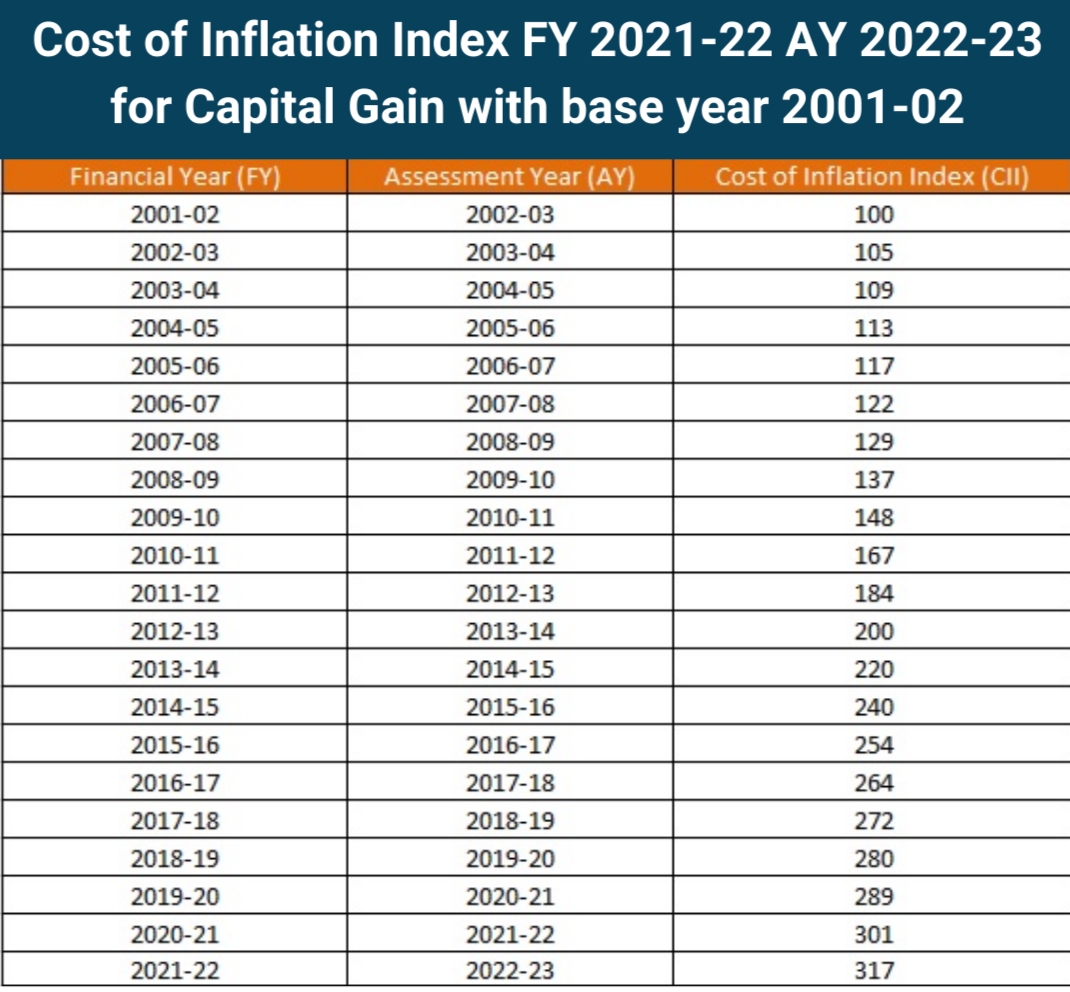
It is an index used to calculate the notional increase in the value of an asset due to inflation(inflation-adjusted cost price of an asset). The inflation-adjusted price then is used to arrive at long-term capital gains or long-term losses. The CII number is used to calculate the inflation-adjusted price of assets such as land, building, house, gold jewelry, debt mutual funds, etc. However, it cannot be used for equity shares and equity mutual funds whose gains are taxable at the rate of 10 percent without any indexation benefit.

At the time of income tax returns filing next year, this CII number will be helpful to you to ascertain the long-term capital gains on which you are liable to pay taxes.

Cost of Inflation Index FY 2021-22 AY 2022-23 for Capital Gain

Below is the complete list of Cost of Inflation Index FY 2021-22 AY 2022-23 for Capital Gain from the new base year FY 2001-02 to FY 2021-22.

This notification will come into force with effect from the 1st day of April 2021 and will accordingly apply to the Assessment Year 2021-22 and subsequent years.


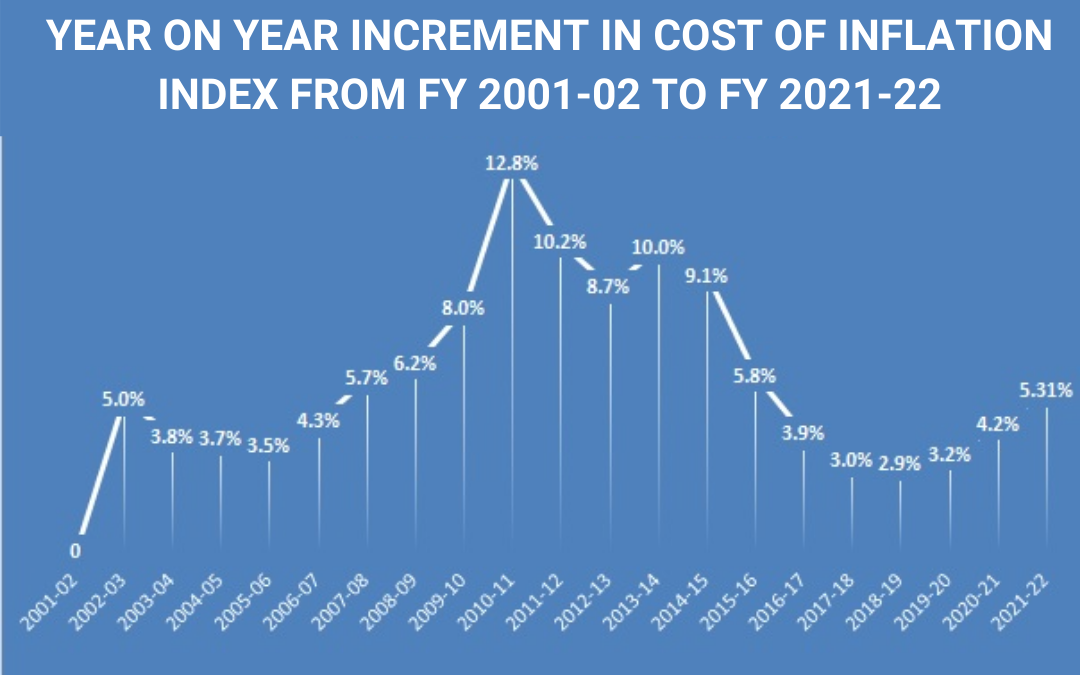
Let us see how year on year it is increasing from FY 2001-02 to FY 2021-22


You noticed that the CII increased to around 5.31% from the last year.

Hope this information will help you in arriving at your capital gain tax.

25

What are airline credit cards? Who should use these credit cards?

“Miles to go before I sleep.” Yes, you can take that quote literally. In the world of air travel, there is a category of people that is all about the miles it earns. If you are a frequent flyer or love traveling, then you should definitely apply for an Airline Credit Card. These cards offer numerous benefits that include air miles in terms of points, huge discounts on hotel bookings, air tickets fare, discounts on renting a car, vouchers for shopping, access to airport lounges, etc.
Airline credit cards have been around almost as long as frequent flyer programs themselves.
At first, the formula was simple: You signed up for a card and earned a bonus worth a free flight or two. After that, you would make everyday purchases with your card to rack up enough miles for another free flight every year or so, depending on your spending patterns. Award charts and earning rates were, at a minimum, predictable.
Since then, however, not only have airline mileage programs changed dramatically but so have the number and types of travel reward credit cards available to consumers.

Let’s have a look at the common benefits offered by airline credit cards.

Earn air miles: All the airline-related transactions done using an airline credit card will earn air miles which can be redeemed for purchasing tickets on both domestic and international airlines.

Bonus miles: It could be as a welcome gift or a renewal gift, credit card issuers typically offer bonus miles within a few days of card issuance. The miles can be encashed in the form of airline tickets during your next trip.

Accelerated miles: What’s more fun than earning more reward points. With the accelerated miles program, some credit cards offer accelerated miles on certain transactions. Make sure you’re aware of the transactions eligible for accelerated rewards to make the most of the program. You must keep checking your emails - generally, credit card companies email the users with such offers.

Airport lounge access: Sit back and relax in the airport lounges in times of delayed flights with the complimentary lounge visits offered by airline credit cards. The access is limited to select airports in India and abroad. Cardholders need to display their credit cards at the eligible airport lounges and can enjoy the refreshments, internet facility, and amenities offered by the lounges.
The most credit card offers lounge access - ensure that they are not chargeable and in which airport is it available before you go swiping your cards for free access.

Fuel surcharge waiver: Of the other benefits offered by airline credit cards, a fuel surcharge waiver is something useful even for less frequent travelers. Every time you purchase fuel using an airline credit card, the fuel surcharge, which is typically charged on all card transactions at fuel stations, will be waived. Cardholders can thus enjoy fuel savings using an airline credit card.

How to pick an airline credit card?

Before you pick a credit card to use for flights, you should answer a few questions.

Do you always fly the same airline?

If you don’t always fly the same airline, it almost certainly makes sense to pick up a flexible points card, at least if you’re only looking to add one card to your wallet.

For eg - Vistara has great tie-ups with credit cards. You can check them out.
Jet Airways used to have one of the best loyalty programs but we all know what happened to that.

Do you have a status with an airline?

If you already have status with an airline, you’re unlikely to pick up much in terms of benefits from a mid-tier airline-specific credit card as many of the benefits, such as free checked bags, are also benefits of status.

Do you want to access airport lounges?

If you want access to airport lounges, you have quite a few options. Would you prefer to access a specific airline’s lounge? If so, look into its top-tier credit card. If you prefer more general lounge access, consider a card that includes Priority Pass. In many cards, priority passes are chargeable so ensure you check terms and conditions beforehand.

Do you want travel insurance?

Some credit cards include various types of travel insurance as a benefit of using the card to book your tickets. If this is something you think you can benefit from, choose a card that offers protection.

Own Portals:

Many Indian cards like HDFC cards and Amex cards have their own flight booking portals where you can use the accumulated reward points on your cards to book flight tickets across various airlines. This works as the best way to use it. Generally, the conversion points are 0.25 paise or 0.30 paise. Do check the terms & conditions and charges before you get all excited for the next free travel.

Conclusion
Whether or not it makes sense to carry an airline credit card will come down to several key factors.

  • First, think about whether you will use its ongoing benefits like day-of-travel perks and discounts enough to offset its annual fee. (yes a good card with good rewards will always come with an added fee)
  • Next, make sure you are getting a great deal on the sign-up bonus. (you can always negotiate for this one)
  • Finally, think about whether a rewards card that earns transferable points instead will suit your spending habits and travel needs better.


By answering those few questions, you will have all the information you need to make your decision. If you travel often, you can get an airline credit card and a no-fee general travel card for all other travel-related expenses.
As long as the rewards you get from a card outweigh the costs of carrying it, you'll come out ahead, no matter your destination.

Article headers

When should one opt for a loan against a life insurance policy?

A life insurance policy is designed to provide a protective cover. However, life insurance is a far more versatile option nowadays. While they are primarily aimed at providing financial cover for the family in case of the death of the breadwinner, insurance policies can also be used to raise money for urgent needs. At times, one may need to take a loan when a financial emergency comes up. In such a situation a personal loan is one of the quickest options. But is it the best option? Instead of going for an expensive option like a personal loan, there is another option you can consider. This is taking a loan against a life insurance policy. So, not only does it provide security, but it also helps when one is going through a cash crunch.


What is a loan against an insurance policy?

A loan against an insurance policy is an arrangement where a borrower can avail loan by pledging their insurance policy as collateral with the insurance company. If the borrower is unable to pay back the loan on time, then the company reserves the right to hold on to the policy until the debt is realized in full.


Which insurance policies are eligible for a loan?

You cannot avail of loans against every type of life insurance policy. Therefore, it is better to check with your insurance company before buying any plan. Policies such as whole life policy, money-back policy, and endowment plan provide a loan against a life insurance policy. However, such loans are not available against term insurance policies and unit-linked plans. (This does not mean you do not take term insurance policies. The use of insurance is to protect your loved ones after you are gone, hence, a term insurance policy is a must)


Eligibility

When borrowing a loan against an insurance policy, you are essentially borrowing from yourself. You can thus borrow the money for any kind of expenses without having to provide an explanation, and you do not have to undergo intense scrutiny or a stringent approval process. Though the income of the borrower is also not a deciding factor for deciding the eligibility, the creditworthiness is considered nevertheless.


How much loan can I get against my insurance policy?

You can get a loan against an insurance policy starting at Rs 2 lakh, and up to 80% of the surrender value of the policy you pledge. Surrender value is the amount that a policyholder gets if he/she decides to exit the policy before maturity.


On what basis is the interest charged?

The interest rate charged in the case of a loan insurance policy is based on the premium already paid and the number of premiums that have been paid, the more the premium amount and the number of premiums paid, the lower the rate of interest charged. Usually, the interest rates are charged around 10% p.a., for loans taken against insurance policies.


What are the documents required?

To avail of this loan, a policyholder will have to submit:

  • A loan application form
  • The original insurance policy document along with your address proof, ID proof, and income proof
  • 'Deed of Assignment’ which will assign your insurance policy in favor of your lender
  • A copy of a canceled cheque
  • Payment receipt for the loan amount


What happens if you fail to repay?

If you fail to repay the loan taken against your policy, then the interest will keep adding to the balance amount. If the loan amount exceeds the insurance policy’s surrender/cash value, then this can become a reason for your policy lapse. The insurer can recover the loan amount and interest from the surrender value of your policy and may also terminate your insurance plan.
Be extremely careful when you are choosing this option, do not take a loan on an insurance policy if you know you won't be able to repay it. In this case, you will lose all the benefits of the policy.
Note: In the event of a policy lapse, taxes must be paid on the cash value.


Conclusion

Note that when you opt for a loan against the life insurance policy, like any other secured loan, the collateral is assigned to the lender. This means that the lender has the right to deduct the interest and principal amount in case of the death of the policyholder. This could compromise the financial security that you had placed in mind for your family. Therefore, before you plan to avail of such loans, make sure to go through the terms and conditions of the lender to avoid any discrepancies at the time of applying for a loan against an insurance policy
Ideally, opt for such a loan if the loan has a short tenure and you are unable to seek an alternative source of borrowing. You may also opt if you have a term insurance policy in place to secure your loved ones' future.


To learn more - you can check our course - NM 102: Build a Safety Net. Use code SAVE20 for 20% off.


    Get your weekly dose of Money Masala from us.


    [mc4wp_form id="2150"]

    WCafe Financial Services Pvt Ltd (formerly known as Wealth Cafe Financial Services Pvt Ltd) is a AMFI registered ARN holder with ARN-78274.

    WCafe Financial Services Pvt Ltd (formerly known as Wealth Cafe Financial Services Pvt Ltd) is a SEBI registered Authorised Person (sub broker) of Sharekhan Limited with NSE Regn AP2069583763 and BSE Regn AP01074801170742.

    Copyright 2010-20 Wealth Café ©  All Rights Reserved