6

Mistakes Investors Make That You Should Avoid

Hello fellow investors!

This Thursday, we are sharing a few mistakes that a beginner does when he/she starts investing and it is important that you understand them and act on it accordingly.


1. Not investing

The first and the biggest mistake investors and savers make is not doing it.
Don’t wait for that raise, inheritance, or lottery win. Start today, right now, with whatever you can.

Consider this: If you can save just 100 INR a day every day for 20 years, and earn 12 percent on it, you’ll end up with INR  30,48,395. That’s enough to change your life and the lives of those you love. So let's just start with keeping INR 100 aside.


2. Investing before doing your homework

When it comes to investing in risk assets like stocks, one mistake I’ve made is going on “gut instinct” and 20 minutes of Internet research.

When dealing with investments that can go south, don’t invest without a clue. If you’re thinking about stocks, there’s plenty of online research and information available free, not to mention TV shows and library books.


3. Being impatient


In a post called The 10 Commandments of Wealth and Happiness, the author, Stacy Johnson, offers this advice: Live like you’re going to die tomorrow, but invest like you’re going to live forever.

Stare at a newly planted tree for 24 hours and you’ll be convinced it’s not growing. Fixate on your investments the same way, and you could miss out on a game-changer.

As discussed above, your 100 INR daily grows into 30 lakhs over 20 years, you gotta be consistent and patient.


4. Not diversifying

There are two types of risk in stocks. The first is called market risk: If the entire market tanks, your stocks probably will as well. The other is called company risk: the risk a specific company will do poorly.

It’s hard to eliminate market risk, but you can reduce company risk by investing in lots of companies.

Can’t afford to own a meaningful number of companies? That’s what mutual funds are for. A mutual fund allows you to own a slice of dozens – even hundreds – of companies with an investment of as little as INR 500.


5. Taking too much risk

Everybody wants to double their money overnight. But if you’re always swinging for the fence, you’re going to strike out often.

Some investments are little more than gambling. Investments like options and commodities, for example, promise huge rewards, but the risk is also huge. Don't forget high risk = high returns.


6. Not taking enough risk

On the other side of the same coin, some investors stand like a deer in the headlights, unwilling to take even a measured amount of risk.

Instead, they keep their savings only in fixed deposits and bank, earning less than 6% (which is only reducing) and comforting themselves with Mark Twain’s expression: “I’m more concerned with the return of my money than the return on my money.”

Insured savings will ensure you never lose anything. But they’ll also ensure the purchasing power of your savings won’t keep pace with inflation. In other words, you’ll become poorer over time.


7. Paying too much attention

There is such a thing as information overload. Between the Internet, newspapers, magazines, and cable TV, it’s easy to get more than your fill of conflicting information.

Step back, look at the big picture, find a few financial journalists or others you trust, then tune out the rest.


8. Following the herd

One of the world’s wealthiest men, Warren Buffet, said, “Be fearful when others are greedy; be greedy when others are fearful.”

If you’re convinced the economy is going to zero, buy guns and canned goods. But if you can reasonably expect a recovery someday, invest – even if that day is a long way away, and even if it’s possible things could get worse before they get better.

We have seen the recovery that has happened from the below of March 23, 2020, of the stock market to current where we are almost back to what we were at the beginning of 2020.


9. Holding on when you should be letting go


Equity is best played as a long game. You should hold on long enough to see it through, but not knowing when to get out could cost you big.

Don’t obsess over your investments, but don’t ignore them either.


10. Being overconfident

The economy runs in cycles of boom and bust – when times are good, people often confuse luck with skill.

This is what happened during the housing bubble and the dot.com stock bubble and the past 4 months (March 2020 to July 2020). Being in the right place at the right time isn’t the same as being smart.


11. Failing to adjust

How you invest should change as your life changes. When you’re young, it makes sense to invest aggressively, because you have time to recoup from mistakes.

As you approach retirement age, you should reduce your risk.


12. Not seeking qualified help

While investing isn’t rocket science, if you don’t have the time or temperament, consider getting help.
The wrong help?
A commissioned salesperson more interested in their financial success than yours.
The right help?
A fee-based planner with the right blend of education, knowledge, credentials, and experience - you can contact us at ria.wealthcafe.in

Happy Investing!

Disclaimer: - The emailers are for information purposes only. Information presented is general information that does not take into account your individual circumstances, financial situation, or needs, nor does it present a personalized recommendation to you. You must consult a financial advisor who understands your specific circumstances and situation before taking an investment decision.



2

One size does not fit all!

Hi fellow investors,


Ever walked into the ladies' shoe section of the mall during the sale season?

They have long tables filled with all kinds of shoes and each table has the shoe size written on it. I happened to have very petite feet (a size 36) and I look forward to the sale season to upgrade my shoe collection. And during the sale, I go to the mall oozing with enthusiasm to pick up some great heels at flat 50% off, fight off scores of other women and claw my way to the front of the table only to find ugly black chappals in my size!

However, at the end of the store, there is a table filled with some amazing shoes and without the commotion around it, but they are SIZE 41 - 42. Ugh! I hate having small feet during the sale season. All the best brands have their best discounts on shoes in the 40-42 size range. They even have color options! They have so many great options that I am even tempted to try them on just to see what they'd look like. But I do NOT buy these shoes because they are NOT my SIZE. They may be the BEST shoes out there but I DO NOT BUY it. Why would anyone spend money on shoes that would ever fit them, right?

So, in spite of knowing not to buy shoes that do not fit them, why do people invest without knowing what is the right fit for them?

Everyone is always searching for:
'The best Mutual Funds to Invest in?' 
'Tell me where can I get the maximum return possible'
'How much returns will I make through this investment'

The best returns are in the shoe of size 42 but clearly, they do not fit me and will only be a waste of money and similarly, so will your investments if they are bought considering only the 'best returns' as criteria.

You need to invest your money in the investments which are 'RIGHT' for you as per your risk profile. The investments which fit perfectly well in the asset allocation determined by your risk profile just as my feet size determine the final shoe design I pick.

What is this Risk Profile?

The risk profile is your risk-taking capacity and how much risk you can take so that you can peacefully sleep at night. It is based on your ability to take a risk and your willingness to take the risk. Where the ability is more a function of your age, your money, and your goals, willingness is completely behavioral and is determined by your life experiences and education.

Before you start your investments, it is very important that you take a risk profile test (we have attached an indicative risk profile for your reference) and know what is the RIGHT Debt-Equity mix for you.

High Risk = High Returns
Low Risk = Low Returns

Where you make the investment decision based on the risk you are taking, you will eventually be able to achieve your goals with peace of mind and not worrying about the volatility in the markets.
Shouldn't that be the whole point of investing in the first place?

Hence, don't just run behind the highest returns, they might not be the right fit for you. Instead, understand what you want to achieve by investing, plan accordingly, and then invest.

Disclaimer -  These articles are for information purposes only. Information presented is general information that does not take into account your individual circumstances, financial situation, or needs, nor does it present a personalized recommendation to you. You must consult a financial advisor who understands your specific circumstances and situation before taking an investment decision.  


2

Understanding 'Mutual Fund Units & NAV

Hello fellow investors

More than 6 months into lockdown, 1 market crash and 1 great recovery, the only constant thing is our learning and our Thursday emails. We started writing our emails soon after lockdown and now we enjoy it so much that we cannot wait for the next Thursday to come and share some insights from the finance world with you. 

In today's email, I am going back to the basics of Mutual Funds and explain what exactly are Mutual Fund Units and NAV and how they help or not help you make investment decisions.


What is a Mutual Fund Unit?


Just as share represent the ownership of Equity, units represent the ownership of Mutual funds. When you invest 5000 INR in a mutual fund and the NAV of the fund is 50 INR - you would get 100 units. 

It is like buying petrol when you go to the petrol pump, you ask them to fille petrol in your car for 1000 INR. If the price per litre is INR 100, you would get 10 litres of petrol in your car.

Let's understand a few facts about Units of Mutual Funds


1. You don't need to buy 1 entire unit of Mutual Fund
You can buy a mutual fund in fractions or parts, it is the amount of money you invest that determines how many units you get. Like when you fill petrol in your car, you tell them fille petrol of INR 1000, if per litre petrol price is 72, you get 13.88 litres of petrol. The same thing happens with Mutual Funds.


2. You do not sell all your units to withdraw from Mutual Funds.
As you can partially invest in mutual funds, you can also partially withdraw from mutual funds. You can do that anytime you want (unless they are close-ended schemes)


3. Units are not the same as the share price
Equity Mutual Funds invests in Equity stocks/shares but it does not mean that units are the same thing. The share price is of an individual company and the demand and supply of that particular stock are one of the factors of their share price movements. Such does not happen to mutual fund units.

An average of all the underlying stocks of the mutual funds helps determine the value of each unit which is called as Net Asset Value - NAV.

4. NAV is the price of each unit
The price of each unit of a mutual fund is the NAV. If you want to buy 1 unit of a mutual fund, the price you have to pay is the NAV of that mutual fund’s unit on that day.NAV changes every day. So when the NAV goes up, you gain.

A high NAV does not mean that a particular Mutual Fund is better than the one with a low NAV. NAV price does not determine the value of the Mutual Fund.

NAV= (Total market value of assets invested by the fund-Expenses)/No of Units

5. Mutual fund unit price (NAV) goes up and down

As NAV is determined based on the total market value of the assets invested in by mutual fund which includes shares, bonds, cash, any interest or dividend earned by them and would also capture the movement in the price of shares & bonds, the NAV would also move.

NAV of a fund changes every day where there is a change in the underlying asset, this change helps you know if you are in profit or loss.


Mutual Funds are considered one of the most common forms of investing today, in fact it has generated a lot of wealth for investors who have understood the risk of investing in them and managed it appropriately. We will soon be launching a course on Mutual Funds and more, so stay tuned and keep reading our emailers for a detailed update on the same super soon.

Disclaimer: - The articles are for information purposes only. Information presented is general information that does not take into account your individual circumstances, financial situation, or needs, nor does it present a personalized recommendation to you. You must consult a financial advisor who understands your specific circumstances and situation before taking an investment decision.


8bfedc1901692a67b64a52a6937bdfdd_accounting-balance-banking-159804-3504-c-90

Should I pause/stop my SIP?

The tides may appear to have calmed down for now but we never know what is in store for us next. Some relaxations have definitely come out and some more are expected. However, this does not cure COVID 19, it just prepares us for the new normal of living with Covid as we begin to resume our old routines.

While there are many uncertainties looming over us, including pay cuts and job loss, some of you guys asked us if they should discontinue/pause their SIPs under these circumstances?

Like always my answer to this will depend upon how much extra cash you have left each month and if there is an Emergency Fund (equal to 4/6 months of your monthly expenses) in place to take care of these uncertain times.

  • If you have not been affected by pay cuts, you must continue your SIPs as before. Additionally, since you are spending less than before, the savings again must get channeled into your investment portfolio.
  • If your pay has been reduced, counter that with the reduced spends, and if your total savings are still the same, continue with your SIPs. If the savings are lower, then you can dip into your Emergency Fund to ensure your SIPs don't stop. If you have not set up an EMergency fund, then you will have to reduce your monthly SIP to match the amount you are able to save each month.
  • If you have lost your job, or your salary has been paused, then you can fall back on your emergency fund to take care of your monthly expenses. SIPs will have to be stopped and will suffer.

What is the point of SIPs right now?

SIPs (known as systematic investment plans) are where you invest a fixed amount of money into a choice of your mutual fund at regular intervals (generally monthly). It is an automated process and the amount is debited from your bank and mutual fund units credited to you.

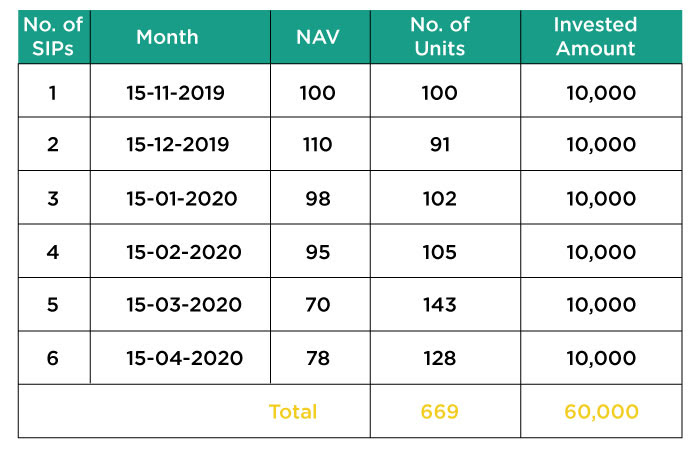
Buying in a falling market reduces your cost giving you higher benefits when the market goes up. To understand this better, let us run you through this example.

You get more units when the fund's NAV (market price) is lower
You get less units when the fund's NAV (market price) is higher.

As of 10 May, the NAV is priced at 85, hence the value of your investments will be 54,880 @5% loss.

Instead of doing SIP, had you invested a lump sum of INR 60,000 on 15 November, you would have got only 600 units (as opposed to 669 here) and the value of your investments would be INR 51,000 on 10 May 2020 (at a 15% loss). 

No one knew that the market would fall so drastically and be so volatile in 2020, but your SIPs definitely help you to invest in a staggered and make most of the down market.

Everyone wants to know when we will reach the bottom to buy the maximum number of units. But it is anyone's guess when the markets will reach the bottom or what the bottom price is.  Hence, SIP is your friend in such markets. When you continue your SIPS, your amount keeps buying a varied number of units (more in a down market) and thus, helping you to average your cost of buying.

Do not stop your SIPs now just because the markets are down, for all you know this time may turn out to be a bargain and help you get better returns in the future.

8

What is travel insurance ?

With the increase in travel, one of the important things that travellers need to know about is Travel Insurance. This form of insurance helps cover a whole range of uncertainties and scenarios that can drain out a traveller’s finances. Most countries require mandatory Travel Insurance while applying for a visa. But choosing the right Travel Insurance which covers all the risks of travel is important.


What does Travel Insurance mean?

Travel Insurance is a type of insurance that covers different risks while travelling. It covers medical expenses, lost luggage, flight cancellations, and other losses that a traveller can incur while travelling.

Travel Insurance is usually taken from the day of travel till the time the traveller reaches back to India. Taking Travel Insurance ensures comprehensive coverage in case of any emergency in another country. Travel Insurance is also available for trips taken in the home country of the traveller like Bharat Bhraman & E-Travel, but it is a more popular option for travel abroad.

Some of the risks covered under Travel Insurance are:

  • Personal Accident Cover, which covers:
    • Insured’s Death
    • Permanent Total Disability
  • Accident & sickness medical expense reimbursement
  • Dental treatment relief
  • Emergency evacuation
  • Repatriation of remains in case of death
  • Baggage delay
  • Loss of checked baggage
  • Loss of passport
  • Flight delay
  • Hijack
  • Home burglary
  • Trip curtailment
  • Trip cancellation
  • Missed connection/missed departure
  • Bounced hotel/airline booking.

There may be more risks covered under individual policies depending on the requirements of the traveller. The amounts to which these risks are covered depends on the policy & plan that the traveller opts for. Travel Insurance also covers additional risks at an additional premium. Some of these risks are specific to the traveller or the place the person is travelling to.


Types of Travel Insurance:

There are single trip Travel Insurance policies meant for one journey. But for frequent travellers who travel abroad for business purposes, there is an option to buy a multi-trip Travel Insurance policy. Some policies last for an entire year and cover multiple trips to a particular destination. Opting for such policies is much more cost-effective for businessmen and frequent travellers to a particular destination. We also have student policies which are specially designed for students going abroad for studies at an affordable premium. The maximum trip length can last from 30, 45 and 60 days.

Another type of travel policy is a Group Travel Insurance policy. A group policy covers 7 or more travellers. These policies are cost-effective and offer similar benefits as single trip Travel Insurance policies. Group Travel Insurance policies are based on the age of the travellers which means it works out more cost-effective per traveller. Most travel companies opt for group Travel Insurance policies when they take groups across different countries on tours.

It is easy to pick out a policy once you know the Travel Insurance definition. While planning your trip abroad, pick out a Travel Insurance policy that provides exhaustive coverage with high coverage. It is possible to check the cost of Travel Insurance on insurance aggregators and pick out the best policy. HDFC Bank offers a variety of Travel Insurance policies through the bank’s website like Student Travel Insurance, Domestic, Senior Citizens, Family and even Individual Travel Insurance. You can easily pick out a policy that suits your need and provides the best value for money.


pexels-photo-221534

Public Provident Fund (PPF) - Things to note

Public provident fund (PPF) is a tax-free investment product that comes with a tenure of 15 years. You need to make the periodic investment to PPF every year and the minimum you can invest is ₹500 going up to ₹1.5 lakh a year. You can choose to invest a lump sum amount in the year or invest a sum every month. You can hold a PPF account in your name or even open one in the name of a minor but together the contributions can’t exceed ₹1.5 lakh.

PPF’s returns are pegged to the average government securities (G-secs) yield and are declared every quarter. Currently, it offers a rate of 8% per annum.

You can maximize your return by investing early in the year as then your money will earn interest for the entire year.

Being a tax-free product, the contributions up to ₹1.5 lakh qualify for a tax deduction under Section 80C of the Income Tax Act. A deduction reduces your overall tax liability.

PPF accounts can be opened in banks or post offices, but you need to be a resident Indian.

Things to Note (lesser known facts of PPF)

1. Opening PPF accounts in joint names: Everybody knows that opening PPF accounts in joint names is not allowed. However, parents are allowed to open a PPF account on behalf of a minor child. In case both parents are not alive or a living parent is incapable of acting, then a court-appointed guardian is eligible to open an account on behalf of a minor. But while parents are allowed to open accounts on behalf of minors, both parents can’t open two separate accounts on behalf of the same minor. When the minor attains majority, then they will be treated as the account holder of PPF and not the legal guardian.

2. A PPF account cannot be attached: The money in the PPF account is yours and nobody can take it away. Yes, a PPF account cannot be attached by a person or entity to pay off any debt or liability. This is the gold standard of safety of an asset. Do remember our homes, if taken on a mortgage, can be taken away if we fail to pay the EMIs. But in case of PPF money, even a court order or decree cannot make a person liable to pay off her/his debts using the money from her/his PPF account. This is great protection for millions of PPF account holders. There is one caveat though — the Income Tax authority is free to attach and recover the dues of an account holder.

3. Nomination of nominees: PPF allows you to nominate more than one person. You can nominate one or more nominees to your PPF account if you so wish. The nomination is not allowed to an account opened on behalf of minors. You can change or cancel the nomination at any point of time during the PPF account period, but do note that you cannot nominate a trust to your PPF account. But being the nominee does not mean you will be allowed to continue the account. All the nominee gets is the right of ownership in terms of an authority to collect the money on the death of the subscriber and retain the money as a trustee for the benefit of the persons who are entitled to it under the law.

4. Misunderstanding about lock-in period:  As per the PPF scheme rules, the date of calculation of maturity is taken from the end of the financial year in which the deposit was made. So, it does not matter in which month or date the account was opened. If your first contribution was made on June 1, 2018. The lock-in period of 15 years will be calculated from March 31, 2019, and the year of maturity, in this case, will be April 1, 2034. Do remember this technicality if you are counting on your PPF account maturity sum for an important time-sensitive financial event, like retirement or buying a house or repaying an important loan.

5. Discontinuation of PPF account: Some investors often forget their PPF account. Lack of minimum deposit can lead to discontinuation. If your PPF account is discontinued, you will still get the amount along with interest, but only at maturity. Such a discontinued account will earn interest every year till maturity is reached on the balance available for each year. Even withdrawal or loan facility is not allowed on such a discontinued account. If you want to avail loan or withdrawal facility, you will have to continue the account by paying the prescribed penalty and minimum subscription for the discontinued period. These rules tell you that you should do everything in your power not to let your PPF account become a discontinue done. Keep a note of the account and invest the minimum amount every year.

Wealth Cafe tip - If you do not have an Employee provident fund or not using your EPF for retirement goals and are looking to invest for long term goals like retirement, PPF is a great option. It gives tax savings, security, and good interest rates.


e1f8a0b9fba09014ad5e3f45bd7387bf_adult-banking-blur-1288483-e1542281609390-3000-c-90

Insurance is not Investment

When you Invest your money, you part with your money today to get something in return tomorrow. whereas when you get insurance for something, you expect to get financially covered in case an unforeseen event for which insurance is taken occurs.

Thus, term insurance is a pure insurance product, it is not for your living but in case you die, you get the money. According to us, Term Insurance is the cheapest and best way to insure your life.

However, many people feel otherwise and believe that they want to put money into insurance only when they are guaranteed that they shall get something in return either alive or dead. In this bargain, you are just investing (with insurance as an add-on) but not getting adequate insurance for yourself.

We have already discussed, how a Term Insurance must replace you Financially and how to compute the amount of your sum assured in the article - how compute your sum assured.

In spite of this many people believe otherwise and want to get returns for their insurance.

Let us understand the same with an example

If you spend INR 5000 for your insurance needs each month.

Case 1 - Where you buy a Life insurance product in which you get an amount on maturity where you do not die like a basic money back policy or an endowment plan. 

Particulars  Amount
Premium Per Month               5,000
Premium Per Annum             60,000
Number of years covered under the policy                    30
Total Premium Paid         18,00,000
Sum Assured under this Policy         70,00,000
Amount received on maturity if the person survives         55,30,890

The Rate of Return, in this case, is 6.5%

Case 2 - When you buy a Term Insurance and invest the balance amount in a mutual fund.

Particulars Amount
Term Insurance Premium per month                     850
Term Insurance Premium per annum                10,200
SIP premium amount                  4,150
Mutual Funds Investment per annum                49,800
No of years covered under insurance and investment                       30
Total Investment Amount            14,94,000
Sum assured under this policy            10,00,000
Amount received if you survive
Term Insurance                       -
Mutual Funds Investment         3,46,16,398

The Rate of Return, in this case, is 15%

Comparisons between the  2 cases are as under:

Wealth Cafe actionable - This article is to give you an idea of how important and cheap term insurance is. Buying endowment plans for your insurance needs could be expensive. However, getting an endowment plan for a low-risk investment option could be considered by you for your investment needs. It is important to know the exact return % you are getting from these investments and then, take a decision.


To learn more - you can check our course - NM 102: Build a Safety Net. Use code SAVE20 for 20% off.


    Get your weekly dose of Money Masala from us.


    Income tax Feature Image (1)

    Income-tax Rates FY 2020-21 (AY 2021-22)

    Before knowing the tax rates, it is very important to understand the terms Financial year (FY) and Assessment Year (AY).

    The below-mentioned tax rates/ slab is on the income earned for the period 1 April 2020 to 31 March 2021. FY stands for the ‘financial year’ which is from 1 April 2020 to 31 March 2021. AY stands for Assessment year which 2021-22.

    For individuals, the due date to file the income tax return for the income earned from 1 April 2020 to 31 March 2021 is 31 July 2021. However, this year due to COVID 19 economic relaxations, the due date is pushed to 30 November 2021

    Income tax Rates 

    1. Income Tax Rate & Slab for Individuals & HUF:
      1. Individual (Resident or Resident but not Ordinarily Resident or non-resident), who is of the age of less than 60 years on the last day of the relevant previous year & for HUF:


    Taxable income Tax Rate
    (Existing Scheme)
    Tax Rate
    (New Scheme)
    Up to Rs. 2,50,000 Nil Nil
    Rs. 2,50,001 to Rs. 5,00,000 5% 5%
    Rs. 5,00,001 to Rs. 7,50,000 20% 10%
    Rs. 7,50,001 to Rs. 10,00,000 20% 15%
    Rs. 10,00,001 to Rs. 12,50,000 30% 20%
    Rs. 12,50,001 to Rs. 15,00,000 30% 25%
    Above Rs. 15,00,000 30% 30%


    1. Resident or Resident but not Ordinarily Resident senior citizen, i.e., every individual, being a resident or Resident but not Ordinarily Resident in India, who is of the age of 60 years or more but less than 80 years at any time during the previous year:
    Taxable income Tax Rate
    (Existing Scheme)
    Tax Rate
    (New Scheme)
    Up to Rs. 2,50,000 Nil Nil
    Rs. 2,50,001 to Rs. 3,00,000 Nil 5%
    Rs. 3,00,001 to Rs. 5,00,000 5% 5%
    Rs. 5,00,001 to Rs. 7,50,000 20% 10%
    Rs. 7,50,001 to Rs. 10,00,000 20% 15%
    Rs. 10,00,001 to Rs. 12,50,000 30% 20%
    Rs. 12,50,001 to Rs. 15,00,000 30% 25%
    Above Rs. 15,00,000 30% 30%


    1. Resident or Resident but not Ordinarily Resident super senior citizen, i.e., every individual, being a resident or Resident but not Ordinarily Resident in India, who is of the age of 80 years or more at any time during the previous year:
    Taxable income Tax Rate
    (Existing Scheme)
    Tax Rate
    (New Scheme)
    Up to Rs. 2,50,000 Nil Nil
    Rs. 2,50,001 to Rs. 5,00,000 Nil 5%
    Rs. 5,00,001 to Rs. 7,50,000 20% 10%
    Rs. 7,50,001 to Rs. 10,00,000 20% 15%
    Rs. 10,00,001 to Rs. 12,50,000 30% 20%
    Rs. 12,50,001 to Rs. 15,00,000 30% 25%
    Above Rs. 15,00,000 30% 30%
    1. Surcharge:
      a) 10% of Income tax where total income exceeds Rs.50 lakh
      b) 15% of Income tax where total income exceeds Rs.1 crore
      c) 25% of Income tax where total income exceeds Rs.2 crore
      d) 37% of Income tax where total income exceeds Rs.5 crore
    2. Note:Enhanced Surcharge rate (25% or 37%) is not applicable in case of specified incomes I.e. short-term capital gain u/s 111A, long-term capital gain u/s 112A & short-term or long-term capital gain u/s 115AD(1)(b).
    3. Education cess:4% of income tax plus surcharge
    4. Note: A resident or Resident but not Ordinarily Resident individual is entitled to rebate under section 87A if his total income does not exceed Rs. 5, 00,000. The amount of rebate shall be 100% of income-tax or Rs. 12,500, whichever is less. rebate under section 87A is available in both schemes I.e. existing scheme as well as new scheme.


    1. Income Tax Rates for AOP/BOI/Any other Artificial Juridical Person:
    Taxable income Tax Rate
    Up to Rs. 2,50,000 Nil
    Rs. 2,50,001 to Rs. 5,00,000 5%
    Rs. 5,00,001 to Rs. 10,00,000 20%
    Above Rs. 10,00,000 30%

    Surcharge:
    a) 10% of Income tax where total income exceeds Rs.50 lakh
    b) 15% of Income tax where total income exceeds Rs.1 crore
    c) 25% of Income tax where total income exceeds Rs.2 crore
    d) 37% of Income tax where total income exceeds Rs.5 crore

    Note: Enhanced Surcharge rate (25% or 37%) is not applicable in case of specified incomes I.e. short-term capital gain u/s 111A, long-term capital gain u/s 112A & short-term or long-term capital gain u/s 115AD(1)(b).

    Education cess: 4% of tax plus surcharge


    1. Tax Rate for Partnership Firm:

    A partnership firm (including LLP) is taxable at 30%.

    Surcharge: 12% of Income tax where total income exceeds Rs. 1 crore

    Education cess: 4% of Income tax plus surcharge


    1. Income Tax Slab Rate for Local Authority:

    A local authority is Income taxable at 30%.

    Surcharge: 12% of Income tax where total income exceeds Rs. 1 crore

    Education cess: 4% of tax plus surcharge


    1. Tax Slab Rate for Domestic Company:

    A domestic company is taxable at 30%. However, the tax rate is 25% if turnover or gross receipt of the company does not exceed Rs. 400 crore in the previous year.

    Particulars Tax Rate(%)
    If turnover or gross receipt of the company does not exceed Rs. 400 crore in the previous year 2018-19 25%
    If the company opted section 115BA (Note 1) 25%
    If the company opted for section 115BAA (Note 2) 22%
    If the company opted for section 115BAB (Note 3) 15%
    Any other domestic company 30%


    Note 1: Section 115BA - A domestic company which is registered on or after March 1, 2016 and engaged in the business of manufacture or production of any article or thing and research in relation to (or distribution of) such article or thing manufactured or produced by it and also It is not claiming any deduction u/s 10AA, 32AC, 32AD, 33AB, 33ABA, 35(1)(ii)/(iia)/(iii)/35(2AA)/(2AB), 35AC, 35AD, 35CCC, 35CCD, section 80H to 80TT (Other than 80JJAA) or additional depreciation, can opt section 115BA on or before the due date of return by filing Form 10-IB online. Company cannot claim any brought forwarded losses (if such loss is related to the deductions specified in above point).

    Note 2: Section 115BAA - Total income of a company is taxable at the rate of 22% (from A.Y 2020-21), if the following conditions are satisfied:
    - Company is not claiming any deduction u/s 10AA or 32(1)(iia) or 32AD or 33AB or 33ABA or 35(1)(ii)/(iia)/(iii)/35(2AA)/(2AB) or 35AD or 35CCC or 35CCD or section 80H to 80TT (Other than 80JJAA).
    - Company is not claiming any brought forwarded losses (if such loss is related to the deductions specified in above point).
    - Provisions of MAT is not applicable on such company after exercising of option. company cannot claim the MAT credit (if any available at the time of exercising of section 115BAA).

    Note 3: Section 115BAB - Total income of a company is taxable at the rate of 15% (from A.Y 2020-21), if the following conditions are satisfied:

    - Company (not covered in section 115BA and 115BAA) is registered on or after October 1, 2019 and commenced manufacturing on or before 31st March, 2023.
    - Company is not formed by splitting up or reconstruction of a business already in existence.
    - Company does not use any machinery or plant previously used for any purpose.
    - Company does not use any building previously used as a hotel or a convention center, as the case may be.
    - Company is not engaged in any business other than the business of manufacture or production of any article or thing and research in relation to (or distribution of) such article or thing manufactured or produced by it. Business of manufacture or production shall not includes business of -

    • Development of computer software;
    • Mining ;
    • Conversion of marble blocks or similar items into slabs;
    • Bottling of gas into cylinder;
    • Printing of books or production of cinematographic film; or
    • Any other notified by Central Govt.

    - Company is not claiming any deduction u/s 10AA or 32(1)(iia) or 32AD or 33AB or 33ABA or 35(1)(ii)/(iia)/(iii)/35(2AA)/(2AB) or 35AD or 35CCC or 35CCD or section 80H to 80TT (Other than 80JJAA and 80M).

    - Company is not claiming any brought forwarded losses (if such loss is related to the deductions specified in above point).

    - Provisions of MAT is not applicable on such company after exercising of option. company cannot claim the MAT credit (if any available at the time of exercising of section 115BAA).

    Surcharge:
    a) 7% of Income tax where total income exceeds Rs.1 crore
    b) 12% of Income tax where total income exceeds Rs.10 crore
    c) 10% of income tax where domestic company opted for section 115BAA and 115BAB

    Education cess: 4% of Income tax plus surcharge.


    1. Tax Rates for Foreign Company:

    A foreign company is taxable at 40%

    Surcharge:
    a) 2% of Income tax where total income exceeds Rs. 1 crore
    b) 5% of Income tax where total income exceeds Rs. 10 crore

    Education cess: 4% of Income tax plus surcharge.

    Taxable income Tax Rate
    (Existing Scheme)
    Tax Rate
    (New Scheme)
    Up to Rs. 10,000 10% -
    Rs. 10,001 to Rs. 20,000 20% 22%
    Above Rs. 20,000 30% -
    1. Income Tax Slab for Co-operative Society:

    Surcharge:

    1. a) 12% of Income tax where total income exceeds Rs. 1 crore
    2. b) In case of Concessional scheme, surcharge rate is 10%

    Education cess: 4% of Income tax plus surcharge.

    Disclaimer: - The articles are for information purposes only. Information presented is general information that does not take into account your individual circumstances, financial situation, or needs, nor does it present a personalized recommendation to you. You must consult a financial advisor who understands your specific circumstances and situation before taking an investment decision.

    chest-container-craft-220994

    Why you should avoid investing all your money in a FIXED DEPOSIT?

    First job – first income – first savings – first investment is always a fixed deposit. The moment there is any lump sum savings in our bank account, we make a fixed deposit.

    Recurring deposits are also a type of fixed deposits where a fixed amount is invested monthly in the deposit account.

    Most either invested in a fixed deposit or a recurring deposit once in our lifetime. Fixed Deposit is the stepping stone to our investment journey.

    Fixed Deposit is a low risk – low return investment product.

    Return: A fixed deposit currently gives a return of 7%-7.5% before tax and after taking into an account the tax rate of 30% on the income from fixed deposit. It would be anything between 5.75% - 6%.  Hence, the return from a fixed deposit is not a lot.

    Risk: Investors assume that Fixed Deposit is the safest investment option and nothing can go wrong with them. It is important to note that a small amount of risk is always associated with every investment. The RBI ensures a balance of Rs. 1 lakh per account holder in case of default by any scheduled bank. Anything more than that in any bank is not insured and hence, is at risk, if the bank was to shut down. So, if you have a deposit of 5 lakh rupees with a scheduled bank and it was to go bust, RBI will only pay you back 1 lakh rupees. Also, it is important to know that the banks are governed by RBI and the big banks will not just shut down tomorrow, there is a relative risk which we all bear when we take a fixed deposit.

    Co-operative Banks: Co-operative banks are not scheduled banks. They generally give a return of 1% or 2% more than the other private/public banks making a fixed deposit with these banks a  very lucrative investment option. However, a higher return means higher risk. Co-operative banks are notoriously known for shutting down without any prior notice and the government may not come to rescue these banks. So, the amount of risk that you take for 1% extra return is not justifiable and it is not a MEASURE RISK and hence, you should try and avoid the same.

    Why do you invest?

    1. You can own what you cannot own today
    2. You can own more than what you want to own today but cannot.

    Basically, your investments should beat inflation. Because with time, things keep getting more expensive at the rate of inflation, so your money today has to grow at a rate higher than the inflation rate for you to be able to afford what you cannot afford today.

    The current rate of inflation is 5% - 5.5% and hence, your investments must fetch you more than this to help you get whatever that you want to own.

    Are your fixed deposits giving you a return higher than the inflation rate?

    We have tabulated below to explain how your money grows in a fixed deposit versus in a mutual fund. This growth in money is compared to the price of movie tickets and how the same has grown expensive over a period of time.

    In this table, you can see the difference in the price of a movie ticket, 10 years ago and today. The same is compared to the growth in your fixed deposit investment @current rate of 6%.

    Whereas, if you invest in mutual funds, your money would grow @15% and after 10 years, you will have 4 times the value and in 20 years, 10 times the value you get from a fixed deposit.

    You should just not invest your money, but you should invest it right to get more than what you can today.

    If you can 10 years from today exactly what you can today, what is the point of investing. This is what fixed deposit does to your money. It does not make it work hard enough for you to be able to enjoy life. By investing in a fixed deposit, you will only be able to own what you have today, tomorrow, not really a lot more.

    Wealth Cafe Actionable - Invest in fixed deposit when you are closer to your goal and cannot afford to take a risk. You can also invest for your emergency fund in a fixed deposit as the returns are similar to a liquid fund but fixed deposits are safer. The only problem with fixed deposits is that they are illiquid and you have to bear a penalty for premature withdrawal of a fixed deposit.

    Image Credit: Wooden Earth

    [mc4wp_form id="2150"]

    WCafe Financial Services Pvt Ltd (formerly known as Wealth Cafe Financial Services Pvt Ltd) is a AMFI registered ARN holder with ARN-78274.

    WCafe Financial Services Pvt Ltd (formerly known as Wealth Cafe Financial Services Pvt Ltd) is a SEBI registered Authorised Person (sub broker) of Sharekhan Limited with NSE Regn AP2069583763 and BSE Regn AP01074801170742.

    Copyright 2010-20 Wealth Café ©  All Rights Reserved