How are investors buying mutual funds - looking at the best performing ones?

The first thing to answer before you start investing is to know “WHY” you are investing in Mutual Funds.

  1. Debt Funds - To build a safety net, achieve short term goals and earn higher tax efficient returns compared to  fixed deposits.
  2. Equity Funds - To create long term wealth and achieve goals


Many Investors just look at the best performing funds. They would google - Top 5 funds for 2020 or Top 5 funds for 2021 and invest their money in the fund names that appear. So much so that most of the time they do not even remember the name of the fund. So many times, we have asked people - which fund have you invested in and I would get an answer saying - Umm HDFC bank? Kotak? Something DDFC…basically full confusion and no research.


Yes, when you don't know how to invest and you want to invest, choosing the best funds based on recent past performance seems the easiest choice to make. However, it would also turn out to be a bad choice. 


Studies have proven that selecting mutual funds based on high-performance track records is naïve. The Star rating of various mutual funds keeps changing, a fund that is top rated in this one year, is hardly the top-rated fund in the subsequent years. Tim Courtney, a chief Investment advisor of US-based Burns Advisory, did backtesting of past performance of the funds most highly rated, he found that they usually performed poorly after they have gotten 5 ratings. Hulbert financial digest, an investment newsletter, found that if investors continually adjusted their mutual funds' holdings to hold only the highest-rated funds, a total stock market index would have beaten them by 45.8 % in the past decade (he studied funds from 1994 to 2004 in the USA). In fact over the years, it has gotten even more difficult to beat the markets and get alpha on your investments.  - extracts from Millionaire extracts - How to build wealth living overseas by Andrew Hallam


Recently, even ET money conducted a similar study for the Indian Mutual Fund market and tracked the returns investors would make. As per the study, they tracked that if investors followed a buy and sell strategy with top rated mutual funds i.e. they bought the best fund and then sold them when their rankings fell, they would make a CAGR of 12.6% in the past 10 years (without accounting for the cost of investing, selling and taxation on the same). Now, instead of doing this, if the investor would have only invested in an index fund in the past 10 years (2010 to 2020), they would have made a return of 12.2%. 


The cost of transactions such as brokerage, exit load, STT and capital gains taxes (payable every time you book gains on mutual fund transactions) would further reduce your returns in case of a buy and sell strategy based on the top ranking fund. Also, it is not feasible to follow this approach once your portfolio grows too much.


Some learnings from the above 2 studies are as follows:


  1. Chasing past performance and looking out for best returns is a futile activity, it is not giving you better performances. It is only tiring you and keeping you away from focusing on important parameters.
  2. Invest as per your goals and risk profile, finalize the funds and stick to them. Rather than looking for quick gains, understanding wealth creation takes consistency and discipline is the way.
  3. If you want to learn on what parameters to check to select the right fund (please stop using the word best funds), check our blog  - Factors to check.
  4. If you really want to invest and make a financial plan - you can reach out to us by filling this google form or at iplan@wealthcafe.in We are SEBI registered investment advisors and can help you make sound investment decisions. You can read about our advisory services at ria.wealthcafe.in


Wealth Café Advice -  “Past performance is no guarantee of future results.” In search of looking for the best, you are missing on the right and the time a fund needs to create wealth and achieve your goals.


Check our course- NM 104: Basics of Mutual Funds - to learn more about Mutual Funds in detail.

Disclaimer: - The articles are for information purposes only. Information presented is general information that does not take into account your individual circumstances, financial situation, or needs, nor does it present a personalized recommendation to you. You must consult a financial advisor who understands your specific circumstances and situation before taking an investment decision.

How long should you stay invested in mutual funds?

The struggle to stay committed to investments is as real as it is to stay committed to a human. How long your relationship with your mutual funds is a function of your need for that investment and your risk profile. 


Based on tenure of your goals


Invest based on your goal tenure: Investing is very simple if we understand all the rules. Goal based investing is based on the tenure of your goals.

  • Short term goals are less than 3 years goals.
  • Long term goals are more than 3 years goals


Invest in mutual funds by first identifying for which goal you are investing, what is the tenure of that goal and then invest till that goal is accomplished. Now where you invest to achieve that goal is a function of your risk profile. (we have discussed that here)

  • Short term goals are less than 3 years goals. - Debt Mutual Funds (short term)
  • Long term goals are more than 3 years goals - Mix of debt & Equity (as per your risk profile)


Invest in Equity for long term for higher gains and managed risk


Invest in equity for the long term to reduce the risk of investing in equity. Compound and grow your wealth and eventually achieve your long term goals. Lets understand how your long term goals will be achieved by investing in Equity. 


For instance, in 2010, if Rakhi had a goal of financing her child’s education and back then she knew that 12 years later i.e. in 2023 for her child’s Graduation, she would need around 1 crore for the same she would invest in the below mentioned manner (based on our recommendations)


From our savings calculator, you would have known that you need to invest INR 42,000 each month for the next 10 years (based on the assumption that you have a growth profile and would earn 12.6% returns from the same).


Now based on our investment plan - she would put 70% in equity and balance 30% in debt. Hence, from INR 30,000 if she invested 21,000 in Nippon India Growth Fund ( a mid cap Mutual Fund) each month for the past 10 years and stayed with the fund through all ups and downs, she would have made 17.10% return. Do note that when you are investing for a long term goal it will eventually turn into a short term goal and in the last 2 or 3 years remaining for the goal, you must shift your investments to debt and discontinue investing in Equity.


Hence, in case of Rakhi, she would invest in Nippon India Growth Fund till 2021 and then discontinue the same. For 2021, 2022, and 2023, she would invest the entire 30,000 INR in debt.


As per the returns, in 2021, she would have an equity corpus of INR 98.31 lakhs and a debt corpus of INR 21 lakhs. A total of INR 1.19 crores was accumulated in 2021. Given the goal is 2 years away, we advise Rakhi to gradually move her Equity exposure to debt to avoid any last minute volatility. Where the goal's value would have changed and Rakhi decides to continue her 30,000 investments, she can invest the same in Debt. 

(image from value research)


Please note that the context of this article is that you must invest for the long term in Equity only where your goal is long term. Over the long term, the risk of equity also reduces as we can see in the case of Nippon India Growth Fund from the image above. Long term investing results in higher gains due to compounding. Still people do not make returns, because they cannot stay committed to their mutual funds.


Do people actually stay invested for long term

Nippon India Growth Fund, launched in October 1995 as a mid-cap scheme, completed 26 years in October 2021 delivering a compound annual growth rate (CAGR) of 22.91%. Since launch, the fund has grown 207 times over. In other words, ₹1 lakh invested in the fund at the start would now be worth ₹2.07 crore.

However, according to data released by the fund house, only 2,600 investors have stayed with the fund since inception and their average assets under management (AUM) is a mere ₹5 lakh. In other words, this cohort of patient investors would have invested just ₹2,415 on average at the time when this fund was launched. (source of this data is from mint - https://www.livemint.com/mutual-fund/mf-news/nippon-amc-sheds-light-on-missing-mf-millionaires-11634232789297.html)

The effect of your money staying invested for longer is far more than getting in at the right time. Not many investors had stayed put for more than 15 years. Unfortunately, people try to time the market. The fund had been managed by various fund managers over time, and has weathered numerous economic events, including the dot com bust, the 2008 crisis, 2013 taper tantrum and covid in 2020.

Wealth Café Advise:

As investors, learn to be more disciplined and focused on the long term and do not get carried away by market volatility.

According to the study conducted by Axis Mutual Fund, four behavioral traits affect investors’ returns:

  • They overreact to market sentiment.
  • They focus too much on short-term market or fund performance.
  • They don’t follow an asset allocation strategy.
  • And, finally, they tend to invest haphazardly, rather than systematically.


Check our course- NM 104: Basics of Mutual Funds - to learn more about Mutual Funds in detail.

Disclaimer: - The articles are for information purposes only. Information presented is general information that does not take into account your individual circumstances, financial situation, or needs, nor does it present a personalized recommendation to you. You must consult a financial advisor who understands your specific circumstances and situation before taking an investment decision.

Mutual Funds for a beginner - Your First Mutual Fund Investment?

Mutual Funds are one of the first investments that everyone wants to make. Reasons are very simple, it is super easy to invest in them and they are literally everywhere. Your uncle is recommending you the same, your friend has invested in it, even the influencers are talking about it. 

Many beginners get stuck with which mutual funds to invest in. There are over 2500 schemes across 44 AMC i.e. like there are over 4000 flavors available across 50 ice cream shops and one can only eat so much.

When it comes to ice cream, we all know that chocolate or candies are the standard safe bets that one can start with. Similarly in Mutual Funds, there are some categories which you can look at when you are a beginner. 


Before you start the process of Investing in Mutual Funds, check out the below 3 steps.


Step 1 - Understand what a Mutual Fund is - watch our YouTube video to know more about it.

Step 2 - Types of Mutual Funds and what do they mean - read our articles on this - Types of Mutual Fund

Step 3 - Know the basics of Investing your money that high risk = high returns and low risk = low returns. So when you are investing in Equity Mutual Funds, it sure does give you higher returns but has higher risks. On the other hand, when you invest in Debt Mutual Funds, it gives you lower returns but has lower risk. The only way to manage this high risk of equity to earn higher returns is to invest for a long  period of time (i.e. for more than 3 years) and stick to debt for short term investments. (Refer to the article to know how to invest your money based on your goals - Investment for children's higher education)


Mutual Funds to focus on as a beginner


Make your first investment in Debt Mutual Fund 


For the first time Mutual Fund investor, we would recommend going for a liquid mutual fund or an ultra short duration fund. These Mutual Funds basically invest in T-bills or short term debt investments with a maturity of not more than 90 days to 6 months. This ensures that there is liquidity and interest rate risk is minimized . Ensure that the underlying investment of the debt funds are all AAA rated to ensure your credit default risk is minimized. 


We recommend beginning with these funds as the risk is low and it will guide you to be more familiarized with the process of investing.


If you are skeptical of Equity, Invest in Hybrid Mutual Funds


Next investments you can try are Hybrid Mutual Funds such as Balanced Advantage Funds or Dynamic Asset Allocation Funds. These Mutual Funds primarily invest in a mix of debt and equity giving a balance of debt along with some growth exposure to equity. Do check the underlying portfolio mix of the Mutual Fund before you invest in them. For example, currently as of October 2021, ICICI prudential Balanced Advantage Fund has 60% in Equity and 40% in Debt. 

By Investing in a hybrid fund, you are not getting a 100% exposure to equity and it works good for you if you have never invested in equity and are skeptical to invest in it. By investing here, you will understand how volatile they can be and understand your risk tolerance better.


Going for Equity Mutual Funds as a beginner


Where you are comfortable with investing in Equity, you can try investing in either large cap mutual funds or index mutual funds. 


 Index fund is a mutual fund which invests in stocks which are a part of the indices that they track. The index can be the benchmark Nifty 50 index or it can be a small cap index or a sectoral Pharma Index.. There are index funds which track these indices and then change their allocation as per the changes in the index. Index Funds that track the Nifty 50 Index are a good starting point  as they give you exposure to the top 50 companies listed on the Indian Stock exchanges i.e. the large-cap companies. There is little to nil interference from the fund manager as they track the underlying index. Also, the expense ratio is lower compared to other actively managed funds. Hence, as a beginner a Nifty50 based index fund can be a good bet to begin with.


Large Cap Fund - These mutual funds select at least 80% stocks for investment from the largest 100 stocks listed in the Indian markets (highest market capitalization). These funds  may have higher expense ratios compared to Index funds as they are actively managed by the fund manager.  An actively managed fund attempts to beat the returns from an index fund by selecting stocks that the Manager expects will outperform. 


You can select between an active fund or a passive fund based on how you want your money to be managed.  


Useful, simple to understand and easy to execute. These should be the qualities of your first mutual fund. 


Wealth Café Advice:

Do not look at making quick returns by investing in mid or small cap mutual funds when you are a beginner. Start with large cap  mutual funds or hybrid mutual funds, understand them better, learn more about them and then allocate your money properly across other categories of Mutual Funds. You can start your investments in 2-3 Mutual Fund Schemes and build your portfolio over time. But be sure to keep a tab on the total numbers of Mutual Funds you own. Read our article - How many mutual funds to invest in to learn more about this.


To sum it up, your experience with your first fund will in many ways set the course for how you invest. This is why you do not want to overcomplicate the decision.

Check our course- NM 104: Basics of Mutual Funds - to learn more about Mutual Funds in detail.

Disclaimer: - The articles are for information purposes only. Information presented is general information that does not take into account your individual circumstances, financial situation, or needs, nor does it present a personalized recommendation to you. You must consult a financial advisor who understands your specific circumstances and situation before taking an investment decision.

What are the differences between Mutual Funds and Smallcase investments?

As an investor if you want to invest in equity, you have 2 options- you either invest directly via stock market or through equity based mutual funds. A small case is a new and exciting product for retail investors that offers portfolio diversification as an in-built feature. 


What is a smallcase?

The new term ‘smallcase’ is something that is catching on with digitally savvy investors.

It is essentially a basket of stocks or ETFs, curated around a specific theme, or a specific investing style. For example Rising Rural Demand - Companies that stand to benefit from increasing rural consumption, IT Tracker-  Companies to efficiently track and invest in the IT sector, etc 

Under this platform, an investor can either create their own model investment portfolio, also termed as smallcase, or choose from the several existing ones which are created and managed by SEBI (Securities and Exchange Board of India) registered entities. All one needs to begin investing is a trading account and a demat account.

So again, back to the basic question, how is this any different from a mutual fund?

Smallcase portfolios often get compared with mutual funds. While the two are similar in that they both minimize risk through diversification, there are some of the prominent differences too.

Check our course- NM 104: Basics of Mutual Funds - to learn more about Mutual Funds in detail.


Mutual Fund  Small Case
When you invest in a Mutual Fund, you buy units and not the individual stocks You buy the stock rather than units
Managed by mutual fund managers of the respective fund house  Managed by different entities including research firms, financial planners, etc
Predominantly have categorized based on fund size Smallcase portfolio is built on the theme or idea
Mutual funds have an  expense ratio The cost would vary from broker to broker. They can be a little on a higher side as compared to mutual funds.
Only the fund manager has the authority to update your fund and add or remove stocks Flexible as it allows you to update your smallcase portfolio and add or remove stocks
Some mutual funds preclude investors from exiting their investments for a certain period of time No lock-in periods
Some mutual funds preclude investors from exiting their investments for a certain period of time Needs a higher capital for investing. Since you are directly investing in shares, you will have to buy each unit of them, and to create diversification takes much of your capital
Mutual funds are managed by experts they have a lower risk Smallcase comes with a higher risk
There are some mutual funds that are termed ELSS (Equity Linked Saving Schemes) which can give you some tax benefits.  There is no tax benefit


Wealth Cafe Advice:

Mutual funds can be preferred for investors who are not from a financial background and want to give all the control to a third party to manage the money on their behalf.

Smallcase on the other hand can be useful for someone who’s with some financial intelligence and understands the technical jargon of the market

However, You need to have a long-term view towards investing if you want to put your money in smallcases.

Article Headers (20)-min

FMP? - Know everything about Fixed Maturity Plan

Many of us want to invest in instruments that are not very risky and generate good risk-free returns. Here comes the concept of investing in Fixed Maturity Plans (FMPs). 

What are FMPs?

These are closed-end debt funds, sold as if they were replacements for multi-year fixed deposits. The idea was:

  • You bought a fund
  • The fund bought some debt securities scheduled to mature in a certain period say 3 years.
  • After three years, the fund gave you back the maturity amount minus their fees and all that.

FMPs invest in commercial instruments, highly rated corporate bonds, and various money market instruments. The basic rule in the FMP is to park money in an instrument that has a similar maturity date.

Features of FMPs

  1. Fixed Maturity - The maturity period of an FMP is fixed and once you have invested through NFO (new fund offering), your investment is essentially locked in till maturity. The maturity period of FMPs is usually more than 3 years from the date of unit allocation. This ensures that indexation benefits can be obtained on FMP investments. Read more about indexation and capital gains here
  2. Reduced Interest Rate Risk - FMPs are least exposed to interest rate risk, as the fund holds instruments till maturity-getting a fixed rate of return. Interest rate risk indicates that whenever there is a change in the interest rate, the value of the underlying security and hence, the NAV of the fund would change (more or less) depending on the movement of interest. Locked-In Rates: While locked-in rates are an excellent choice during a falling interest rates regime, the same can become a problem during a period of rising interest rates. When market rates move upwards, locked-in rates can lead to missed opportunities concerning potentially higher returns coupled with possibly lower risk levels. You can learn more about it here -NM 104: Basics of Mutual Funds
  3. Low Liquidity - FMPs are not liquid, you cannot withdraw before the completion of full tenure. So, if you invest in an FMP of 3-year tenure, you can withdraw only after 3 years and not in between. 
  4. Lower tax liability - A majority of new FMPs feature a maturity period of 3 years or more. This ensures that long-term capital gains tax rules including indexation benefits apply to capital gains from these non-equity investments. Indexation provides investors with the benefit of factoring in inflation, which reduces overall tax liability on gains. Read more about mutual fund taxation rules
  5. Returns Not Guaranteed: Fixed Maturity Plans provide investors with the benefit of locked-in returns from instruments held till maturity and high-quality investments minimize the credit risk for investors. That said, the low potential risk does not mean zero risks for the investors, and returns from FMPs are still market-linked. As a result, returns from FMPs are not guaranteed unlike other fixed return instruments such as fixed deposits.
  6. Not similar to fixed deposit
    Comparison Criteria Fixed Maturity Plans Fixed Deposit
    Returns Market – Linked Returns Guaranteed Returns
    Taxation Capital Gains Taxation Rules apply to the  benefit of indexation Interest is taxed as per the Income Tax slab rate of the investor
    Liquidity Low Liquidity Premature withdrawal options and sweep-in fixed deposits make it very liquid.
    Maturity Options Varies for each scheme (typically 3-4 years) Varies by a bank (typically 7 days to 10 years)
  7. Banks waive penalties

On the other hand, an increasing number of banks are not levying any penalties on premature withdrawal of fixed deposits. The State Bank of India, for instance, does not charge any penalty on premature withdrawals from short-term deposits of Rs 15 lakh and above after seven days.

In cases of tenure of more than one year, there is a small penalty. The deposit earns 0.5% below the rate applicable for the period the money remained with the bank or 0.5% below the contracted rate, whichever is lower.

This makes bank FDs a better proposition for those in the lower tax brackets. The tax on FMPs will only be marginally lower and not make a significant difference for someone who earns less than Rs 5 lakh a year. Even though the tax will be higher on FDs, they will offer greater liquidity to the investor.

What are the things you must check before investing in an FMP?

While FMP offers several advantages over other fixed-income products, there are still certain factors that investors should keep in mind before taking the plunge. Here are a few of them.

  • Check Indicative portfolio:  If the indicative portfolio shows the portfolio will invest the majority of the corpus in bank certificates of deposits (CDs), then the portfolio may have lower risks compared to FMP’s which invest predominantly in Commercial Papers (CPs). Seen from the other side, having Commercial Papers in the portfolio may mean slightly higher rates. So as an investor before investing in an FMP you should have a clear idea about the risks you are willing to take and how does the portfolio looks like.
  • Credit rating of the securities:  You should also check the scheme’s offer document for the minimum credit rating of the securities the fund intends to invest in. The investors should also note that the higher the credit ratings of their securities, the lower the returns would be for the FMPs and vice versa. However, lower credit rating securities have higher credit risks; hence investors should keep in mind the same. Credit risk indicates the risk of default. 
  • Expense Ratio of the scheme – Investors should select a scheme that has a reasonable expense ratio as per the tenor of the FMP, as a higher expense ratio reduces the overall yield on the FMP.
  • Maturity of the Scheme: Some of the FMPs launched between January and March every year offer double-indexation benefits. Double Indexation helps reducing long term capital gains thereby reducing overall tax liability

TAXATION OF FMPS

As FMPs are a type of debt fund, they are taxed like other debt funds. Investments held for more than 36-months are taxed at the rate of 20%. But there is an indexation benefit available here. With indexation, you get to increase the purchase price of FMP units in accordance with the inflation during the period. This helps in reducing your taxable returns from FMPs. Do note that tax-saving FDs falling under 80C do not allow premature withdrawal. Where FMPs score over FDs is indexation benefit, which results in paying lower taxes.


Who Should Consider Fixed Maturity Plans?

Investors who are looking for higher returns in comparison to FDs and RDs and are willing to accept frequent market fluctuations can invest in FMP’s. Additionally, investors must be willing to lock in their funds for a time period of 3 years. In a bid to provide higher income to their investors, FMPs invest in instruments that bear some credit risk so ensure that you understand the risk when you invest in FMPs and do not invest in them as a replacement for fixed deposits.

Separately, for all your emergency funds - we would advise you to continue to invest in fixed deposits or liquid mutual funds. For short-term goals of up to 3 years - you can invest in short-term debt funds or could consider FMPs. But do remember that FMPs come with Fixed Tenure and hence, you cannot access it unless the tenure is completed.


Consult your financial advisor to understand how these funds fit into your risk appetite and goals. We are SEBI registered investment advisors and can help you make sound investment decisions - you can reach out to us at iplan@wealthcafe.in, in order to help you make a financial plan for yourself.

To learn more about Asset classes enroll in our course NM 103: Basics of Asset Classes

You can also check our course on Mutual Funds NM 104: Basics of Mutual Funds

When to exit from Mutual Funds or stop SIP?

One of the most common themes of discussion about Mutual Funds is – When it is a good time to invest? While answers to this question are readily available, a relatively less discussed theme is – When is a good time to exit your Mutual Fund investments? 

If you have been paying those SIP installments over a period of time, chances are that at some point, you would have asked yourself whether you should discontinue the payments.

So what are the triggers that should prompt you to exit from mutual funds or stop your SIP? In this blog, we will discuss specific instances of when you should consider exiting from your Mutual Fund investments and also how to come up with a viable exit strategy that works for you. 

Things To Know Before You Exit the Fund

It’s essential to choose your alternatives before you exit a fund. You need to ensure that the new fund is in sync with your needs. For instance, if you had invested in large-cap funds because they are less risky and find that your fund has now been merged with a mid-cap fund, then you can redeem the combined fund for a fund composed of pure large-cap units only.

Along with this, you also need to take the LTCG (Long-Term Capital Gains) tax into account and see to it that the exit and redemption do not cause you huge losses.

Know when to exit from investments in mutual funds

Sometimes even during your goal period, there might be instances demanding you to exit from investments. In such scenarios, exiting the investment is suggested only when:

  • When you achieve your financial goal

The basic reason you invest is to achieve your goals and if your goals are achieved or are at the stage where you need the money for the goal, you exit the fund. It is very simple right. However, your debt: equity allocation would tell a different story. If you had invested in a long-term goal say your kid's education of 15 years then you start exiting equity in the 12th year when it becomes a short-term goal and switch your money to liquid debt funds (safer options). From this debt fund, you redeem your units as and when you need money for the goal. Now after the 12th year you are sure that you will have money whenever you will need it for your child’s education. You no longer have to continue to invest after the 15th year. This is the most important reason or timing to exit the fund.

  • Consistent poor performance of the fund

If a scheme has underperformed consistently versus its category peers over the past several quarters, you should consider exiting the scheme in favor of a more consistent performer. There can be many reasons behind your fund’s dipping performance.

It might have taken exposure to an unsuitable sector or theme at an inappropriate time. In yet another case, your debt fund might have invested in low-credit-rated securities and failed to earn high returns as planned. 

Therefore, in order to gain the benefits, the mutual fund's investments should be tracked regularly. The performance of the mutual funds has to be seen in the right way. Following are some of the measures:-

  1. Compare your fund with the benchmark index
  2. Compare with the category average
  • Fund level changes are making you uncomfortable

This is quite a common problem. For example, the fund manager who was doing a wonderful job for the last 10 years may have moved on. Occasionally, the AMC gets sold to a new fund manager and you may be uncomfortable with the strategies of the fund. There are also occasions when the fund may have made some changes to the objectives of the fund or its asset mix which may be incongruent with your goals. These are again genuine cases for you to terminate your SIP or exit from the particular scheme. You can look for other funds that are consistent with your objectives.  

  • To Rebalance Your Investment Portfolio

Rebalancing and asset allocation are crucial parts of your investment strategy. 90% of your returns are determined from your rebalancing rather than the exact fund you invested in. For instance, when you started investing your asset allocation was 70:30 into equity and debt. After completion of one year, your target allocations might have skewed. It might be the result of the recent rally increasing NAV of the equity component of the portfolio.

Or, in another case, a macroeconomic policy shift may have made large-cap stocks more favorable over others. All of these would trigger a portfolio rebalancing. In this, you sell those funds which have become irrelevant in the current context. You invest that money in other funds which look more favorable. 

Ideally, SIPs should be investments in perpetuity. However, like all investments, one must review, re-balance and reset portfolios in line with current requirements and their risk appetite (which are always changing)

  • The fund is all over the media for the wrong reasons

Let us start with a caveat here! Not everything that appears on the media or social media needs to be entirely believed. They must be taken with a pinch of salt. But when you see consistent negative cues like SEBI investigations, penalties imposed, customer dissatisfaction, services issues, allegations of circular trading, etc, there is obvious room for worry. Random media reports are understandable. However, do your own research that if you find such news temporary and you have the risk of holding on, you could consider not selling. Just the media news cannot be a reason, otherwise, you will be changing your portfolio every 6 months.

  • There is an emergency

In case of financial emergencies, when your emergency fund isn’t sufficient to meet your requirement, you need to consider exiting your mutual fund investments. Therefore, funds should be parked in liquid funds for contingencies like emergencies.


If not for the above reasons, holding your investments for longer durations is always suggested. Along with an investment plan, always have an exit strategy ready for your investments. 


Always remember why you invested in a particular fund (and please may that not be ‘best funds of 2020’). Once you map your investments to your goals, these questions will not be very difficult for you to answer. As you exit when your goals are due or only when something gravely is wrong with the fund. Otherwise, it is Janam Janam ka Saath (especially in equity funds).


Hence, we always recommend learning about goal setting and investing properly to achieve your goals - check our course- NM 104: Basics of Mutual Funds

Taxation of Mutual Funds for FY 2021-22 (AY 2022-23).

First, let us understand what are the factors that determine Mutual Fund Taxation. The three major parts of these are below.

  • Your Residential Status-Resident or Non-Resident (NRI)

Your tax will be based on your residential status. If you are a resident then the taxation rules will be different and if NRI then it differs. Hence, first, you have to make sure of your residential status.

  • Types of Funds-Equity Funds or Non-Equity Funds-

Any fund which invests 65% or more in equity is called an Equity Fund. For example, large-cap funds, multi-cap funds, small and mid-cap funds, or equity-oriented balanced funds (where the equity exposure is 65% or more) are all called equity-oriented funds.

If the equity portion is less than that, then they are all treated as debt funds or non-equity funds. For example liquid funds, ultra-short-term funds, short-term funds, income funds, gilt funds, debt-oriented balanced funds, gold funds, funds of funds or money market funds.

  • Holding periods of Investment–

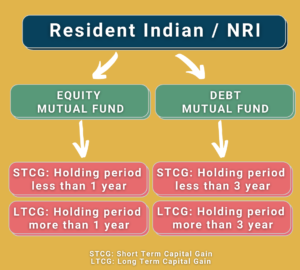
The holding period for Equity and Debt Funds will be different for taxation purposes. For equity funds, if the holding period is more than a year, then it is called the long term. If the holding period is less than a year, then such an equity mutual funds holding period is considered a short term. Whereas in

Whereas in the case of debt funds, a holding period of more than 3 years is considered as long-term. If the holding period of debt funds is less than 3 years, then it is considered short-term and taxed accordingly.

I will try to explain the same from the chart below.

The Capital Gain Mutual Fund Taxation FY 2021-22 / AY 2022-23 will be as per the below table.

Individuals

NRI

Stocks & equity oriented Mutual Funds

LTCG 10% above Rs 1 lakh gain 10% above Rs 1 lakh gain
STCG 15% 15%

Other than Stocks & equity oriented Mutual Funds

LTCG 20% with indexation Listed 20% (with indexation) & unlisted 10% (without indexation).
STCG Based on individual slabs Based on individual slabs


There is no change in Capital Gain Tax Rates from last year. Hence, the old rates will be applicable for FY 2021-22 also.

Note-Surcharge @ 15%, is applicable where the income of Individual/HUF unit holders exceeds Rs. 1 crore. Also, surcharge @10% to be levied in case of individual/ HUF unitholders where the income of such unitholders exceeds Rs.50 lakhs but does not exceed Rs.1 Cr. Further, Health and Education Cess @ 4% will continue to apply on the aggregate of tax and surcharge.

As you may be aware that during Budget 2018, LTCG was introduced again to Equity Funds. Hence, let me explain the same on how to calculate the LTCG on Equity Funds as below.

How to calculate LTCG on tax slabs & Equity Mutual Fund?

LTCG & STCG on Stocks & Mutual Funds (up to 31st January 2018)

Bought before 31st January 2018 10,000 stocks at INR 100
Sold within 365 days 10,000 stocks at INR 130
STCG Profit INR 130 15% STCG = INR 45,000
Sold after 365 days 10,000 stocks at INR 150
LTCG Higher of a) or b)

a)Actual cost (i.e INR 100)

b)Lower of the below

-The highest price of 31st Jan 2018 (Rs 120)

-Actual selling price (INR 150)

(Assumed that the highest price on 31st Jan 2018 is INR 120)

10% LTCG on INR 1,20,000

(10,000*Rs 120) - INR 1,00,000

INR 20,000

LTCG & STCG on Stocks &  Mutual Funds(from 1st February 2018)

Buy on 1st February 2018 10,000 stocks at INR 100
Sold within 365 days 10,000 stocks at INR 130
STCG Profit INR 3,00,000 5% STCG = INR 45,000
Sold after 365 days 10,000 stocks at INR 50
LTCG Profit INR 5,00,000 LTCG = Actual profit- INR 1,00,000

=INR 4,00,000

10% LTCG on INR 4,00,000 

=INR 40,000

Mutual Fund Taxation FY 2020-21 – Dividend Distribution Tax (DDT)

As I pointed above, effective from FY 2020-21, DDT was abolished in the hands of Mutual Fund Companies. Hence, any dividend you receive will be taxable for you as per your tax slab.

At the same time, if your such dividend income is more than Rs.5,000 in a Financial year, then there will be a TDS @ 10%.


Mutual Fund Taxation FY 2021-22: DDT Rates

Individual

NRI’s

Equity Oriented Schemes

As per the Tax slab As per the Tax Slab
Debt Oriented Schemes As per the Tax slab

As per the Tax slab


Security Transaction Tax (STT) for FY 2021-22

Security Transaction Charges or STT is the charges or tax when you buy or sell securities (excluding commodities and currency) through a recognized stock exchange. Therefore,

The definition of securities involves the below products.

  • Shares, scrips, stocks, bonds, debentures, debenture stock or other marketable securities of a like nature in or of any incorporated company or other body corporate;
  • Derivatives;
  • units or any other instrument issued by any collective investment scheme to the investors in such schemes;
  • Security receipt as defined in section 2(zg) of the Securitization and Reconstruction of Financial Assets and Enforcement of Security Interest Act, 2002;
  • Government securities of equity nature;
  • Rights or interest in securities;
  • Equity-oriented mutual funds

Therefore, whenever you buy and sell these securities through a recognized stock exchange, then you have to pay this STT.

Now let us understand the latest Security Transaction Tax (STT) applicable for FY 2021-22.

Security Transaction Tax (STT) Rates for FY-2021-22

Transaction Type Rates

Payable By

Purchase/ of equity shares (delivery Based) 0.1% Purchaser/ Seller
Purchase of units of equity-oriented mutual fund NIL Purchaser
Sale of units of equity-oriented Mutual fund 

(delivery Base)

0.001% Seller
Sale of equity shares, units of business trust, units of equity-oriented mutual fund 

(Non-Delivery Based)

0.025% Seller
Sale of an option in securities 0.05% Seller
Sale of an option in securities, where the option is exercised 0.125% Purchaser
Sale of future in securities 0.01% Seller
Sale of units of an equity-oriented fund to the mutual fund 0.001% Seller

Sale of unlisted equity shares & units of business trust under an initial offer

0.2%

Seller


TDS (Tax Deducted at Source) Rates for NRI Mutual Fund Investors 2021-22

Below are the applicable TDS rates for NRI Mutual Fund investors for FY 2021-22.

STCG Equity-The current TDS of 11.25% which was modified from 14th May 2020 to 31st March 2021 will I think continue for STCG-Equity Funds

STCG Other than Equity-The current TDS of 22.5% which was modified from 14th May 2020 to 31st March 2021 will I think continue for STCG-Other than equity.

LTCG Equity-The current TDS of 7.5% which was modified from 14th May 2020 to 31st March 2021 will I think continue for STCG-Equity Funds.

LTCG Other than Equity-The current TDS of 15% (for listed) and 7.5% (for unlisted) which was modified from 14th May 2020 to 31st March 2021 will I think continue for STCG-Other than equity.


Wealth Café Note: You pay taxes in a Mutual fund only when the gains are realized i.e. you redeem the funds and the proceeds of the same are credited to you. Now if there is a gain then the same is taxed as the taxation of mutual funds.

Hope now you got the clarity related to Mutual Fund Taxation FY 2021-22 / AY 2022-23.

Article headers 8

8 Easy Ways To Reduce Your Expenses

Spend less than you earn. That’s the mantra of personal finance success. Every week, month, and year that you spend less than you earn, the more you save and the better your financial situation will be.

A big part of that solution is cutting back on spending, and for many people, the thought of cutting back on spending seems unpleasant. Losing out on the things that bring you pleasure in life seems like a pretty steep price to pay for a little financial success.

The secret is to intentionally target spending on the things you don’t care about and rarely use while holding steady on the things you do care about.

Scale back on entertainment costs
1. Cut cable: These days, streaming services and free over-the-air television provide more content than any one person could ever watch. Take advantage of the variety by eliminating cable service.
2. Focus your interests on finishing rather than collecting: Rather than collecting physical or digital items in a media collection, focus on actually finishing those things or enjoying them to completion. For example, instead of buying yet more books that go unread, aim instead to build a long list of books you have read. Make doing the center of your hobby, not buying. After all, isn’t that what you really love?
3. Don’t treat shopping as entertainment: It’s fine to go out in the town to be entertained but keep to a simple rule: don’t go into a store unless it’s for the purpose of buying something you’ve already decided you need before going in. Don’t go to stores just to browse for entertainment, as they’re designed to convince you to buy things you don’t need or even really want, but just react on impulse. Find other places to be entertained.

Reduce your food costs
4. Use a meal plan and make a grocery list: Instead of going to the grocery store whenever you feel like you need food, get into a routine of making a meal plan once a week, then constructing a grocery list from that plan. The time invested in making that plan is more than saved by spending less time in the store and having a list to stick to saves a ton of money on grocery store impulse buys that just sit in your pantry.
5. Learn how to cook: Cooking for yourself doesn’t have to involve three-course meals or Gordon Ramsey-level skills. Start by identifying things you enjoy eating, then look for how to easily prepare it from scratch and with basic ingredients.
6. Buy in bulk: The big bulk packages might seem like they have a high price, but they’re usually quite a bit cheaper per use, meaning you get more value for your dollar. If you frequently buy something at the store, look at the big bulk versions and save up for them. You’ll save over the long run. It's basically what our parents or grandparents did - buy - store and use efficiently.
Cut your monthly bills
7. Go through your bills: Sit down with every regular bill you have and go through it line by line, making sure you understand everything you’re being charged for. If something isn’t clear, Google it. If it doesn’t seem like something you should be charged for or is a service you don’t want, call the bill issuer and get it removed from future bills.
8. Cut your subscriptions down to just the things you actually use: If you have a subscription or membership that you haven’t used in the last month, cancel it. Turn off any auto-renew you have with that service and allow it to expire. You can always renew it in the future if you decide you have a need for it again.

What you should do with the money saved from trimming your budget?
The key to making frugal living tips really work for you is to not simply spend that money on something else fun. Keep your “fun” spending at the same level and use the money you save when you cut down your monthly budget on something smarter.  Cut un-fun things like your energy bill for something financially useful that can build a bright future for you.

One great option is to open an account and use your savings to create your emergency fund or you could save it up for your next trip. Whatever excites to reduce your unnecessary spending. These are just some of our suggestions. Do let us know what you had like to read and learn more about and we shall share more content on that.


Disclaimer: - The articles are for information purposes only. Information presented is general information that does not take into account your individual circumstances, financial situation, or needs, nor does it present a personalized recommendation to you. You must consult a financial advisor who understands your specific circumstances and situation before taking an investment decision.

5

How can I downsize my portfolio? - Part 2

Hi fellow Investors,

As discussed 2 weeks back (in our article - How many Mutual Funds should you have, an investor should not have more than 5-6 Mutual Funds in his/her portfolio. These should be restricted to 1 Mutual Fund scheme to invest in each Mutual Fund category based on your risk profile, goals, and other requirements. As a follow up to this, we told you that we shall tell you how to downsize/limit your portfolio to 5-6 Mutual Fund schemes.

The simplest way to do this is to first identify which Mutual Fund categories you need to invest in (based on your risk and goals) and identify the right schemes in each category (it is advisable to invest in schemes that are right for you and not look for the best schemes). This will give you your desired holding of Mutual Fund Schemes.

Once you have done that, it is important to take stock of mutual funds that you already have.

Make a list of all your investments in Mutual Funds. To do this, you can download your Consolidated Account Statement from CAMS Online. It will give you transaction wise details of all your mutual fund transactions provided you have used your existing email ID when doing the transactions. Otherwise, if you have an agent or use a platform for investing in mutual funds - you can ask them as well for a holding report.

Compare the existing holding of schemes with the list of desired holding schemes determined above.

SELL unwanted schemes

The way to downsize is to redeem the extra/unwanted schemes and invest the proceeds from the redemption into the desired mutual fund schemes. You can exit from some scheme and buy another scheme in the same category (hence, setting off your loss or gain). You will have to trim your portfolio to reduce it to 5-6 mutual fund schemes.


How should you decide what to sell?


Maintain your Asset Allocation

We always tell you to do this and this time around as well, it's the same solution.  Your investments in various asset classes should be made to achieve the right allocation. Even with Mutual Funds, your split between Debt & Equity should be based on your asset allocation. You can read more on this here - https://financial.wealthcafe.in/how-should-you-invest-right-now/


% of your portfolio - Small value funds
 

 You can choose to sell the schemes where the invested amount is low and they are only increasing the number of schemes you hold.


Underperforming funds
 
Analyze the performance of your invested funds and understand which are the funds you should have in your portfolio. Exit from risky funds and poor performing funds. This can be understood by checking the returns of your scheme with the underlying benchmark returns.   
Currently, almost all your investments pre-march would be performing poorly, hence it is important for you to check funds past consistent performance and not just last 2 months' results. 

Minimalism is the key to a cleaner and better portfolio as the reduced number of funds makes it easier for you to analyze your invested funds regularly and also, take a more informed decision with respect to your investments. Also, the cost of managing these funds is reduced.

Where you have just started investing, keep in mind that every time you want to invest more money, you need not invest that in a new mutual fund scheme. You can instead increase your SIP amounts in your existing schemes.


Consult an Advisor
 
Where you already have 15 - 20 Mutual Funds and are finding it difficult to select which ones to keep and which ones to let go, it is advisable to get the assistance of a financial advisor who will go through your risk profile and advise you exactly which mutual funds to hold and for how long. Where you need an advisor/financial planner for your specific financial needs, you can reach out to us at  https://ria.wealthcafe.in/


3

How Many Mutual Funds Should You Have? (Part 1)

This week I am back with some discussion around Mutual Funds. In one of my workshops, during our mutual fund's discussion, I had this one trainee ask me - So what's your number?

I stared at her for a while not knowing what I am supposed to answer to that. Well, she rephrased her question, 'What is the number of mutual funds you are invested in?'  I said, '6 Mutual Funds'.She had the bewildered look on her face wondering how I had so fewer funds. I decided to show her my portfolio.


How many mutual funds schemes should you own? 

Owning around 5-7 mutual fund schemes across various categories is enough. These many mutual fund schemes will help you diversify, do your asset allocation, and also map these investments to your goals. You can invest your savings in the mutual fund schemes as per the below categories:

  1. Large Cap Mutual Fund (Equity)
  2. Large & Mid-Cap Mutual Fund (Equity) (your ELSS tax saving schemes are generally a Large & Mid Cap Mutual Fund)
  3. Mid Cap Mutual Fund (Equity)
  4. Small-Cap Mutual Fund (Equity)
  5. Thematic Mutual Fund (where you understand specific sectors and have a higher risk-taking appetite)  
  6. Short Term Debt Mutual Fund (For your short term goals)
  7. Long Term Debt Mutual Fund (For your long term goals)

In addition to the above, I have one Liquid Mutual Fund where I park my Emergency Funds. You can park your Emergency Fund in a Bank Fixed Deposit as an alternative.


Why only 5-7 Mutual Funds?

When you invest in Mutual Funds, you already diversify your risk across the stocks of the companies a particular mutual fund has invested in. Hence, with a large-cap mutual fund, your risk is diversified across more than 70 stocks that particular large-cap mutual fund has invested in. Investing in three different large-cap funds is not going to reduce your risk further, it will only make your investment portfolio messy.

'Mutual funds investing is to diversify your risk and not to di"worsify" the same'.

Further, reducing the number of schemes to a minimum of 5 also reduces the cost of managing the same and the time that goes in keeping a track of it and analyzing it regularly.


What do I do when I have more savings to Invest?

Increase your investment in the existing mutual fund's schemes you own. 
Investing in a new scheme every time you have extra savings will just lead you to own 15-20 mutual funds schemes with no plan in sight. Hence, it is important to do your due diligence and identify the mutual funds you want to invest in and stick to them. 

Yes, you must review your schemes regularly to see how are they performing in various market cycles but know that all schemes will not give you the best results always. There are some time periods where mid-cap and small-cap schemes will do better, other times when large-cap schemes will outperform and sometimes your debt investments will be the best performer for the year. Hence, it is important to be diversified across categories.


'Every time I check for the best mutual fund scheme and invest in the ones that are on the top' 

Studies have proven that selecting mutual funds based on high-performance track records is naive. The Star rating of various mutual fund keeps changing, a fund that is top rated in this one year, is hardly the top-rated fund in the subsequent years. Tim Courtney, a chief Investment advisor of US-based Burns Advisory did backtesting of past performance of the funds most highly rated, he found that they usually performed poorly after they have gotten 5 ratings. Hulbert financial digest, an investment newsletter found that if investors continually adjusted their mutual funds' holdings to hold only the highest-rated funds, a total stock market index would have beaten them by 45.8 % in the past decade (he studied funds from 1994 to 2004 in the USA). In fact over the years, it has gotten even more difficult to beat the markets and get alpha on your investments.  - extracts from Millionaire extracts - How to build wealth living overseas by Andrew Hallam

Hence, just investing in top-rated schemes is not going to give you the desired returns but only make your portfolio messy and not even get you the best returns.

Wealth cafe Takeaway - While you are investing in 5-7 different schemes across the options stated above, ensure that you invest across various AMCs as well. This will ensure that you are diversifying your risk and your entire money is not with only one AMC.

We shall follow up this article with a part 2 on how to downsize your portfolio.

Until then, keep reading, if you find this helpful, do share it with your friends.

Disclaimer: - The articles are for information purposes only. Information presented is general information that does not take into account your individual circumstances, financial situation, or needs, nor does it present a personalized recommendation to you. You must consult a financial advisor who understands your specific circumstances and situation before taking an investment decision.



[mc4wp_form id="2150"]

WCafe Financial Services Pvt Ltd (formerly known as Wealth Cafe Financial Services Pvt Ltd) is a AMFI registered ARN holder with ARN-78274.

WCafe Financial Services Pvt Ltd (formerly known as Wealth Cafe Financial Services Pvt Ltd) is a SEBI registered Authorised Person (sub broker) of Sharekhan Limited with NSE Regn AP2069583763 and BSE Regn AP01074801170742.

Copyright 2010-20 Wealth Café ©  All Rights Reserved