Article Headers (6)

Benefits available to government employees

Have you ever wondered why people in our country still crave to get into a government job despite the swanky workplaces as well as the high-end lifestyle offered by the private sector?

Well, the answer lies in the numerous benefits which a government employee is eligible to avail. A government employee not only enjoys high prestige in the society but also other benefits such as job security, fixed working hours, paid holidays, retirement benefits, and most important of all various tax benefits on his salary as compared to a non-government employee.

Let me take you through the prominent differences in the tax implications on the Salary Income of a private sector employee as compared to a Government Employee. It includes the treatment of various incentives, retirement benefits, or deductions received by employees of both sectors. We will discuss all these benefits one by one in detail. Let’s begin.

Firstly, we will start with the salary benefits available to Government employees :

SALARY BENEFITS

Dearness Allowance (DA):

Dearness Allowance (DA) is an allowance paid to government employees as a cost of living adjustment to cope with inflation. It has hiked from the existing 17% to 28% percent of the basic pay for central government employees and autonomous bodies from July 2021.

DA paid to employees is fully taxable with salary. The Income Tax Act mandates that tax liability for DA along with salary must be declared in the filed return.

DEDUCTION FROM SALARY

Entertainment Allowance:

The deduction on this allowance is allowed only to a Government Employee. That means the non-government employees shall not be eligible for deduction if an entertainment allowance is received by them.

The deduction from the gross salary of the government employees shall be a minimum of the below three limits :

  1. Actual entertainment allowance received
  2. 1/5th of salary exclusive of any allowance, benefit, or perquisite.
  3. Rs. 5000

Foreign allowances :

Foreign Allowances or perquisites paid or allowed only to Government Employees posted outside India are fully exempt from tax.

Allowances to members of UPSC :

The serving Chairman or Member of UPSC is given the following tax-free allowances and perquisites:

  1. Value of rent-free official residence
  2. Value of conveyance facilities including transport allowance
  3. Sumptuary allowance (This allowance is provided to the members of honorary posts for daily expenditures.)
  4. Leave travel concession

Further, if allowances are provided to Retired Chairman/Members of UPSC then the tax exemption shall be up to Rs.14,000 per month for offering services on a contract basis.

Allowances by UNO :

Allowances paid by the UNO to its employees are also exempt.

Allowances to Judges :

Allowances paid to Judges of the High Court or Supreme Court are exempt from tax. Eg - The compensatory Allowance is exempt.

Allowances to SAARC member states:

Salary, as well as allowances received by the professors from SAARC member states, are also exempt.

RETIREMENT BENEFITS

Gratuity

It is a part of salary which you receive as an appreciation from your employer for the services offered to the company. You are eligible to receive gratuity only if you have rendered services for 5 continuous years or more to the organisation.

The amount of Gratuity received is fully exempt from tax

Pension 

With time, only you retire but your tax does not!! Tax will always be levied till the time a person earns Income irrespective of age. A pension is a payment made by the employer at the time of retirement as a reward for a past service. There can be two types of pension. The brief description is as under:

  1. Uncommuted Pension: If the Pension is received periodically i.e. on monthly basis then it is fully taxable in the hands of both government as well as non-government employees.
  2. Commuted Pension: It refers to a lump-sum pension payment received in place of periodic pension. The taxability has been defined under the income tax act:
    The amount received is fully exempt from tax

Leave Encashment

Every organisation grants certain leaves to its employees and these leaves, if unused, can either be carried forward or are lapsed at the end of the year. You can encash the unused accumulated leaves, depending upon the policy of the company either during the time of employment or at the time of retirement.

Tax Treatment of Leaves encashment :

Received during employment: Where the leaves are encashed during the period of employment, it is fully taxable for the government as well as non-government employees.

Received at the time of retirement: The amount shall be fully exempt for government employees.

The numerous tax benefits enjoyed by the government employee could be one of the reasons which give them an edge over the non-government employee. However, the job content and job satisfaction should be equally evaluated before deciding upon the organisation you wish to work for.

    Get your weekly dose of Money Masala from us.


    LTA related questions

    As the name itself suggests, it is an exemption for allowance/assistance received by the employee from his employer for travelling on leave. Though it sounds simple, many factors need to be kept in mind before planning the trip to claim an LTA exemption. Income tax provision has laid down rules to claim exemption of LTA.

    Frequently Asked Question

    Q1. How much can I claim tax exemption in Leave Travel Allowance or LTA?

    A. The amount of LTA exemption depends on the LTA component in your compensation package or CTC. You can furnish proof of travel within the block period and claim up to the amount prescribed in your CTC.

    Q2. What is the latest block period to claim LTA exemption?

    A. The latest block period of four years is from 1 January 2018 until 31 December 2021.

    Q3. How many trips can I make in one year to claim the exemption?

    A.You can claim LTA exemption only for one trip in one calendar year.

    Q4. Can we carry forward unclaimed LTA?

    A. Yes. An employee can carry forward one trip to the next block year. This means in 4 block years, he can claim one trip and one trip he can carry forward to the next block year. During the next block year, instead of 2 trips, they can undertake 3 trips and claim LTA benefits. However, this has to be communicated to an employer so that they can make provisions in their books.

    Q5. Can I claim an LTA benefit for the travel costs of my family?

    A. You can claim LTA benefit for the travel costs of yourself, your family consisting of your spouse, children, dependent parents, brothers, and sisters of the employee.

    Q6. How many kids are eligible to travel to get an LTA benefit?

    A. 2 kids are eligible to travel to get LTA benefits. In case there is a triplet kid, due to twins, such twins would be considered as one kid for this purpose.

    Q7. If an employee does one trip but visits multiple places, is he eligible to claim LTA?

    A. The income tax rule indicates that LTA can be claimed for the shortest distance between the starting point and farthest point. In between, if there are more places to visit, you can do that.

    Q8. Can I claim LTA by travelling abroad?

    A. LTA can be claimed for travel taken within India. You cannot claim foreign trip expenses for LTA benefits.

    Q9. What mode of travel is eligible for claiming LTA?

    A. In the case of air travel, economy class is eligible.

    In the case of train travel, up to the first AC is eligible.

    In the case of road transport, a rented vehicle/bus of any kind is eligible to claim LTA benefit.

    Q10. If an employee travels at the end of the year and returns from a trip which falls beyond 31st Dec, how does it work?

    A. In such cases, employees need to consider the starting date as a basis and claim for that calendar year.

    Q11. If an employee travels at the end of the block year and returns from a trip after 31st Dec which falls in a different block year, how does it work?

    A. Block year for the current LTA period is from 1-Jan-2018 to 31-Dec-2021. Assume that you want to claim your 2nd LTA amount and plan your trip from say 25th Dec 2021 to 5th Jan 2022. Since 1-Jan-2022 onwards is a different block period, you can still claim this trip under the 2018-2021 block period.

    Q 12. I missed submitting my first LTA claim in a block year. Can I submit 2 LTA claims in a block year later?

    A. As per IT Rules, an employee needs to claim 2 trips LTA in a block of 4 years. However, if you have missed a claim in the first 2 years, you need to indicate this to your employer, so that they can carry it forward to the subsequent 2 years of the same block year. You can later submit the bill of the first 2 years (bill date should indicate that) and claim it. However, you cannot claim 2 trips expenses in the subsequent 2 years of a block period (with bill dates of the 3rd and 4th year of a block period).

    Q13. Do I need to submit a single bill for our trip or multiple bills would be accepted for LTA?

    A. LTA benefit is given for a trip. This means, one family is travelling. Ideally, there would be one bill. However, there are cases where multiple bills would be received for a single trip (for airfare bills, where a family member agreed to join later and the booking was made later, but the travel date is the same for the remaining members). In such cases, these are agreed upon by employers. It would be better to check with your employer in such circumstances before proceeding further.

    Q 14. How can we claim LTA even without travelling?

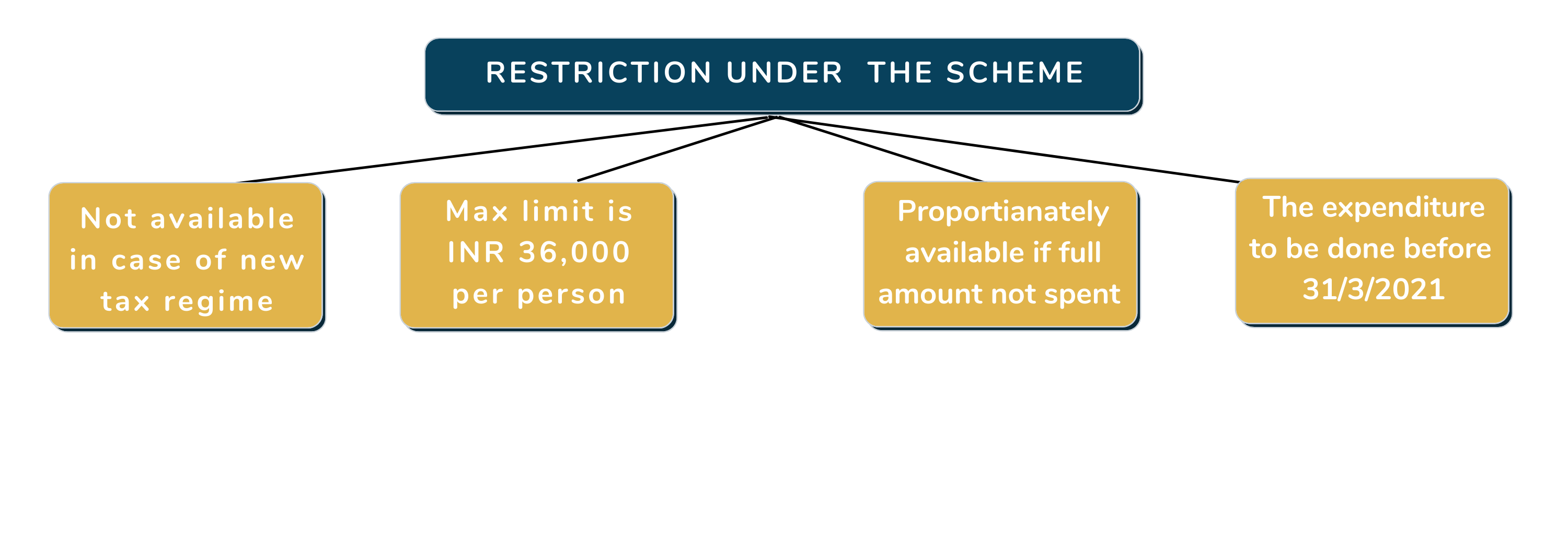
    A. Due to the Covid-19 pandemic, many people are not in a position to travel with family, and, therefore, LTA can be claimed even without travelling. For claiming the LTA exemption,

    Conditions to be fulfilled for claiming LTA exemption under the scheme

    • 3 times the amount of LTA earned to be spent
    • Goods and Services to be purchased from registered GST dealer
    • Payments to be done only through digital modes
    • All Invoices of the purchase has to submit to the employer

      Get your weekly dose of Money Masala from us.


      Pay taxes on Mutual funds - Unrealized vs Realized Gains

      Whether you are putting money away for a rainy day, retirement or anything in between, you are likely to be taxed. Investors do not think about tax expenses when making investment decisions, even though it is one of the crucial aspects of investing.

      Do you check pre tax and post tax returns before you invest your money ? Do you know how fixed deposits and debt mutual funds investments can impact your tax differently? Let's discuss how the difference in taxability of Debt Mutual Funds versus Fixed deposits becomes one of the factors you must consider when you make an investment decision.

      Difference between realized and unrealized gains in a mutual fund.

      Realized gains are the returns you make after actually redeeming(selling) your mutual funds. Unrealized or notional gains or losses are the ones which you see based on everyday market movements but do not book it. Unrealized gains only exist on paper and results from an investment which has yet not been sold.

      Taxation of gains

      Where there are unrealized gains - no tax is payable as you have not booked any profits. Only in case of realized gains, do you have to pay taxes in case of a mutual fund. So once you sell your Mutual funds and the funds are credited to your bank account, you have to compute your tax liability and pay capital gains taxes on the same.

      To know more about the taxability of mutual funds, check here - Taxation of Mutual Funds for FY 2021-22 (AY 2022-23).

      It is not that every other asset class, you pay taxes on actual basis, in fact in a fixed deposit, you pay taxes on interest accrued to you, even where the same is not credited to your bank account each year. This way Fixed deposit income is taxed differently as compared to debt mutual funds (because the gains are taxed only on realisation) 

      Let's take an example to help you explain how tax eats into your profits.

      For the purpose of this example, we shall consider that the returns from fixed deposits and debt mutual funds are the same. They will be taxed as per the relevant tax laws and how that would impact the net returns you can make from the investment. 

      Ria is the investor and she falls under the 20% tax bracket. She has made an investment of INR 10 lakhs in FD and debt mutual funds for 3 years, giving a return of 8% per annum.

      https://financial.wealthcafe.in/blog/2021/06/cost-of-inflation-index-fy-2021-22-ay-2022-23-for-capital-gain/

      In case of FD, interest will accrue to her every year, and she has to pay taxes on the same as per her slab rate every year, even where the same is not credited to her bank account. Infact, the interest after the taxes are paid will be reinvested.

      FD = INR 10,00,000

      Interest - INR 80,000

      Tax - 16,000

      Reinvestment of Interest in year 1 = 64,000

      (same reinvestment would happen in year 2 and year 3 - after tax)

      After 3 years: 

      Total tax paid - INR 48,000

      Net cash in hand = INR 12,04,288


      In case of debt mutual funds, she will have to pay taxes only on realization of profits. She decided to sell the same after 3 years and will have to pay long term capital gains on the same at 20% (with indexation benefits). So effectively, the tax she has to pay is less than what she had to pay for her fixed deposits. Also, the reinvestments would be of the entire earnings and not just post tax earnings in case of fixed deposits.

      Amount invested - INR 10,00,000

      Gains = INR 80,000

      Tax - Nil (No sale)

      Reinvestment of gains = INR 80,000*

      After 3 years

      Total Tax Paid - INR 32,565 (indexation benefit)

      Net cash in hand - INR 12,27,147

      *the returns are not assured in a debt mutual fund. We have considered this for explanation purposes here.


      From the above example, you can understand that the net cash in hand that ria would earn is 102% of the final amount from fixed deposits. Infact, if she was in the 30% tax bracket, she would make 104% more in the case of debt mutual funds than fixed deposits.

      This is how realized and unrealized gains impact your tax in various asset classes and also become one of the factors that one must consider when they are investing their money.

      You can also check our blog on -Why you should avoid investing all your money in a FIXED DEPOSIT?


      Wealth Café advice: 

      Please note that tax is not the only but one of the criteria that one must look at when investing their money in debt funds and Fixed deposits. Fixed deposits are safer and provide assured returns as compared to debt mutual funds. Debt mutual funds have many types and each has a different risk parameter. You can look at the liquid funds, or ultra short duration debt funds for lower risk and comparable returns to Fixed deposits. Please note that returns in all debt mutual funds are volatile and invest in them only after considering all the possible risks.

      Check our course- NM 104: Basics of Mutual Funds - to learn more about Mutual Funds in detail.


      Disclaimer: - The articles are for information purposes only. Information presented is general information that does not take into account your individual circumstances, financial situation, or needs, nor does it present a personalized recommendation to you. You must consult a financial advisor who understands your specific circumstances and situation before taking an investment decision.

      All about Tax Deducted at Source (TDS)

      An individual can earn income from various sources. Income tax is a direct tax that they need to pay, depending on which tax bracket their total income falls in. According to the Indian tax system, Tax Deducted at Source (TDS) is an essential term in taxation that has a significant bearing on the taxpayers. It is a means of collecting income tax by the government and offers convenience to the deductee as it is deducted automatically.  

      What is TDS?

      The TDS full form is Tax Deducted at Source (TDS). The system was introduced by the Income Tax Department of India. In this, people who are responsible for making payments like salary, commission, professional fees, interest, or rent are liable to deduct a specified percent of tax before making the full payment. In simple words, the system allows tax deduction right at the source.

      To understand the TDS better, consider the following example.

      Assume that the nature of payment is professional fees on which the rate specified for TDS is 10 percent (To know more - click here). An ABC organization pays INR 50,000 as professional fees to Ms. XYZ. In this case, the ABC organization is liable to deduct INR 5000 and make a net payment of INR 45,000 to Ms. XYZ. The INR 5000 deducted by the company will be deposited directly to the credit of the government.

      What are the rules for Tax Deducted at Source?

      There are rules concerning not just income tax return filing but also concerning TDS. If an individual or organization meets these rules adequately, they will be able to avoid penalties, fees, or interest. The main rules related to TDS are:

      1. One of the first essential rules is that Tax Deducted at Source needs to be deducted at the time when the payment either gets due or when the actual amount is made, whichever is earlier
      2. Delay in deduction of TDS will attract interest @ 1% per month until the tax is deducted [2]
      3. Every person, whether an employer or otherwise, needs to credit the tax deducted to the government’s account by the 7th day of the following month
      4. In case of late or non-payment of TDS, an interest @ 1.5% per month will be levied until the tax has not been deposited

      How to apply for a TDS refund?

      A major misconception that many individuals have is that an excess TDS refund is different from that of an income tax refund. However, according to the Indian Tax System, there is only one type of return that you claim at the time of filing your annual income tax return.

      For filing your TDS refund, it is compulsory to quote bank account details such as account number and IFSC code. Failing to do so will not generate a valid file for you. In case if someone deducts more tax than he should have deducted, then there will be an income tax refund, which can be claimed upon the filing of the annual income tax return (ITR).

      For example, you own a transport agency, and yours is a proprietorship firm. You presented an invoice for Rs. 20,000/- and the person paying freight paid you a net amount of Rs. 19,600/- (after deducting tax of Rs. 1,000/- @ 2% under section 194C). In this case, the tax will be deducted at 2% instead of 1% and hence deducted excess TDS by Rs. 200/-. This excess TDS of Rs. 200 will arise as a refund in the income tax return, according to the Income Tax Act, 1961.

      Ensure Proper TDS Deduction

      Tax Deducted at Source is an essential legal obligation for everyone earning an income. It ensures that there is no tax evasion as it is levied at the source itself. Every employer, as well as individuals, should give proper attention to meeting with this deduction. It is because non-filing or late filing of Tax Deducted at Source will attract penalties and fines.

      Along with being aware of how to file ITR, Individuals at their end should share proper documentation with the employer as well as check online for any updates in TDS provisions. It will ensure that your employer makes the right Tax Deducted at Source declaration from your salary income.

      Wealthcafe Advice

      There is only a single refund i.e. Income Tax Refund which is an excess of tax already paid by way of TDS, TCS, advance tax or self-assessment tax less tax on your total income. You can get a refund of additional tax only after filing your income tax return for that particular year.

      In other words, there is no other method to get a refund other than by filing an Income Tax Return.

      Things you must know about the new income tax portal for easy filing of the return for FY 21-22.

      Income Tax Return ITR E-Filing Direct Link

      1. There is a direct link for the e-filing of Income Tax returns. It is the official portal of Income Tax India.
      2. You need to visit – www.incometaxindiaefiling.gov.in to file your income tax return.
      3. Taxpayers can file ITR, verify income tax returns, link Aadhaar with PAN, know Aadhaar-PAN link status, e-pay tax, track status of e-filed Income Tax Return status, know tax deductors across India etc.

      Here are key things to know about filing ITR:


      What are the new options for filing ITR on the new portal?

      The I-T department has encouraged taxpayers to update their profiles to avail accurate pre-filled ITRs and enhanced user experience.

      On the top of the new website, one can find the tab to access individual-based help content. Clicking on the application tab takes an individual to view guidance on how to file ITRs and applicable forms for the same. Deductions, refund status, tax slab and other related information are also present there.

      The department has claimed that the new IT return e-filing portal and the new mobile app will be easy to use for taxpayers.


      What are the additional features of the new portal in terms of ITR filing?

      The new portal has a drop-down menu for taxpayers for checking instructions on ITR filing, refund status, and tax slabs. The new site also has detailed user manuals, FAQs and videos to help taxpayers understand various services available on the portal.


      What are the forms of return prescribed under the income tax law?

      The Income Tax Department has notified 7 forms for filing ITR this year. These forms include Sahaj (ITR-1), Form ITR-2, Form ITR-3, Form Sugam (ITR-4), Form ITR-5, Form ITR-6 and Form ITR-7.


      What are the different modes of filing the return of income?

      The return form can be filed with the Income-tax Department in any of the following ways, -

      (i) by furnishing the return in a paper form;

      (ii) by furnishing the return electronically under digital signature;

      (iii) by transmitting the data in the return electronically under electronic verification code;

      (iv) by transmitting the data in the return electronically and thereafter submitting the verification of the return in Return Form ITR-V;


      How to file the return of income electronically?

      The Income-tax Department has established an independent portal for e-filing of return of income. The taxpayers can log on to https://www.incometax.gov.in for e-filing the return of income.


      What are the benefits of filing my return of income?

      Filing of return earns an individual the dignity of consciously contributing to the development of the nation. Apart from this, income tax returns validate an individual's credit-worthiness before financial institutions and make it possible for him/her to access many financial benefits such as bank credits, etc.

      Article headers2

      Are ULIPs Taxable Like Mutual Funds? Budget 2021 Update

      Hi there

      Until last year many people invested in ULIPs (Unit Linked Insurance Plans) to make the most of the tax benefit that one would get from it. They gave you insurance and investment benefits along with no taxation. However, this loophole is now covered in Budget 2021, which has made ULIPs taxable.

      However, to bring equality between ULIPs and Mutual Funds, during the Budget 2021, the Finance Minister proposed the changes in the taxation of ULIPs. Let us take a look at the new taxation rules of ULIPs.


      Taxation of ULIP

      There are three aspects of taxation that we have to consider while investing in ULIPs.

      1. At the time of Investing
      2. When you surrender or ULIPs mature
      3. At the time of death


      1. Tax deduction at the time of Investing

      This is still applicable up to INR 1,50,000 per annum towards your premium for ULIPs under section 80C of the Income-tax Act,1961.  You can claim a deduction for the investment made for himself, spouse, or children (dependent or independent) and HUF can claim a deduction for the investment made for any member of HUF.

      The deduction under section 80C is restricted to 10% of the sum assured. It means suppose the sum assured is Rs.10 Lakh, then the premium that you pay under the ULIP should be up to the maximum of Rs.1,00,000. If the premium is beyond 10%, then it is not eligible for deduction under Sec.80C. Only INR 1,00,000 will be eligible for deduction.

      One more important point to understand here is that, If you stop the premium payment before the expiry of five years or you terminate your participation by notice to that effect, the aggregate of deductions allowed to you in the earlier years shall be considered as your income and will be chargeable to tax in the year in which such termination or cessation occurs as per your income tax slab.

      Do remember that you can pay the premium as much as possible. However, the benefit in Sec.80C is limited to Rs.1,50,000 a year and the premium must be 10% of the sum assured.


      2. Taxation at the time of Maturity 

      This is where the budget has made a change

      Before the Budget 2021

      Any sum received under ULIP including the bonus on such policy was not taxable (exempt) under section Section 10(10D) of the Act. However, if the premium payable for any of the years during the term of the policy exceeds 10% of the actual sum assured, then no exemption is allowed.

      After the Budget 2021

      Effective from 1st February 2021, no exemption is allowed under Sec.10(10D), if the amount of premium payable for any of the previous year during the term of the policy exceeds Rs. 2,50,000.

      However, if the total premium payable during any financial year is less than Rs.2,50,000 (including all the multiple policies), then you still enjoy the tax-free maturity benefits under Sec.10(10D).

      The budget 2021 states that any amount allocated by way of bonus on such policy, then, any profits or gains arising from receipt of such amount by such person shall be chargeable to tax under the head “Capital gains” in the previous year in which such amount was received.

      The manner in which the income will be taxed is not yet notified.

      Under ULIPs you have the option to select if you are investing under the debt funds or the equity funds, now given the taxation of debt and equity is different there was a question on how your gains from ULIPS be taxed. In the Finance Budget 2021, it is proposed to cover ULIPs to which exemption under Section 10(10D) does not apply on account of the applicability of the fourth and fifth proviso thereof. Thus, the high premium ULIPs shall be considered as Equity Oriented Fund even if a portion of the fund is invested in the debt-based scheme.

      Thus, the long-term capital gains, in excess of Rs. 1,00,000, shall be taxable at the rate of 10% without indexation under Section 112A. Whereas the entire amount of short-term capital gains shall be taxable at the rate of 15% under Section 111A. The ULIPs shall be considered as a long-term capital asset if they are held for more than 12 months and short-term capital assets if held for 12 months or less.

      One more important aspect to consider here is the taxation about the switching. As of now, switching from one fund to the other provided the maturity/redemption of units of ULIPs are exempt under Section 10(10D). However, as per the new proposal, if the premium is more than Rs.2,50,000, then they are not eligible to claim the exemption under Sec.10(10D). In such a situation, we have to wait for clarity about the taxation on switching of the policies whose premium is more than Rs.2,50,000.


      3. Taxation of ULIPs at death

      In the event of the death of the policy-holder, the exemption shall not be denied under Section 10(10D) from either of the policy, that is, excess premium policy (more than 10% of sum assured) or higher premium policy (more than Rs. 2,50,000).

      Hence, irrespective of the premium amount, the death benefit is always tax-free in the hands of the nominee.

      If you are considering investing in ULIPs now, ensure that you account for taxation of the same going forward.


      To learn more - you can check our course - NM 102: Build a Safety Net. Use code SAVE20 for 20% off.


      Disclaimer: - The articles are for information purposes only. Information presented is general information that does not take into account your individual circumstances, financial situation, or needs, nor does it present a personalized recommendation to you. You must consult a financial advisor who understands your specific circumstances and situation before taking an investment decision.


        Get your weekly dose of Money Masala from us.


        Income tax Feature Image

        Income-Tax Relief For Home Buyers

        Hello fellow investors
         
        As a part of various relief measures taken by the Government in response to the economic slowdown post-COVID-19, the Finance Minister (FM) has announced a very attractive income tax relief for home buyers (new residential properties of value up to Rs 2 crore). Here is what you need to know.  
         
        Income Tax relief for home buyers 

        In case the declared purchase consideration of the land/building is less than the stamp value (circle rate) by up to 20%, there will be no additional tax outgo for both the seller and the purchaser for the period 12th November 2020 to 30th June 2021. Earlier, the acceptable difference was 5% which was to be enhanced to 10% with effect from 01 st April 2021.

        This move will also help developers in selling off their unsold inventory at up to 20% below the circle rate and the buyers in getting cheaper homes without any additional tax burden on either party. Let’s look at the relevant provisions of the Income Tax Act to understand the applicable tax relief.

        Section 43CA of the Income-tax Act - for the seller

        This section provided for deeming of the stamp duty value (circle rate) as sale consideration for the transfer of real estate inventory in the case the circle rate exceeded the declared consideration. The circle rate is the minimum rate per unit area fixed by the state governments for the sale of land or property and is
        aimed at reducing stamp duty evasion by declaring lower sale values in the sale-purchase deeds.

        Thus, even if the real estate was sold at a price below the circle rate, the circle rate was considered as the sale value for the calculation of the business profits of the seller. For example, if a house is sold by a developer for Rs 80 lakh but its value as per the circle rate is Rs 96 lakh, the developer is supposed to take Rs 96 lakh as the sale value for
        calculating his profit.

        Through Finance Act 2018, a difference of 5% between the two rates was declared to be acceptable. This was increased to 10% through Finance Act 2020. Now, the FM has raised this acceptable difference to 20%. Thus, in the above case, the difference is exactly 20% as seen below and the developer can consider Rs 80 lakh for calculating his profits from the sale. 

        Section 56(2)(x) of the Income-tax Act for the buyer

        This section is applicable to the buyer and provides for stamp duty value to be deemed as purchase consideration even if the purchase was made at a lower price. As per the above example, the buyer is deemed to have received Rs 16 lakh (the difference between the stamp value and the sale consideration) and was supposed to declare this amount as ‘Income from other sources and pay tax on the same. Now, he will not have to pay any tax if the difference is up to 20% as is the case in the above example.


        In summary, this announcement by the FM comes as a major relief to real estate developers who were struggling to offload their inventory due to lower demand in the market. The benefit is applicable, however, only for the primary sale of residential properties and not for commercial and secondary sales.


        Know your Mutual Funds (2)

        List of banks for your PPF investments

        What is PPF?

        Public provident fund is a popular investment scheme among investors courtesy of its multiple investor-friendly features and associated benefits. It is a long-term investment scheme popular among individuals who want to earn high but stable returns. Proper safekeeping of the principal amount is the prime target of individuals opening a PPF account.

        Why open a PPF account?

        public provident fund scheme is ideal for individuals with a low-risk appetite and is okay to invest their money in the long term. Since this plan is mandated by the government, it is backed up with guaranteed returns to protect the financial needs of the masses in India.

        You can read more about PPF and things to note in PPF in our article.

        Eligibility Criteria

        Indian citizens residing in the country are eligible to open a PPF account in his/her name. Minors are also allowed to have a Public provident fund account in their name, provided it is operated by their parent.

        Non-residential Indians are not permitted to open a new PPF account. However, any existing account in their name remains active till the completion of tenure. These accounts cannot be extended for 5 years – a benefit available to Indian residents.

        Interest in a PPF Account

        The interest payable on the public provident fund scheme is determined by the Central Government of India. It aims to provide higher interest than regular accounts maintained by various commercial banks in the country.

        Interest rates currently payable on such accounts stand at 7.9% and are subject to quarterly updates at the discretion of the government.

        How to Open a PPF Account

        Both offline and online procedures are available for an individual provided he/she meets the requisite parameters mentioned in the eligibility criteria. Activating PPF online can be done by visiting the portal of a chosen bank or post office.

        The following documents have to be produced at the time of activation of a public provident fund account –

        1. KYC documents verifying the identity of an individual, such as Aadhaar, Voter ID, Driver’s License, etc.
        2. PAN card.
        • Residential address proof.
        1. Form for nominee declaration.
        2. Passport-sized photograph.

        Tax Benefits

        Income tax exemptions are applicable on the principal amount invested in a PPF as an account. The entire value of an investment can be claimed for tax waiver under section 80C of the Income Tax Act of 1961. However, it should be kept in mind that the total principal that can be invested in one financial year cannot exceed Rs. 1.5 Lakh.

        The total interest accrued on PPF investment is also exempt from any tax calculations.

        Therefore, the entire amount redeemed from a PPF account upon completion of maturity is not subject to taxation. This policy makes the public provident fund scheme attractive to many investors in India.

        List of Banks Offering PPF Accounts

        • Allahabad Bank
        • Corporation Bank
        • Bank of Baroda
        • HDFC Bank
        • ICICI Bank
        • Axis Bank
        • Kotak Mahindra Bank
        • State Bank of India and its subsidiaries which include the following –
          • State Bank of Travancore
          • State Bank of Bikaner and Jaipur
          • State Bank of Hyderabad
          • State Bank of Patiala
          • State Bank of Mysore
        • Canara Bank
        • Bank of India
        • Union Bank of India
        • Oriental Bank of Commerce
        • Central Bank of India
        • Bank of Maharashtra
        • Dena Bank
        • Syndicate Bank
        • United Bank of India
        • Indian Overseas Bank
        • Vijaya Bank
        • IDBI Bank
        • Andhra Bank
        • Punjab National Bank
        • UCO Bank
        • Punjab and Sind Bank

        These are some of the common PPF Account opening banks. There are other banks too and if you hold a savings account with another bank that is not on the list, you can find out whether the bank is a PPF Account opening bank or not.


        fy

        Income-tax Rates FY 2019-20 (AY 2020-21)

        Before knowing the tax rates, it is very important to understand the terms Financial year (FY) and Assessment Year (AY).

        The below-mentioned tax rates/ slab is on the income earned for the period 1 April 2019 to 31 March 2020. FY stands for the 'financial year' which is from 1 April 2019 to 31 March 2020. AY stands for Assessment year which 2020-21.

        For individuals, the due date to file the income tax return for the income earned from 1 April 2019 to 31 March 2020 is 31 July 2020. However, this year due to COVID 19 economic relaxations, the due date is pushed to 30 November 2020

        Income tax Rates 

        Tax Rates for Individuals (below 60)

        Income Tax Slab

        (in Rupees)

        Tax Rate for Individual Below the Age Of 60 Years
        0 to 2,50,000* Nil
        2,50,001 to 5,00,000 5% of total income exceeding 2,50,000
        5,00,001 to 10,00,000 Tax Amount of 12,500 for the income up to 5,00,000

        + 20% of total income exceeding 5,00,000

        Above 10,00,000 Tax Amount of 1,12,500 for the income up to 10,00,000

        + 30% of total income exceeding 10,00,000

        Tax Rates for Senior Tax Payers between the age of 60 years to 80 years old

        Income Tax Slab Senior Citizens (between 60 years – 80 years)
        Up to 3,00,000 Nil
         3,00,001 to 5,00,000 5% of income exceeding 3,00,000
         5,00,001 to 10,00,000 Tax Amount of 10,000 for the income up to 5,00,000

        + 20% of total income exceeding 5,00,000

        Above 10,00,000 Tax Amount of 1,10,000for the income up to 10,00,000

        + 30% of total income exceeding 10,00,000

        Tax Rates for Super Senior Taxpayers above the age of 80 years

        Income Tax Slab Very Senior Citizens of and above 80 years of age
        Up to 5,00,000 Nil
         5,00,001 to 10,00,000 20% of income exceeding 5,00,000
        Above 10,00,000 30% of income exceeding 10,00,000

        Important Notes:

        • The income tax rates are applied to the annual income calculated. Thereafter Surcharge and Cess are added to the tax payable.
          • A surcharge is also applicable slab wise. The surcharge is calculated on the Tax amount. If the income is:
        1. Above Rs.50,00,000 and up to Rs.1 crore – then 10% surcharge is applicable
        2. Above Rs.1 crore and up to Rs.2 crore – then 15% surcharge is applicable.

        In the Union Budget 2019-20, a new surcharge on income tax for super-rich individuals has been levied. So, individuals earning:

        1. Between Rs.2 crore and up to Rs.5 crore –then 25% surcharge is applicable;
        2. For Above Rs.5 crore – then a 37% surcharge is applicable.
        • An additional Cess of 4% for Health & Education is applicable to the income tax plus surcharge.
        • Section 87A allows tax rebates to Individuals whose total annual income falls below Rs.5,00,000. The rebate is limited to Rs.12,500 or the actual tax amount whichever is lower.

        Income Tax Slabs for HUF

        The Income Tax Slab for Hindu Undivided Family (HUF) is the same as the Tax slabs for Individuals under the age of 60 years in the year 2019 – 2020.

        Income Tax Slabs for Partnership Firms

        There is a flat tax rate for Partnership Firms and LLPs (Limited Liability Partnerships) and they are to pay Income Tax at the rate of 30%.

        Added to the tax amount is:

        1. Surcharge on tax: 12% in cases where the annual income is more than Rs.1 Crore
        2. Cess for Health & Education: is at the rate of 4% - calculated on tax amount plus surcharge

        Income Tax Slabs for Local Authorities

        Local Authorities to are to be taxed at a flat tax rate of 30%.

        Added to the tax amount is:

        1. Surcharge on tax: 12% in cases where the annual income is more than Rs.1 Crore
        2. Cess for Health & Education: is at the rate of 4% - calculated on tax amount plus a surcharge.

        Income Tax Slabs for Domestic Companies

        Domestic Companies have received a boost. With the turnover raised from 250 crores to 400 crores for a tax rate of 25%. The turnover slab wise tax calculation is:

        Turnover Particulars Tax Rates
        Gross turnover up to 400 Cr. in the previous year 25% (subject to conditions as set out in the Taxation Laws Amendment Ordinance, 2019)
        Gross turnover exceeding 400 Cr. in the previous year 30% (subject to conditions as set out in the Taxation Laws Amendment Ordinance, 2019)

        Added to the tax amount is:

        Surcharge on tax:

        1. 7% in cases where the annual income is between Rs.1 Crore to Rs.10 Crore
        2.  12% in cases where the annual income is more than Rs.10 Crore

        Cess for Health & Education: is at the rate of 4% - calculated on tax amount plus surcharge

        Income Tax Slabs for Foreign Companies

        Foreign Companies are taxed at a rate of 40%.

        Added to the tax amount is:

        1. Surcharge on tax: 2% in cases where the annual income is between Rs.1 Crore to Rs.10 Crore
        2. 5% in cases where the annual income is more than Rs.10 Crore
        3. Cess for Health & Education: is at the rate of 4% - calculated on tax amount plus surcharge

        Income Tax Slabs for Co-operative Societies

        Income Tax Slab Income Tax Slab Rate
        Up to Rs.10,000 10% of Income
        Rs.10,000 to Rs.20,000 20% of Income exceeding Rs.10,000
        Over Rs.20,000 30% of Income exceeding Rs.20,000

        Added to the tax amount is:

        1. Surcharge on tax: 12% in cases where the annual income is more than Rs.1 Crore
        2. Cess for Health & Education: is at the rate of 4% - calculated on tax amount plus surcharge
        3. So, to calculate your tax liability for the year, you should keep a track of your annual income to know what Income slab you will be falling under for the year 2019 – 2020.

        Income tax rates for a non-resident - Individuals

        Income Slabs Income-tax rates
        Up to 2,50,000 Nil
        From 2,50,000 to 5,00,000 5%
        From 5,00,000 to 10,00,000 20%
        Above 10,00,000 30%
        Ø  Surcharge: 10% of tax where total income increases Rs. 50 lakhs

        15% of tax where total income increases Rs. 1 crore

        Ø  Health & Education cess: 3% of tax plus surcharge

        Capital Gains Taxation on Mutual Funds/Direct Equity

        For Equity Oriented Schemes/Direct Equity

        • Long Term Capital Gains (units held for more than 12 months)
        • Short Term Capital Gains (units held for 12 months or less)

        For non-equity oriented schemes

        • Long Term Capital Gains (units held for more than 36 months)
        • Short Term Capital Gains (units held for 36 months or less)
          Individual/ HUF Domestic Company NRI

        Equity Oriented Schemes/Direct Equity

        Long term capital gains 10%* 10%* 10%*
        Short term capital gains 15% 15% 15%

        Other Than Equity Oriented Schemes

        Long term capital gains 20% (after indexation) 20% (after indexation) Listed - 20% (after indexation)

        Unlisted - 10% (without indexation)

        Short term capital gains 30%^ 30%^^/25%^^^ 30%^


        Tax Deducted at Source (Applicable to NRI Investors)

         
          Short term capital gains$ Long term capital gains$
        Equity oriented schemes 15% 10%*
        Other than equity-oriented schemes 30% 10% (for unlisted without indexation) and 20% (for listed)

        * Income-tax at the rate of 10% (without indexation benefit) on long-term capital gains exceeding Rs. 1 lakh provided the transfer of such units is subject to STT.

        $ Finance (No.2) Act, 2019 provides for a surcharge at:

        • 37% on base tax where income exceeds Rs. 5 crore;
        • 25% where income exceeds Rs. 2 crore but does not exceed Rs. 5 crore;
        • 15% where income exceeds Rs. 1 crore but does not exceed Rs. 2 crore;
        • 10% where income exceeds Rs. 50 lakhs but does not exceed Rs. 1 crore.

        Further, "Health and Education Cess" to be levied at the rate of 4% on the aggregate of base tax and surcharge.

        @ Surcharge at 7% on base tax is applicable where the income of domestic corporate unit holders exceeds Rs 1 crore but does not exceed 10 crores and at 12% where income exceeds 10 crores. Further, "Health and Education Cess" to be levied at the rate of 4% on the aggregate of base tax and surcharge.

        # Short term/ long term capital gain tax (along with applicable Surcharge and "Health and Education Cess") will be deducted at the time of redemption of units in case of NRI investors.

        ^ Assuming the investor falls into the highest tax bracket.

        ^^ This rate applies to companies other than companies engaged in manufacturing business who are taxed at a lower rate subject to fulfillment of certain conditions.

        ^^^ If total turnover or gross receipts during the financial year 2017-18 does not exceed Rs. 400 crores.

        Further, the domestic companies are subject to minimum alternate tax not specified in the above tax rates. Transfer of units upon consolidation of mutual fund schemes of two or more schemes of equity oriented fund or two or more schemes of a fund other than equity oriented fund in accordance with SEBI (Mutual Funds) Regulations, 1996 is exempt from capital gains.

        Income-tax implications on dividend received by Mutual Fund unitholders

          Individual/ HUF Domestic Company NRI

        Dividend

        Equity oriented schemes Nil Nil Nil
        Debt oriented schemes Nil Nil Nil

        Rate of tax on distributed income (payable by the MF scheme)**

        Equity oriented schemes* 10% + 12% Surcharge + 4% Cess 10% + 12% Surcharge + 4% Cess 10% + 12% Surcharge + 4% Cess
        = 11.648% = 11.648% = 11.648%
        Money market or Liquid schemes /debt schemes (other than infrastructure debt fund) 25% + 12% Surcharge + 4% Cess 30% + 12% Surcharge + 4% Cess 25% + 12% Surcharge + 4% Cess
        = 29.12% = 34.944% = 29.12%
        Infrastructure Debt Fund 25% + 12% Surcharge + 4% Cess 30% + 12% Surcharge + 4% Cess 5% + 12% Surcharge + 4% Cess
        = 29.12% = 34. 944% = 5.824%

        * Securities transaction tax (STT) shall be payable on equity-oriented mutual funds schemes at the time of redemption/switch to the other schemes/sale of units.

        ** For the purpose of determining the tax payable by the scheme, the amount of distributed income has to be increased to such amount as would, after reduction of tax on such increased amount, be equal to the income distributed by the Mutual Fund. In other words, the amount payable to unitholders is to be grossed up for determining the tax payable, and accordingly, the effective tax rate would be higher. The above-mentioned rate is without considering the grossing up.

        Surcharge mentioned in the above table is payable on base tax. Further, "Health and Education Cess" is to be levied at 4% on the aggregate of base tax and surcharge.

        Disclaimer - The tax rates mentioned here are from the Finance Act 2019 and can be subject to changes. It is advisable to consult your tax consultant or financial advisor before finalizing your tax returns.

        accounting-analytics-balance-black-and-white-209224

        Comparison of old & new Tax Regime FY 2020-21 (AY 2021-22)

        The Finance Minister introduced new tax regime in Union Budget, 2020 wherein there is an option for individuals and HUF (Hindu Undivided Family) to pay taxes at lower rates without claiming deductions under various sections. The following Income Tax slab rates are notified in new tax regime vs old tax regime:

        Income Tax Slab Tax Rates As Per New Regime Tax Rates As Per Old Regime
        ₹0 - ₹2,50,000 Nil Nil
        ₹2,50,001 - ₹ 5,00,000 5% 5%
        ₹5,00,001 - ₹ 7,50,000 ₹12500 + 10% of total income exceeding ₹5,00,000 ₹12500 + 20% of total income exceeding ₹5,00,000
        ₹7,50,001 - ₹ 10,00,000 ₹37500 + 15% of total income exceeding ₹7,50,000 ₹62500 + 20% of total income exceeding ₹7,50,000
        ₹10,00,001 - ₹12,50,000 ₹75000 + 20% of total income exceeding ₹10,00,000 ₹112500 + 30% of total income exceeding ₹10,00,000
        ₹12,50,001 - ₹15,00,000 ₹125000 + 25% of total income exceeding ₹12,50,000 ₹187500 + 30% of total income exceeding ₹12,50,000
        Above ₹ 15,00,000 ₹187500 + 30% of total income exceeding ₹15,00,000 ₹262500 + 30% of total income exceeding ₹15,00,000

        New tax regime slab rates are not differentiated based on age group. However, under old tax regime the basic income threshold exempt from tax for senior citizen (aged 60 to 80 years) and super senior citizens (aged above 80 years) is ₹ 3 lakh and ₹ 5 lakh respectively.

        However, under new tax regime person cannot claim up to 70 income tax deductions while calculating taxes. Hence, every person has to make his/her own calculation as per old and new tax regime and calculate which one is beneficial based on type of investments made and returns earned on those investments.

        Which Exemptions And Deductions Are Allowed And Which Have Been Removed? 

        Exemptions means the taxpayer is free from the tax burden on certain incomes. For example, you do not have to pay tax on income from agriculture.

        Deduction means removing certain investments and expenditures the taxpayer makes and then calculating the gross income. For example, if you pay Rs. 20,000 as health insurance premium, you can deduct this amount from your total income.

        In the ‘old tax regime’ there are 120 exemptions. Taxpayers do not benefit from all of them. Most of them complicate the direct tax system. After thorough study, the Ministry of Finance has removed around 70 exemptions.

        Now the question is if you opt for the new tax regime, what are the exemptions and deductions you wouldn’t be able to claim further? Here’s a list

        • Leave Travel Allowance
        • House rent allowance
        • Standard deduction of Rs 50,000 that was available for salaried individuals
        • Deductions available under Section 80TTA/TTB ( on interest from savings account deposits )
        • Entertainment allowance deduction and professional tax ( For government employees)
        • Tax relief on interest paid on home loan for self occupied or vacant property u/s 24
        • Deduction of Rs 15000 allowed from family pension under clause (iia) ( Section 57)
        • Tax-saving investment deductions under Chapter VI-A (80C,80D, 80E,80CCC, 80CCD, 80D, 80DD, 80DDB,, 80EE, 80EEA, 80EEB, 80G, 80GG, 80GGA, 80GGC, 80IA, 80-IAB, 80-IAC, 80-IB, 80-IBA, etc) (Except, deduction under Section 80CCD(2)—employers contribution to NPS, and Section 80JJA) and so on. These popular tax saving investment options include ELSS, NPS, PPF, tax break on insurance premium among others.

        One can still claim deduction under sub-section ( 2) of section 80CCD which is basically employer’s contribution towards employee’s account in NPS and section 80JJAA ( for new employment). Also note that if the employee’s contribution to EPF and NPS exceeds more than Rs 7.5 Lakh, in the financial year in question, then the employee is liable to pay tax. Here’s a list of important exemptions that are retained in the new system

        Important exemptions which are retained in the new system:

        • Income from Life Insurance,
        • Agricultural Income,
        • Standard reduction on rent,
        • Retrenchment compensation,
        • Leave encashment on retirement,
        • VRS proceeds up to Rs 5 lakhs,
        • Death cum retirement benefit,
        • Money received as a scholarship for education, etc.

        An example of a comparison between old and new tax regime? 

        Consider an example, a person aged 35 years has a total income of ₹11, 00,000, and has made the investment under section 80C of ₹1, 50,000, and under Section 80CCD of ₹50,000. He has claimed income tax deduction with medical and Leave travel allowance of ₹50000 and HRA of ₹1,50,000 The tax payable under new and old tax regime is as follows:

        Particulars New Regime Old Regime
        Gross total income ₹ 11,00,000 ₹ 11,00,000
        Less: Deductions under 80C ₹ 0 ₹ 1,50,000
        Less: Standard Deduction (Medical & Travel Allowance) ₹ 0 ₹ 50,000
        Less: Deductions under 80CCD ₹ 0 ₹ 50,000
        Less : HRA deduction as per section 10(13A) ₹ 0 ₹ 1,50,000
        Taxable Income ₹ 11,00,000 ₹ 7,00,000
        Taxes payable as per slab rates
        ₹0 - ₹2,50,000 ₹ 0 ₹ 0
        ₹2,50,001 - ₹ 5,00,000 ₹ 12,500 ₹ 12,500
        ₹5,00,001 - ₹ 7,50,000 ₹ 25,000 ₹ 40,000
        ₹7,50,001 - ₹ 10,00,000 ₹ 37,500 ₹ 0
        ₹10,00,001 - ₹12,50,000 ₹ 20,000 ₹ 0
        Total taxes ₹ 95,000 ₹ 52,500
        Which one is better ? - Both systems have their own sets of pros and cons. The old system has many exemptions and deductions under numerous sections – availing a few of these required people to invest in tax saving investment options, which helped inculcate a good habit of investing. On the other hand, the new system gives people more flexibility and tries to simplify the process. If you are someone who was claiming a lot of deductions under the old regime, you can probably save better sticking with the same system, as per the calculations. If you weren’t making any tax-saving investments or claiming any deductions earlier too, then maybe the new system may prove beneficial. It also varies based on which slab you are in as well. However, since the system is new, it makes sense to consult a competent tax expert who can suggest the optimal tax saving route for you.

        [mc4wp_form id="2150"]

        WCafe Financial Services Pvt Ltd (formerly known as Wealth Cafe Financial Services Pvt Ltd) is a AMFI registered ARN holder with ARN-78274.

        WCafe Financial Services Pvt Ltd (formerly known as Wealth Cafe Financial Services Pvt Ltd) is a SEBI registered Authorised Person (sub broker) of Sharekhan Limited with NSE Regn AP2069583763 and BSE Regn AP01074801170742.

        Copyright 2010-20 Wealth Café ©  All Rights Reserved