How to retire with 5 cr on a salary of 1 lakh a month

We all have our aspirations and dreams for the golden years of our life. We want to have the freedom to do whatever we may want and hope to fulfill all the desires that were not fulfilled during the course of working life. It will only be possible if we have planned it well and enough funds are available to help us live our dreams. Thus, plan today for a beautiful post-retirement life.
You have been saving diligently for retirement. That's good. But in all likelihood, you have just a vague idea about what you want, not a concrete plan.

For example, many of you think that whatever you save during your working life will be sufficient for your sunset years. But have you accounted for the demon that goes by the name of inflation, which nibbles away the value of your money 24X7? Probably not. This means you will not save enough to be able to continue your present lifestyle in old age.
The first question that you may have when it comes to your retirement is

Where to invest for retirement?

When it comes to the accumulation of retirement corpus, people generally play safe and go for fixed interest-bearing risk-free instruments like fixed deposit, or PPF which at best give 8% return (in current market conditions, you are making only 7% there). But as retirement planning is for the longer term, one should take equity exposure to get a better return, which will help you accumulate a bigger corpus by retirement.
Equity can give you a 15% return on an average where you stay invested in it for a longer period of time to reduce the risk of volatility. A portion of the equity in your portfolio is a must. It is where wealth creation happens and it is what will also help you to achieve your corpus. We do not mean to suggest that you should invest 100% in Equity or 100% in Debt, you should invest in asset classes based on your risk profile and goals. Retirement being a long-term goal, one can invest some amount for it in Equity to enjoy the returns and manage the risk of it as well.

Let's understand How do you Invest - Basic Actionable Points?

  • Invest in Debt for Short term goals
  • Invest in a mix of Debt & Equity for long term goals (more than 3 years)
  • Now, this mix of debt and equity is determined based on your risk profile. You can take your risk profile test here - Risk Calculator

This test will help you determine how much risk you are comfortable taking and guide you to invest based on that, rather than investing all your money in equity and having sleepless nights.
You can read more about this here: How should you invest


For the purpose of understanding this working and your goal to achieve a corpus of 5 crores with an income of 1 lakh, let's assume that our investor’s profile is a GROWTH profile and he is going to invest in equity and debt. His Debt-Equity Mix will be 30% debt and 70% equity.

How much you need to invest every month to accumulate Rs 5 crore

Now let's come to the main question - HOW MUCH?
The amount you need to invest to accumulate a corpus of Rs 5 crore will depend on your current age and the age that you want to retire. (i.e. your time to retire)
For example, (where your risk profile is a growth profile) and your current age is 25 years and you want to retire at the age of 55 years then you need to save Rs 11,694 every month for the next 30 years to accumulate Rs 5 crore. This is assuming an annual return of 12.90% (which is derived based on the asset allocation of your risk profile of GROWTH).


The required amount will go up to Rs 13,335 if you start one year later at the age of 26. Similarly, if you delay it by five more years, then you will be required to invest Rs 22,656 every month to accumulate the same amount. The required amount increases drastically with a delay in investment as the effect of compounding reduces.


Here is an illustration of how much you need to save every month to accumulate Rs 5 crore by retirement assuming that your investment grows at an annual rate of 12.90%.

However, if you are young and starting out, it is important to know that you do not need a lot of investments to reach 5 crores - just INR 11,000 is good to begin with, which is not a lot of money - given the time and funds involved. It definitely seems like an achievable goal. 

Worth mentioning here is that you also need to create an emergency fund and your insurance as well as medi claim along with your regular investment for retirement so that your retirement corpus remains untouched in case of emergencies like job loss, hospitalization, or any pandemic that we are witnessing now, which can create potential risk to employment. Also, you may have many goals that may come and go as your life goes o, but your retirement will always be THE MOST important goal.

Do not forget that 'Retirement is that one goal you will never get a loan for, you have to plan for it all by yourself'


What is an IPO ? Difference Between IPO And FPO ?

Now tell me, when you are in need of money what do you do? You either borrow money from your parents/friends or take out a loan.
Exactly in the same way when a company is in need of money it either raises funds via IPO or could raise debt by issuing non-convertible debentures or bonds.

Today, let's focus on what an IPO is?
IPO stands for Initial Public Offering. It is a process in which a private company or corporation sells its shares to the public and in return, it receives capital from the public. In this manner the company raises funds and the investors become shareholders.

Now understand a few facts.
While we buy a share normally the price is decided between the buyer and seller. but in the case of an IPO, the price is decided between the company and the investor. At times, in a few cases, the price of the IPO is overpriced or overvalued. 

For Example:
Recently in Jan 2021, Indigo Paints had issued its IPO. Through IPO, indigo paints had raised Rs 1170 crores and in return diluted promoters' stake from 60% to 54%. This means in return for Rs 1170 crores, Indigo Paints gave the public a share of 6% in their company. Its offer price was Rs 1,290 and got listed at Rs 2,607.50. Yes, a listing gain of approx 50%. 

But this is not always the case, in March 2020 SBI cards offered a price of Rs 755 per share and were listed at Rs 658. This share was meant to be with one of the best financial records but still had to face a loss of 13% due to the prevailing market condition then. So one should have 360-degree research before investing.

Now, what does FPO mean?
FPO stands for Follow on Public Offer. It is a process by which a company, which is already listed on an exchange, issues new shares to the investors or the existing shareholders, usually the promoters.

With the expansion and growth of a company, it is likely to make further issues of stocks with the help of FPO but there are many companies whose IPO is their only public offer.

FPO VS IPO
Here are a few differences between IPO and FPO

It depends on your risk level and goals. Your risk levels need to be extremely high to invest in an IPO because you do not have much idea about the company. An FPO is relatively a safer bet for individual investors and new investors as there is already available information about the company after it has listed on the stock exchange. However, equal research is needed when you invest in equity - whether you do it via the route of IPO or FPO.  IPOs have more potential to return more money if the company kicks off to a good start but there are more ‘ifs’ to it. To understand your profile as an investor and then take the decision.

You can understand more about your risk profile - by taking the test on our calculator here. - Click here.

You can also check our youtube video to learn in detail about IPOs and how do they work - Click here 

What are credit cards with no annual fee?

You see an advertisement promoting a ‘lifetime free Credit Card’, and you wonder what the catch is. Are Credit Cards free? If they are, why do banks take the trouble of issuing them?

Though credit cards with annual fees can be worth it, you don’t have to pay an annual fee to get valuable credit card rewards and benefits. If you're uncomfortable with a yearly fee or you’re planning to use your credit card only occasionally, your credit card spends less and you are just starting out, a no annual fee card is a great choice.

Why Do Some Cards Have an Annual Fee?

The annual fee on a credit card largely helps the card provider cover the cost of rewards and generous sign-up bonuses.

Some credit cards, for example, offer hefty rewards such as sign-up bonuses that are often tied to a minimum spend in a finite period of time, as well as a high rewards rate, such as additional points on money spent on travel and dining. For those whose lifestyle and spending habits align with the rewards a particular card offers, the annual fee could be worth the added expense. 

If lifetime free Credit Cards come without charges, how do banks earn money from the service?

A major portion of Credit Card revenue for banks comes from merchant fees – when you buy a product using a Credit Card, a percentage of its value goes to the card-issuing bank.

Also, the banker makes money when you default on your card, choose to convert your expenses into EMI. The interest on your credit card is at 3% - 4% per month, which is a source of income for the banker.

Benefits of No Annual Fee Cards

There are several advantages to having a no annual fee card. For one, you can save anywhere from Rs 250 to Rs 5000 or more annually.  (High-end premium or elite cards’ annual fees can be Rs 10,000 or more.)

When researching no annual fee cards, it’s important to be aware of the other fees charged by the card, including late fee charges, each card’s annual percentage rate (APR) on both purchases and balance transfers, and how low an APR will remain once an introductory offer expires.

ICICI Amazon Pay - 5% cashback for Amazon Prime users on using Amazon ( Suitable for Online Shopping and Dining)

Kotak Gold Fortune - On spending Rs.1,50,000 in a year, you get 4 free PVR movie tickets or cashback of Rs.750 (Suitable for Movies and Fuel)

Disclaimer: We are using some of these examples to help you understand the concept of cashback. We do not mean to recommend these cards to you. Do your research on your spending habits and affordability before you jump the bandwagon to get your own credit card. 

Conclusion

Go for zero-fee cards if you are using a credit card for the first time and figuring out how it works, how often you need to use it, and the like. This can be the stepping stone to building your credit score and history, and your pathway to more premium and specialized cards. It would also be an inexpensive way to increase your credit limit. So, yes, a Credit Card can be free if you use it smartly.

What are the best cash back credit cards in India?

What is a cash-back credit card?

Who doesn’t like to get money for spending money? That, in effect, is what cashback credit cards are all about! Among the various kinds of credit cards, cashback cards are perhaps one of the most popular.

Cashback is a perk many credit card companies offer on their rewards credit cards. It refers to earning back a percentage of the money you spend on your credit card. A cashback card can be a little easier to use than travel rewards cards because the value of your rewards is clear. However, cashback cards can still differ in important ways depending on the rewards program and specific card.

Choosing the Right Cash Back Credit Card for You
It’s always a good idea to research the credit cards available to you and then weigh your options. Let’s break down the benefits so you can compare cards:

Understand the offers. 

First, make sure you understand the details of each offer. Does the cashback apply to all purchases, select categories, or a combination of both? Some cards may return a higher percentage back for groceries than they do for gas, as an example. Also, be sure you understand the maximum amounts you can earn and when and where you can redeem your bonuses. Lastly, remember that cashback cards may come with expiration rules. So, don’t leave money on the table for missing regularly scheduled payments or going months without using your card.

Know your spending habits. 

Once you’ve nailed down the specifics of each offer, the next step is to analyze your spending habits and match the cashback categories to your style. What types of products and services do you purchase the most – books and movies? Home improvement? Travel? Some credit cards offer cashback bonuses at different places throughout the year, so you have even more ways to earn. 

  • MMT ICICI credit card - For MMT Bookings -  Travel  
  • HDFC Regalia credit card - For good offers across platforms
  • Amazon ICICI - 5% cashback for Amazon Prime users on using Amazon ( Suitable for Online Shopping and Dining)
  • Flipkart Axis - cashback across all your favorite categories including travel, shopping, entertainment, and lifestyle.
  • Basic Kotak credit cards - have cashback which you can adjust your points with

Disclaimer: We are using some of these examples to help you understand the concept of cashback. We do not mean to recommend these cards to you. Do your research on your spending habits and affordability before you jump the bandwagon to get your own credit card. 

Look beyond the cashback. 

While the cashback perks are enticing, don’t forget to compare the non-cash back features of the card with your spending style. Do you pay off your credit card in full every month or just make the minimum payment? If you want to get the maximum benefit from a cashback rewards card, it can be a good idea to pay off your balance each month to avoid paying interest.

Don’t forget about APRs (Annual Percentage Rate). 

Even on a single credit card account, APRs can vary depending on a few different factors. For instance, one APR may be charged for purchases and another for balance transfers. Promotional APRs can help you save over the short term by offering you a low or 0% promotional APR on certain kinds of transactions, for a limited period of time. Keep in mind that some credit card companies will increase your APR if certain conditions are not met. Paying your balance on time may help you keep your low APR.

Compare fees. 

When it comes to credit card fees, be sure to read the fine print. Credit cards can vary significantly in what they’ll charge you for annual fees, late payments, balance transfer fees, etc. – so make sure you understand how these fees may affect you. 

When choosing the right cashback credit card for you, read through the entire offer and get familiar with all the terms and conditions. Then carefully monitor your spending habits over the next few weeks to see how well your new card fits your lifestyle.

Generally speaking, most cards with good rewards have an expense attached to them, so be careful, if you are a beginner start with a free card with no charge and 

How Does Cash Back Redemption Work?

Cashback may be redeemed in a number of ways depending on the bank and credit card. Below are a few examples, be sure to check the terms and conditions of any card you’re looking at:

Statement Credit: You may be able to apply your cashback to your credit card balance.

Gift Cards: Some credit card companies allow you to redeem your cashback in the form of gift cards for popular retailers.

Charitable Donations: Some credit card companies allow you to donate some or all of your cashback to a charity of your choosing.

Bonus Categories: Sign up for extra earning opportunities. You may be eligible for limited-time offers to earn bonus cashback. For example, look for Amex Offers on American Express cards that can give you statement credits for specific purchases. They send emails regularly with what bonus offer is going on.

Why do banks offer cash-back cards?

The logic behind issuing such cards is to encourage you to spend more on your credit card and use it more frequently. If you think you are ‘earning’ money while spending, then you might be motivated to spend more. This is exactly what credit card companies would like to encourage you to do and both sides win.

However, it is very important to be prudent with these spending habits. Do not spend more than your spending budget.

What are the disadvantages?

The only disadvantage is that in order to earn the cash reward, you might be tempted into overspending and racking up a large balance. If you do not pay your bill in full, the interest charges on your outstanding will negate any gains you earned on the cash reward.  

Conclusion

A cashback card is a simple way to earn a little extra cash for doing nothing. Just make sure that you read the terms and conditions carefully, spend within your limits, and make your monthly payments in full and on time. Not following these three practices might end up erasing whatever gains you make on the offer. 

Personal Finance Books: Our Recommendations - Part 1

With the development of society, more and more people realize the importance of personal finance. However, I too want to be rich, I too want to live a financially stable life. The question now boils down to how I can upgrade myself to build a knowledge arsenal that can help me in my personal finance journey.

Sometimes, nothing beats an old-fashioned book when it comes to learning about a specific topic. 

In this blog, I have compiled a list of 5 personal finance books that have cleared my monetary doubts.


The Unusual Billionaires 

Book by Saurabh Mukherjea

It is a very well-written insightful book about the journey of outstanding Indian Companies (Asian Paints, HDFC Bank, Axis Bank, Marico, Berger Paints, Page Industries, and Astral Poly) that have achieved long-term success and made a great deal of money for investors.

Saurabh Mukherjea, bestselling author of Gurus of Chaos, tells you why focusing on the core business is central to corporate success and how a promoter giving up control to the top management could be a boon. He also explains how investors can generate market-beating investment returns from identifying companies such as these using a simple set of metrics.

This book is mandatory reading for anyone who wants to understand how business is done successfully in India.


The Future Is Faster Than You Think

Book by Peter Diamandis and Steven Kotler

This is another POWERFUL book of insights and lessons packed inside a fun journey into the next decade, and beyond. I would recommend this book to anybody, even those who may fear the future. Peter and Steven don't just only write about the future, they demonstrate a healthy mindset that everyone can use to analyze their current situations, their everyday life in 10 years, and even the fate of technology.

As indispensable as it is gripping, The Future Is Faster Than You Think provides a prescient look at our impending future.


One Up on Wall Street

Book by Peter Lynch

One Up on Wall Street, written by Peter Lynch with John Rothchild, is a bestselling book that discusses how to use what you already know to make money in the market. It serves as an extensive guide for investors.

Peter Lynch has divided the book into three distinctive sections, each section dealing with a separate aspect of investing: Preparing to Invest, Picking Winners, and the Long-Term View.

You'll discover why the smart money is not so smart - and why you may be a better stock picker than the pros, how to follow your hunches and back them up with facts, how to disregard reports on the economy and pick your own time to buy and sell, and how to determine which types of stocks are right for you. 


The Psychology of Money

Book by Morgan Housel

In the psychology of money, the author shares 19 short stories exploring the strange ways people think about money and teaches you how to make a better sense of one of life’s most important matters.

This book examines personal finance through the lens of human behavior and explains to you how to have a better relationship with money and to make smarter financial decisions. Instead of pretending that humans are ROI-optimizing machines, he shows you how your psychology can work for and against you.


The Art of Thinking Clearly

Book by Rolf Dobelli

Already an international bestseller, THE ART OF THINKING CLEARLY is essential reading for anyone with important decisions to make. It reveals, in 100 short chapters, the most common errors of judgment, and how to avoid them. Simple, clear, and always surprising, this indispensable book will change the way you think and transform your decision-making - at work, at home, every day. It reveals the most common errors of judgment, and how to avoid them.


These five books can help you get started on your journey into personal finance.

Happy Reading!!

Cost of Inflation Index FY 2021-22 AY 2022-23 for Capital Gain

What is Cost Inflation Index?
It is an index used to calculate the notional increase in the value of an asset due to inflation(inflation-adjusted cost price of an asset). The inflation-adjusted price then is used to arrive at long-term capital gains or long-term losses. The CII number is used to calculate the inflation-adjusted price of assets such as land, building, house, gold jewelry, debt mutual funds, etc. However, it cannot be used for equity shares and equity mutual funds whose gains are taxable at the rate of 10 percent without any indexation benefit.

At the time of income tax returns filing next year, this CII number will be helpful to you to ascertain the long-term capital gains on which you are liable to pay taxes.

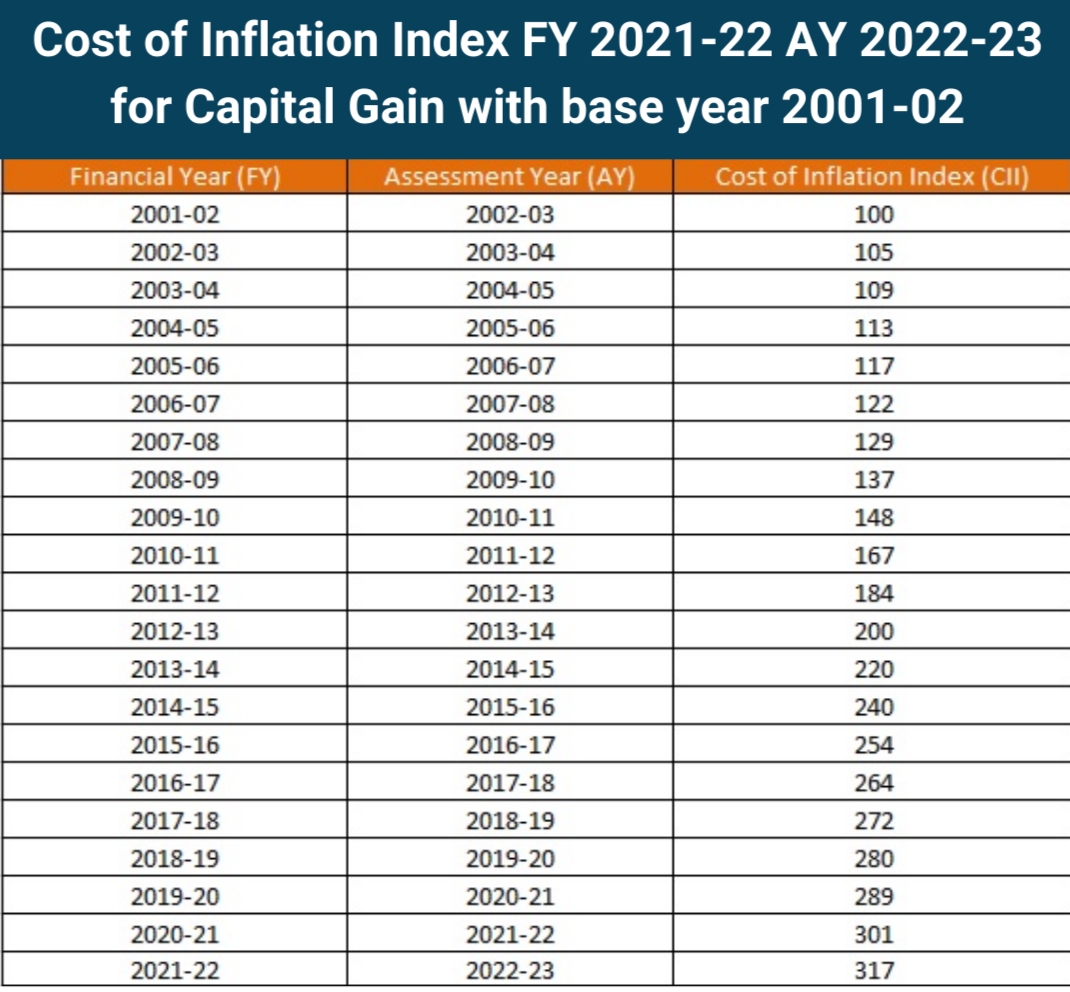
Cost of Inflation Index FY 2021-22 AY 2022-23 for Capital Gain

Below is the complete list of Cost of Inflation Index FY 2021-22 AY 2022-23 for Capital Gain from the new base year FY 2001-02 to FY 2021-22.

This notification will come into force with effect from the 1st day of April 2021 and will accordingly apply to the Assessment Year 2021-22 and subsequent years.


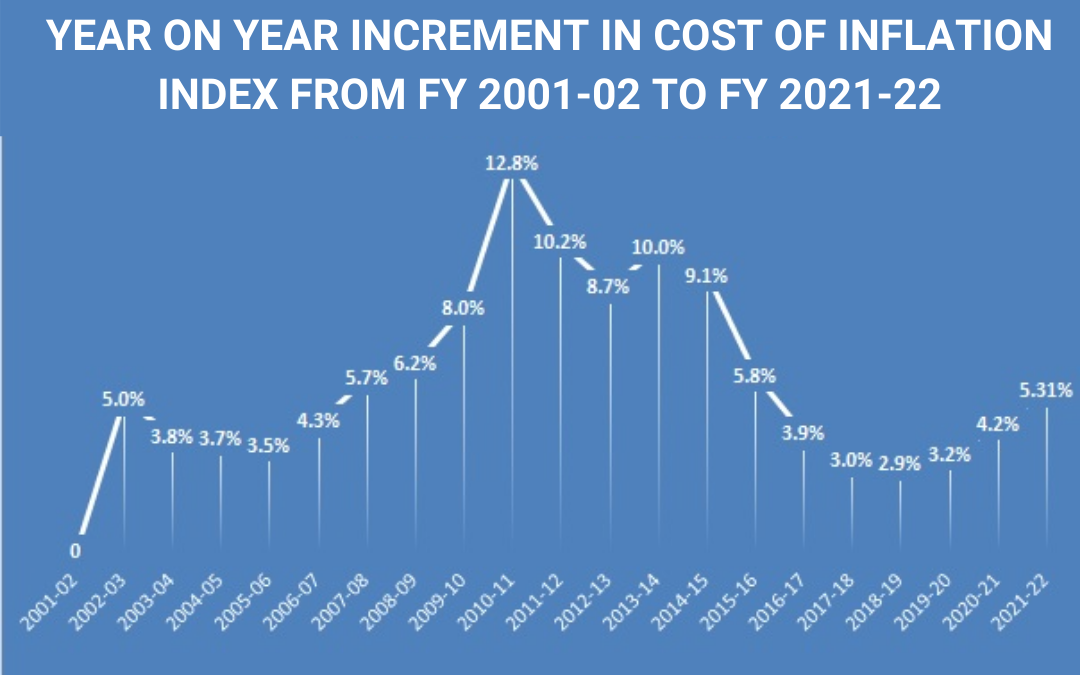
Let us see how year on year it is increasing from FY 2001-02 to FY 2021-22


You noticed that the CII increased to around 5.31% from the last year.

Hope this information will help you in arriving at your capital gain tax.

25

What are airline credit cards? Who should use these credit cards?

“Miles to go before I sleep.” Yes, you can take that quote literally. In the world of air travel, there is a category of people that is all about the miles it earns. If you are a frequent flyer or love traveling, then you should definitely apply for an Airline Credit Card. These cards offer numerous benefits that include air miles in terms of points, huge discounts on hotel bookings, air tickets fare, discounts on renting a car, vouchers for shopping, access to airport lounges, etc.
Airline credit cards have been around almost as long as frequent flyer programs themselves.
At first, the formula was simple: You signed up for a card and earned a bonus worth a free flight or two. After that, you would make everyday purchases with your card to rack up enough miles for another free flight every year or so, depending on your spending patterns. Award charts and earning rates were, at a minimum, predictable.
Since then, however, not only have airline mileage programs changed dramatically but so have the number and types of travel reward credit cards available to consumers.

Let’s have a look at the common benefits offered by airline credit cards.

Earn air miles: All the airline-related transactions done using an airline credit card will earn air miles which can be redeemed for purchasing tickets on both domestic and international airlines.

Bonus miles: It could be as a welcome gift or a renewal gift, credit card issuers typically offer bonus miles within a few days of card issuance. The miles can be encashed in the form of airline tickets during your next trip.

Accelerated miles: What’s more fun than earning more reward points. With the accelerated miles program, some credit cards offer accelerated miles on certain transactions. Make sure you’re aware of the transactions eligible for accelerated rewards to make the most of the program. You must keep checking your emails - generally, credit card companies email the users with such offers.

Airport lounge access: Sit back and relax in the airport lounges in times of delayed flights with the complimentary lounge visits offered by airline credit cards. The access is limited to select airports in India and abroad. Cardholders need to display their credit cards at the eligible airport lounges and can enjoy the refreshments, internet facility, and amenities offered by the lounges.
The most credit card offers lounge access - ensure that they are not chargeable and in which airport is it available before you go swiping your cards for free access.

Fuel surcharge waiver: Of the other benefits offered by airline credit cards, a fuel surcharge waiver is something useful even for less frequent travelers. Every time you purchase fuel using an airline credit card, the fuel surcharge, which is typically charged on all card transactions at fuel stations, will be waived. Cardholders can thus enjoy fuel savings using an airline credit card.

How to pick an airline credit card?

Before you pick a credit card to use for flights, you should answer a few questions.

Do you always fly the same airline?

If you don’t always fly the same airline, it almost certainly makes sense to pick up a flexible points card, at least if you’re only looking to add one card to your wallet.

For eg - Vistara has great tie-ups with credit cards. You can check them out.
Jet Airways used to have one of the best loyalty programs but we all know what happened to that.

Do you have a status with an airline?

If you already have status with an airline, you’re unlikely to pick up much in terms of benefits from a mid-tier airline-specific credit card as many of the benefits, such as free checked bags, are also benefits of status.

Do you want to access airport lounges?

If you want access to airport lounges, you have quite a few options. Would you prefer to access a specific airline’s lounge? If so, look into its top-tier credit card. If you prefer more general lounge access, consider a card that includes Priority Pass. In many cards, priority passes are chargeable so ensure you check terms and conditions beforehand.

Do you want travel insurance?

Some credit cards include various types of travel insurance as a benefit of using the card to book your tickets. If this is something you think you can benefit from, choose a card that offers protection.

Own Portals:

Many Indian cards like HDFC cards and Amex cards have their own flight booking portals where you can use the accumulated reward points on your cards to book flight tickets across various airlines. This works as the best way to use it. Generally, the conversion points are 0.25 paise or 0.30 paise. Do check the terms & conditions and charges before you get all excited for the next free travel.

Conclusion
Whether or not it makes sense to carry an airline credit card will come down to several key factors.

  • First, think about whether you will use its ongoing benefits like day-of-travel perks and discounts enough to offset its annual fee. (yes a good card with good rewards will always come with an added fee)
  • Next, make sure you are getting a great deal on the sign-up bonus. (you can always negotiate for this one)
  • Finally, think about whether a rewards card that earns transferable points instead will suit your spending habits and travel needs better.


By answering those few questions, you will have all the information you need to make your decision. If you travel often, you can get an airline credit card and a no-fee general travel card for all other travel-related expenses.
As long as the rewards you get from a card outweigh the costs of carrying it, you'll come out ahead, no matter your destination.

Article headers 13

Health Insurance: What You Need To Know During COVID

These are cloudy, stormy times and it doesn’t look like the sun’s going to come out any time in the near future. This article -tough as it is to write- is important because we need to be ready for what is happening and what the future could possibly hold for us. Let us try to keep finances out of the worries mounting us, and look at ways in which we can strengthen our financial shield.

Let’s start with the basics:

1. Have some money in your bank account: Have at least 10%-15% of your salary in your bank account in case you need to make any urgent payments.

2. Have some cash on you: We’ve more or less lost the habit of keeping cash with us, but keep around INR 10,000 – INR 50,000 (depending on your income & needs) for unforeseen expenses

3. Do not rush to invest in Equity: Even though it is tempting to invest for quick results, but at the moment, liquidity is key.

Moving on, to the most important point: HEALTH INSURANCE.

It may seem expensive, but at this juncture, you need one. If you don’t have it yet, don’t wait around, get one immediately. Let’s go through some health insurance basics. How does it work and what do you need to know?

· You take health insurance for yourself and you pay a premium for the same (it’s like motor/car insurance), where you get sick & hospitalised, the health insurance company pays your bills for you and you do not have to worry about it.

· Type of Health Insurance:

1) Individual - You can take health insurance only for yourself or 'one single' person like either of your parent/sibling.

2) Family Floater Plan - You take one insurance cover for all your family members.

·  Things to keep in mind: You must disclose all your existing health issues in the insurance or they may reject your claim on the basis of incorrect/incomplete information.

It doesn’t end with just having health insurance you must know its features as well. Most Insurance policies provide COVID cover; check the features and confirm it with your insurance provider. In case it doesn’t, you should consider porting it to another insurer that has this feature. Corona Kavach or Corona Rakhshak Policies will cover COVID care at home.

Prerequisites for using your insurance policy for home care under COVID:

·  A COVID positive report from an ICMR-approved lab

· Doctor's prescription for home isolation and treatment

· Note that antigen reports are not honoured by the insurers. The reports have to be RT-PCR having Specimen Referral Form (SRF) ID.

· There are two conditions when domestic hospitalisation is recommended. First, no medical facility available at the hospital, and second, when a patient's condition is too serious to visit a hospital. So, this is not really a COVID specific thing. In normal cases also domestic treatment is covered under health insurance policies

· This involves medication, nurses' and doctors' visit at home to measure vitals and tests such as CT scan X-ray and of course COVID. Essentially, all medical expenses until the person tests negative are covered. However, there is no concept of pre- and post-hospitalisation expenses in home treatment.

· Also, note that for mild COVID cases where you're treating it at home using antibiotics, you cannot claim insurance on the same.

You should also know that hospitals cannot deny cashless Health Insurance claims. If they do, here’s what you must do:

·  IRDAI directed Insurance companies to ensure the availability of cashless facilities with all empanelled network hospitals by putting in place a continuous communication channel with all the network providers.

· Cashless claim is available only at empanelled hospitals/network hospitals which come under your respective insurance provider. You can check this by visiting the website of your insurance company.

· Keep a list handy of all network hospitals for your insurance provider, so that if the time comes you won’t have to run around in search of a hospital.

Finance Minister Nirmala Sitharaman had asked IRDAI chairman SC Kunthia to “act immediately” to address the complaints of denial of cashless claims by insurance companies. She also mentioned that more than 9 lakh COVID-related claims for Rs 8,642 crores have been settled by insurance companies.

In the meantime, you can reach out to us and we shall help you plan it out better. We want to help you sort your financial stress one day at a time. Let’s be strong and take care of each other.

Article headers 8

8 Easy Ways To Reduce Your Expenses

Spend less than you earn. That’s the mantra of personal finance success. Every week, month, and year that you spend less than you earn, the more you save and the better your financial situation will be.

A big part of that solution is cutting back on spending, and for many people, the thought of cutting back on spending seems unpleasant. Losing out on the things that bring you pleasure in life seems like a pretty steep price to pay for a little financial success.

The secret is to intentionally target spending on the things you don’t care about and rarely use while holding steady on the things you do care about.

Scale back on entertainment costs
1. Cut cable: These days, streaming services and free over-the-air television provide more content than any one person could ever watch. Take advantage of the variety by eliminating cable service.
2. Focus your interests on finishing rather than collecting: Rather than collecting physical or digital items in a media collection, focus on actually finishing those things or enjoying them to completion. For example, instead of buying yet more books that go unread, aim instead to build a long list of books you have read. Make doing the center of your hobby, not buying. After all, isn’t that what you really love?
3. Don’t treat shopping as entertainment: It’s fine to go out in the town to be entertained but keep to a simple rule: don’t go into a store unless it’s for the purpose of buying something you’ve already decided you need before going in. Don’t go to stores just to browse for entertainment, as they’re designed to convince you to buy things you don’t need or even really want, but just react on impulse. Find other places to be entertained.

Reduce your food costs
4. Use a meal plan and make a grocery list: Instead of going to the grocery store whenever you feel like you need food, get into a routine of making a meal plan once a week, then constructing a grocery list from that plan. The time invested in making that plan is more than saved by spending less time in the store and having a list to stick to saves a ton of money on grocery store impulse buys that just sit in your pantry.
5. Learn how to cook: Cooking for yourself doesn’t have to involve three-course meals or Gordon Ramsey-level skills. Start by identifying things you enjoy eating, then look for how to easily prepare it from scratch and with basic ingredients.
6. Buy in bulk: The big bulk packages might seem like they have a high price, but they’re usually quite a bit cheaper per use, meaning you get more value for your dollar. If you frequently buy something at the store, look at the big bulk versions and save up for them. You’ll save over the long run. It's basically what our parents or grandparents did - buy - store and use efficiently.
Cut your monthly bills
7. Go through your bills: Sit down with every regular bill you have and go through it line by line, making sure you understand everything you’re being charged for. If something isn’t clear, Google it. If it doesn’t seem like something you should be charged for or is a service you don’t want, call the bill issuer and get it removed from future bills.
8. Cut your subscriptions down to just the things you actually use: If you have a subscription or membership that you haven’t used in the last month, cancel it. Turn off any auto-renew you have with that service and allow it to expire. You can always renew it in the future if you decide you have a need for it again.

What you should do with the money saved from trimming your budget?
The key to making frugal living tips really work for you is to not simply spend that money on something else fun. Keep your “fun” spending at the same level and use the money you save when you cut down your monthly budget on something smarter.  Cut un-fun things like your energy bill for something financially useful that can build a bright future for you.

One great option is to open an account and use your savings to create your emergency fund or you could save it up for your next trip. Whatever excites to reduce your unnecessary spending. These are just some of our suggestions. Do let us know what you had like to read and learn more about and we shall share more content on that.


Disclaimer: - The articles are for information purposes only. Information presented is general information that does not take into account your individual circumstances, financial situation, or needs, nor does it present a personalized recommendation to you. You must consult a financial advisor who understands your specific circumstances and situation before taking an investment decision.

[mc4wp_form id="2150"]

WCafe Financial Services Pvt Ltd (formerly known as Wealth Cafe Financial Services Pvt Ltd) is a AMFI registered ARN holder with ARN-78274.

WCafe Financial Services Pvt Ltd (formerly known as Wealth Cafe Financial Services Pvt Ltd) is a SEBI registered Authorised Person (sub broker) of Sharekhan Limited with NSE Regn AP2069583763 and BSE Regn AP01074801170742.

Copyright 2010-20 Wealth Café ©  All Rights Reserved