checklist

UAN - Universal Account Number - Things to note

What is UAN?

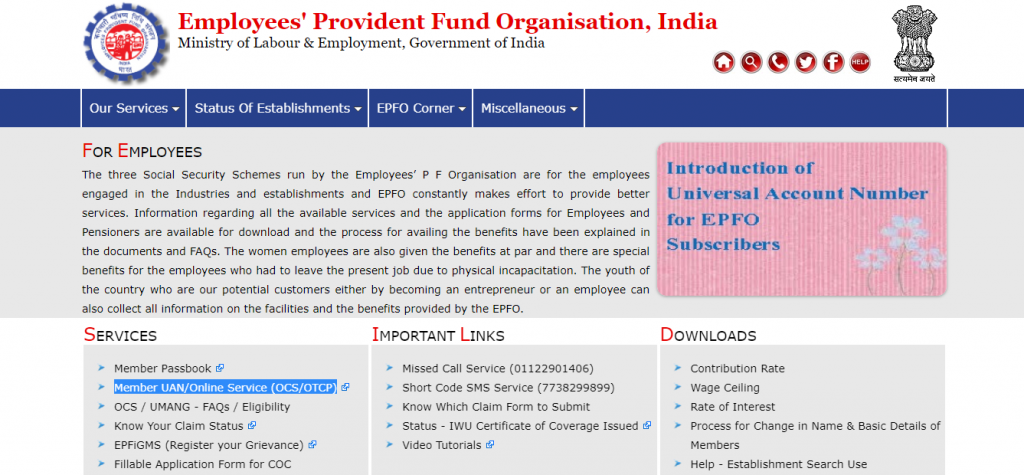
The UAN or the Universal Account number is a 12 digit unique number allotted to each member of the Employee Provident Fund (EPF) which helps them to manage their EPF account.

The UAN will be associated with an employee and will connect all his PF (Provident Fund) accounts across organizations.

This number is issued by the Ministry of Labor and Employment, Government of India.

If an individual changes his job, he will get a new PF account with the organization. This way, multiple PF account numbers will be allotted to an employee. Multiple PF account numbers is an area of concern as many employees report grievances related to transfer and withdrawal of PF amount. To counter this problem and to make the management of provident fund accounts easier, the concept of UAN was introduced The UAN is a single account number that will connect the multiple IDs associated with an employer. With UAN, an employee can connect all his EPFO accounts to make the process of PF withdrawal and transfer easier.

Advantages of UAN

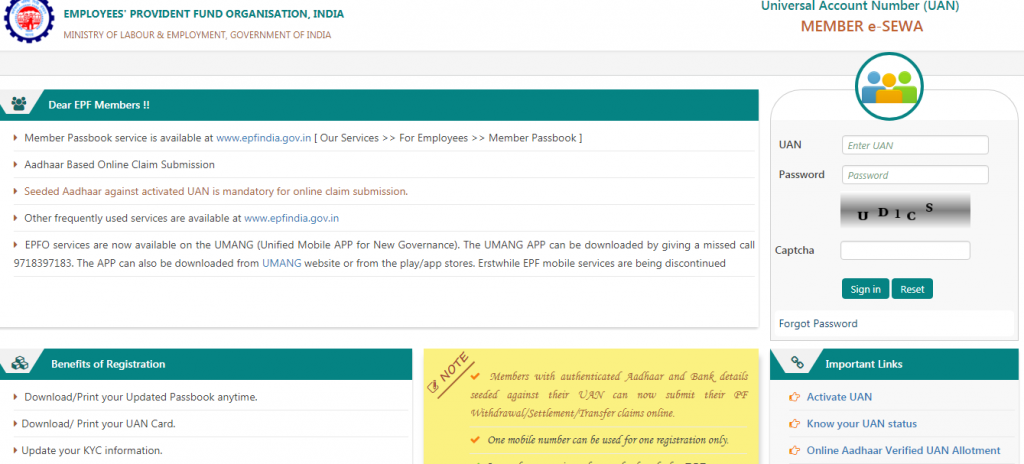
Once you have the UAN number and you register it then you can check many details. Benefit Of Registration of UAN  at UAN Member e-Sewa Portal are as follows:

  • You can download the updated EPF passbook. The passbook will tell you the EPF balance broken into Employee Contribution(EE) and Employer Contribution (ER). Also deduction for Employee Pension Scheme (EPS). Sample passbook is shown below.
  • You can link your previous PF accounts (before Oct 2014) which are not linked to UAN number.
  • All you have to do to bring your PF accounts together is give your UAN to current employer. After KYC verification, you will be able to view and manage all accounts.
  • You will get notifications on your mobile every time your employer makes a monthly deposit in your PF account.
  • You will know about all the movements in your PF account and thus, your employer cannot dominate the same anymore.
  • You can verify your transfer claims on EPFO web portal by mentioning your UAN.
  • You can change the mobile number and email address.

Read about the step by step process of opening your UAN account in the next article.

pexels-photo-1602726

Basics of Employee Pension Scheme (EPS)

We have discussed the basic contributions of EPF and how the money is invested, contributed and received by the employees. There is a component called EPS (employee pension scheme) and as per the law, a fixed amount or % of the employer’s contribution goes towards EPS which works as a retirement pension corpus for the employees.

While reading about EPF, I realized that EPS is more detailed than I had imagined and it has implications on the financial decisions of each employee. At the outset, it is a very good scheme, each month 8.33% of the basic pay is contributed towards EPS and on retirement, one gets the money back as a pension. Thus, the EPS part of your EPF works like an annuity plan.

Employees’ Pension Scheme (EPS)

  • Employees are automatically enrolled in the EPS Scheme only if they are members of the EPF scheme.
  • EPS is financed by diverting 8.33% of employer’s monthly contribution from the EPF. Monthly contribution to EPS is restricted to 8.33% of Rs. 15,000 i.e. Rs. 1250.
  • Unlike the EPF contribution EPS, the part does NOT get any interest.
  • The fraction of service for six months or more shall be treated as one year and the service less than six months shall be ignored. So 9 years and 6 months will be rounded up to 10 years.
  • The lifelong pension is available to the member and upon his death members of the family are entitled for the balance pension.
  • Pension received is lifelong and passes on to spouse and two children upon the employee’s death
  • Employees can receive only pension from EPS and are eligible only after completion of 10 years of service and must have attained the age of 50 years for early pension and 58 years for regular pension
  • No pension is payable before the age of 50 years.
  • The maximum Pension per month is subject to a maximum of Rs 3,250 per month.
  • Maximum service for the calculation of service is 35 years.
  • No pensioner can receive more than one EPF Pension.

When can Employee Avail the Pension

Unlike EPF, EPS cannot be withdrawn at any point of career. There are only specific cases where the same will be receivable:

  • Through Superannuation, where he/she has completed 10 years of service and is above 58 years and can continue to work. No fresh EPF will be made in his/her name.
  • Early pension, when completed 10 years of service, between 50 to 58 years and is not working anymore.
  • Unfit to perform the job or permanent disability

Transfer of EPS on Transfer of EPF from one company to another. 

  • When the employee switches jobs, the EPF gets transferred to the new employer, but not the EPS.
  • When the employee switches jobs, the EPS amount or carries it forward to the next job. This, however, depends on the length of his service and his age.
  • If EPF gets transferred the EPS also gets transferred. However, the UAN passbook shows amount as 0.
  • While transferring PF from one establishment to another, the service details, information (like the length of service, non-contributory period, last wages drawn are furnished to the receiving PF office in Annexure K which will be used to calculate the pension benefits. AMOUNT IN PENSION FUND IS NOT REQ”.

Claiming Pension Money

  • If you have scheme certificate of pension

Once the employee crosses the age of 50, he or she is entitled to get pension by Scheme Certificate. The employee is required to fill Form 10-D to avail regular pension. If the employee has more than one Scheme Certificate, he or she can directly go to the EPF office. This requires attestation of the employee’s Form 10-D by the bank manager.

  • If you don’t have scheme certificate of pension

In case an employee has not completed 9.5 years of service, you must claim a pension refund. In order to do, you have to fill Form 10-C along with EPF Withdrawal form and submit it through your employer.

writing-notes-idea-conference

Forms of EPS

There are various forms that need to be submitted to avail different benefits under Employee Pension Scheme. They are:

Form name Filled by Benefit
Form 10C Beneficiary or member ·        Withdrawal benefit

·        Scheme Certificate

Form 10D Member ·        To avail pension after 58 years of age

·        To avail pension before 58 years but after turning 50

·        To avail disability pension

Form 10D Nominee or widow/widower or Children ·        To avail nominee or dependant pension

·        To avail family pension

·        To avail children or orphan pension

Life Certificate Pensioner ·        To be submitted by pension beneficiary or children every November

·        To be submitted to the manager of the pension disbursing banks

Non-remarriage Certificate Widower/widow ·           To be submitted by widower every year

·           To be submitted by the widow at the beginning of pension

pexels-photo-1282308

Is your employer’s Health insurance sufficient?

I was personally always covered by the health insurance/medi-claim provided by my previous employer and thought that there is no need to have health insurance coverage for myself separately. The same even covered all my family members. It catered to all my health needs so I never looked around for additional health insurance.

There was some amendment in the health insurance scheme provided by my previous company and we were asked for our approvals on the same. During this time, I actually read the medi-claim policy of my employer. I noted the following points.

  • The medi-claim was a 20% co-pay health insurance (i.e. every time there is any claim to be recovered, I have to personally bear 20% cost of the medical bills as the insurance company will reimburse only 80%).
  • Siblings are not covered under the health insurance policy (my younger sister did not have a health insurance cover).
  • I was paying INR 350 per month towards critical illness diseases and an additional cover of my parents (i.e. INR 8400 per annum towards a health insurance premium which did not even give me a 100% cover).

I knew there were certain immediate action points that I must take.

  • I took a basic health insurance policy for my sibling.
  • I also got a health insurance policy for my mother. I had been delaying it for the pre-existing clause and the policy was expensive due to her age and blood pressure issues. However, I realized the more I push it, it is going to become more expensive.
  • When I decided to quit my job, I bought a health insurance policy for myself even before I put in my papers. In fact, I should have bought it the day I realized it was 20% co-pay. Nonetheless, later than never. I had quit my ex-employer in January 2016 and in February 2016, I had to be hospitalized for typhoid and all the expenses of my hospitalization were taken care off by my health insurance. Some may call it lucky, I call it smart financial planning.

Thus, one cannot completely rely on the health insurance provisions of the employer. I have listed below various reasons why you should not rely 100% on your employer’s health insurance policy.

  1. When you change your jobs – The earlier you buy insurance, the better and cheaper it is for you. Thus, if at the age of 40, you wish to change your job or retire early, your new employer may not provide your health insurance and buying one now could be very expensive or not possible.
  2. An employer may decide to change the configuration of the health insurance: The employer may even decide to reduce the members of your family to be covered at its expense or update certain conditions like introduce co-pay, refuse to cover pre or post hospitalization expenses etc. In such a scenario, though you would still be covered, the expenses to be incurred by you will definitely increase.
  3. Post-retirement: The health insurance provided by your employer shall in majority cases not extend post your retirement. Health Insurance may not be available for you in the years where it is most needed and you may not be able to obtain one during your retirement. Hence, buying a basic health insurance plan today itself (in spite of having one from your employer) is one of the major steps you can do for your financial plan.

Many of us do not buy the right financial products merely out of laziness, endangering our savings and future financial plan. Almost everyone knows the cost associated with a sudden health problem, in spite of that many of us refuse to obtain good and appropriate health insurance for self.

Read more about health insurance and things to focus on in our Article http://www.wealthcafe.in/health-insurance-things-to-note/


To learn more - you can check our course - NM 102: Build a Safety Net. Use code SAVE20 for 20% off.


    Get your weekly dose of Money Masala from us.


    12

    House Rent Allowance (HRA)

    House Rent Allowance is a component of the salary provided by the employer to his/her employee. If you receive HRA as part of your salary and you live in a rented accommodation, then you can claim full or partial HRA exemption u/s 10. However, HRA is fully taxable if you don’t live in a rented accommodation. How to calculate HRA? Your HRA depends upon the following 4 factors. They are:
    • Salary
    • HRA component
    • Rent Paid
    • Location of your rented house
    Tax exemption on HRA is least of the following: 1) Actual HRA received 2) Actual rent paid reduced by 10% of salary 3) 50% of basic salary if the taxpayer is living in a metro city 4) 40% of basic salary if the taxpayer is living in a non-metro city Since the least of the above is exempt from tax, you can ask your employer to restructure your salary to get maximum tax benefit.
                                                                                                      Pay rent and save taxes
    What if my employer does not provide me with the HRA? If you are making payments towards rent for any furnished or unfurnished residential accommodation occupied by you, but do not receive HRA from your employer, you can still claim the deduction and that would be under Section 80GG. Conditions that must be fulfilled to claim this deduction:
    1. You should be self-employed or salaried
    2. You have not received HRA at any time during the year for which you are claiming 80GG
    3. You or your spouse or your minor child or HUF of which you are a member – do not own any residential accommodation at the place where you currently reside, perform duties of office, or employment or carry on business or profession.
    In case you own any residential property at any place other than the place mentioned above, then you should not claim the benefit of that property as self-occupied. That other property would be deemed to be let out in order to claim the deduction under section 80GG. Refer our Articles on Income from house property where we have discussed this in detail. As per section 80GG of the Act, the least of the following will be considered as tax-free:
    1. Rs 5,000 per month;
    2. 25% of adjusted total income*;
    3. Actual Rent less 10% of adjusted total Income*
    *Adjusted Total Income means Total Income Less long-term capital gain, short-term capital gain under section 111A and Income under section 115A or 115D and deductions 80C to 80U (except deduction under section 80GG). How to Claim HRA When Living With Parents? Where you are staying in your parents’ house and your parents are owner of the same, you can still claim the HRA. You can pay the rent to your parents and claim the allowance provided. You will have to enter into a rent agreement with your parents, provide their PAN card to your employer, also generate rent receipts. In this case, please note that the rent amount that you showing as payment to your parents will be taxed as rental income in their hands. Is my landlord's PAN mandatory to claim HRA? Yes, it is where your annual rent crosses 1 lakh INR. If your landlord does not have a PAN, then you (as the employee) have to obtain the declaration to this effect from the landlord along with  the name and address of the landlord. A Format of Deceleration May be as follows :- Date To Name & Address DECLARATION I ____________(Full name and address of the declarant) aged ____ do hereby declare that I have leased the Flat No._______________________________ From 1st April’2018 to 31st March’2019 to ___________( Name of lessor) at a monthly rent of  Rs. _______/- ( __________________ only). Further I do hereby declare that my total income during the financial year 2018-2019 did not exceed the statutory  limit prescribed under Income tax Act,1962 and have not assessed to tax and does not have a PAN card . Verification I,_________________ do hereby declare that what is stated above is true to the best of my knowledge and belief. Verified today, the _____________ day of _________________
    Date : ________________Place : ________________ (Name of the declarant)
    HRA is one of the most common component of a salary structure and hence, you must claim the same where you are staying on rent. If you are not staying on rent and living with your parents, it is important you analyse the overall family's taxability before declaring that you are paying rent to your parents.
    hands-2847508_640

    How much cover is required for Term Insurance?

    Have you looked at the insurance aggregator's website and wondered how much insurance cover you should take? At the preliminary view, an insurance cover of INR 50 lakhs for someone who just started working also looks very good and an insurance cover of INR 1 crore may not be enough for someone who is married with 1 child. The amount of cover varies from person to person based on their financial background, situations, responsibilities, lifestyle etc.

    You can read our Article on 10 things to note before buying term insurance which will give you an exact idea of what is term insurance and all the things that you must focus on before investing in one.

    We have listed below the process to compute your term insurance cover.

    Step 1 - Use your actual Income

    You are opting for term insurance to ensure that the financial life of your loved ones is not impacted. Based on this, your term insurance cover must compensate for the income/earnings that you were providing to your family.

    Your monthly income is the minimum amount that your financial dependents must get from the term insurance cover.

    Accordingly, where your income is INR 1 lakh per month, your annual income would be 12 lakhs. Your insurance cover amount must be such that on investing it in a debt product of around 9% return, you get the annual income value as returns.

    For example:

    Income - 1 lakh per month

    Annual income - 12 lakhs

    Return % - 9%

    Amount of cover - (12 lakhs*100)/9 = 1.33 crores

    On an investment of INR 1.33 crores in a debt financial product which gives a return of almost 9% per annum, a return of INR 1 lakh per month (i.e. 12 lakhs per annum) will be received.

    1.33 crores X 9% pa = 12 lakh per annum i.e. 1 lakh per month.

    Post taxes of around 20% that would be INR 80,000 per month which shall be equal to the in-hand salary of the person with the monthly income of INR 1 lakh.

    Reverse Calculation

    • You can also do a reverse calculation, where you may take the in-hand salary of say INR 1 lakh (this would be a post-tax number)
    • Accordingly, the pre-tax would be INR 1.25 lakhs
    • You have to earn INR 1.25 lakh for 12 months i.e. INR 15 lakhs.
    • The cover amount must be such that it gives 15 lakhs as 9% of the cover amount.
    • Using the above formula = (15 lakhs*100)/9 will give you 1.66 crores.

    Hence, you should take an insurance cover of INR 1.66 crores.

    Step 2 – Loans and other liabilities.

    You should add the value of your total loans and other debts due to your insurance cover. This will ensure that there is no fallout of debt on your dependents.

    In this case, if you already have home loan insurance, verify if it is sufficient to cover the entire outstanding loan.  If yes, then you need not add that amount to your term insurance cover, if not then add the loan amount to your insurance cover.

    If there are any other loans or liabilities that you have taken from anyone, add that amount to your term insurance cover amount. For example, a car loan or a personal loan.

    Step 3 – Reduce your assets

    Where you have any investments made in the form of mutual funds or any other investments for your retirement, reduce the value of the same from your insurance cover amount.

    In this case, please keep in mind that the value of the assets like the house you are residing in or depreciating assets like your car should not be considered. These are the assets that are used by your family/people.

    Step 4 – Important Events

    This includes setting aside a lump sum amount for important events or milestones of life such as education of your child, or their marriage or a business set-up for your partner. Calculate roughly how much you would need for your such events (Do include inflation into consideration).

    For example, if you feel that today when your child is 5 years old, you would need INR 20 Lakhs for their education 15 years from now. Ensure that this INR 20 Lakhs is not based on the education cost today, but an estimated cost of the same 15 years from today.

    Final Working

    (Your annual income*100)/ return rate of a debt product + outstanding liabilities - Investments (saleable assets) + Inflated cost of important futuristic life events

    Conclusion

    Many insurance aggregators and their website calculate the term insurance cover that may be applicable to you.  These calculators work on a simple formula of the time value of money. Basically, it’s the present value of all the future income that you are expecting to earn until you retire. These easy to use calculators are available on the websites of all insurance providers and require certain information from your end like your current age, current annual income and expected future rate of return.

    These calculations may not fulfill your entire insurance needs specific to your requirements. You must use an adequate method otherwise even after obtaining term insurance your family/dependents will not be free of their financial liabilities.

    The best way to buy term insurance is to directly obtain the same from the website of the insurance provider. Refer to our Article http://www.wealthcafe.in/myths-about-buying-insurance-online/

    To learn more - you can check our course - NM 102: Build a Safety Net. Use code SAVE20 for 20% off.


      Get your weekly dose of Money Masala from us.


      [mc4wp_form id="2150"]

      WCafe Financial Services Pvt Ltd (formerly known as Wealth Cafe Financial Services Pvt Ltd) is a AMFI registered ARN holder with ARN-78274.

      WCafe Financial Services Pvt Ltd (formerly known as Wealth Cafe Financial Services Pvt Ltd) is a SEBI registered Authorised Person (sub broker) of Sharekhan Limited with NSE Regn AP2069583763 and BSE Regn AP01074801170742.

      Copyright 2010-20 Wealth Café ©  All Rights Reserved