Article Headers (22)

What is e-Rupi? All you need to know about India's new digital currency.

There have been incidents of poor people being regularly robbed of their pensions and scholarships by corrupt banking correspondents who take their fingerprints citing different excuses. To eliminate such problems, on 2nd August 2021, the Prime Minister of India Mr. Narendra Modi launched a digital payment platform called e-RUPI Digital Platform. 

The US, South Korea, and several other countries have used similar voucher-based incentives for welfare services.

What is e-RUPI?

e-RUPI is an e-voucher, which is cashless, contactless, and is a person and purpose-specific payment solution. A beneficiary will be required to show the QR code or the SMS message to the merchant, who will scan the same and a verification code will be sent to the beneficiary’s phone number. The latter will have to share the code with the merchant and the payment will be successful.

For instance, if you have an e-RUPI voucher for the Covid-19 vaccine, then it has to be redeemed for vaccines only. Before e-RUPI coupons are sent to the mobile numbers, the mobile number and identity of the citizen will be verified. This could also help in preventing corruption in the system (at least until the corrupt officials find a way to circumvent this too :P)

State Bank of India (SBI), ICICI Bank, HDFC Bank, Punjab National Bank (PNB), Axis Bank, and Bank of Baroda will provide both issuance and redemption facilities for e-RUPI coupons. Meanwhile, Canara Bank, IndusInd Bank, Indian Bank, Kotak Mahindra Bank, and Union Bank of India will only issue e-RUPI coupons for now.

As a one-to-many payments facilitator, it will help the government sharpen targeted welfare programs. The private sector will find it helpful to disburse non-cash benefits to employees and support focussed CSR programs. Later, individuals could use it for gifting.

What are the uses of e-RUPI?

Many services will be provided by the government through e-RUPI in the country. It can also be used to ensure leak-proof delivery of wellness services. To be used for leak-proof delivery of fertilizer subsidies, TB eradication programs, Ayushman Bharat, Pradhan Mantri Jan Arogya Yojana, Mother, and Child Welfare Schemes, etc.

The government has also talked about giving the benefit of this digital voucher for the private sector employee welfare and corporate social responsibility. This app is not released as a normal payment app. Soon you will be able to get many services through e-RUPI after it is released by the government today. E-RUPI will be spread across the country through SMS string or QR code.

  • COVID Vaccine Registration
  • SSC CGL Admit Card 2021
  • Download Window 11 ISO file
  • Upgrade Window 10/7 to 11
  • OLA Electric Scooter Dealership
  • Delta Plus Variant Symptoms
  • T20 World Cup Schedule
  • IPL Schedule 2021 Remaining matches

Benefits and loopholes

Aimed at bridging the digital gap among the unbanked population, the beneficiaries or users of this payment mechanism will not require a card, digital payments app, or internet banking access to redeem the voucher.

e-RUPI transaction process is said to be secure and will be keeping the details of the beneficiaries completely confidential, maintaining their privacy.

The introduction of the Covid vaccination voucher is also aimed at ramping India’s vaccination drive as e-RUPI allows beneficiaries to easily book appointments for the shots. However, with the beneficiary not required to disclose their identity, these vouchers are also likely to be claimed by other people.

With the help of the E Rupi application, digital payment has been done simply. Many institutes have shown their interest in this application. The adoption of e-RUPI in various government programs will enhance business efficiency, simplicity, transparency, and accountability in various programs with tax implications such as meals, education, travel, and health. So, if you want to enjoy this app, download it from the online interface.

Official Portal Click here
MPNRC Home Click here

e-RUPI opens up a world of opportunities to the government, people, and businesses to provide, avail, and pay for services seamlessly. You will soon be able to use e-Rupi Digital Payment System. 

Through this article, we have provided you with all the basic details regarding e-RUPI digital payment. If you are still facing any kind of problem then you can write us your questions related to your e-Rupi Digital Payment in the comment box.

I am unable to ‘Save’ any money ! Guide me.

A common question people ask is, "Where does all my money go?" Though they mean it as a joke, it's said with a sense of sadness. But the reason they don't know where their money goes isn't that they lost it or forgot the pin number to their bank card. They don't know where their money is going because they don't control the cash flow pattern of their money, their money controls them.

Once a young man named Raj approached us for our advice, as he was facing the same issue - how should he manage his expenses?. Raj is a bachelor living in Pune alone in a rented house away from his hometown, Lucknow. It's his first job so he wanted to enjoy his money but he is also responsible to send some back to his parents however, he just cannot save. Every month he feels, this is it, I am going to save money today but it just never happens. He approached us as he had no surplus of money left at the end of the month and hardly had any savings.

Are you A RAJ !!?

Does this happen to you? Do you feel you are doing everything right but you are still not saving any money at the end of the month? Let us help you with it.

Let's review Raj’s monthly income and expenses and help him find some money to save!

We believe everyone can save a bit if they just push themselves a bit.


Step 1 -Review of his monthly income & expenses - HIS CASH FLOWS

Raj’s Expenses:

Particulars Amounts
Rent 15,000
Toiletries + Basic monthly expenses 5,000
Bills 5,000
Sending to his family 10,000
Food  18,000
Traveling 6,750
Misc 2,500
TOTAL 62,250

Raj’s Income = INR 60,000

Extra Spend/Loss = INR 2,250

Looking at his expenses it was a little difficult to figure out until we had a close look at it. Most of the expenses like Rent, Toiletries + Basic monthly expenses like utility bills & the amount that he uses to send his family were expenses that we couldn't fidget with and were his absolute needs. Further, we noticed that he was spending INR18,000 on food! So we asked him to share more details of the same. Traveling expenses and Miscellaneous expenses were also much more than one would expect someone to spend in Pune on a monthly basis. Therefore, we further explained to him how such expenses were harming his savings.

On a closer look at his expenses, we guided him to look at cheaper alternative options for things he was splurging (provided he was ready to make the shift). We also guide him on how these reduced expenses would increase his savings and when these savings are invested it would grow to be a substantial amount for him.

Wealth Cafe Solution:

Food:

So Raj was ordering in every meal (almost) and while it seemed fun and easy, it was making a huge hole in his pocket. So, rather than ordering we advised him to opt for having help to cook at home. Making food at home isn’t free, but it could probably squeeze out savings if, 

  1. you buy your groceries in bulk 
  2. if you are ready for home-cooked ‘good’ and ‘healthy food’
Principal No of meals 

(per day)

Cost per meal Days Total cost a month
When you order from outside
How much do you spend 2 300 30 18,000
When you cook at home/or have help to do that
Help expenses 3,500
Grocery spends 5,000
once a week you still order 1 300 5 1,500
10,000
Monthly Savings 8,000

Further, we explained to him how grocery shopping should be done, with the intention of saving money. The key here to save money is by buying groceries in bulk and managing it wisely. I have shown it in detail in the table below by taking an example of rice and wheat flour.

Ration Rice* Flour* Total
Where I order 1 kg 180 55
how many times ordered 5 5
The total cost of 5Kg 900 275 1175
Where I order 5 kg directly 639 269 908
Monthly Savings 261 6 267

*Price referred from dmart website.

By buying Rice and Flour in bulk, one could save approx 23% in comparison to buying in small quantities. Raj could follow this with other grocery items as well so as to save his money.

By just shifting your monthly habit of ordering into cooking at home, he can have enough savings to start investments and SIPs. This may seem a very small thing but trust us many people get stuck to order in and this just changes everything in your monthly budget.

Traveling: (7 km)

Principal Cost per day (both side travel) Days Total cost a month
Uber/Auto/Taxi 270 25 6,750
Public transport (train + bus) 50 25 1,250
Monthly Savings 5,500

By using an alternative, i.e, public transport Raj could save INR5,500 every month. That is INR 66,000 every year. Public transports are everywhere and paid for by our taxes. Which means it’s a bit of a waste if we don’t use them at all, right?

Miscellaneous

A major proportion of Raj’s miscellaneous expenses consisted of buying cigarettes. It is easy to look at small purchases and say “whatever, it’s only INR 15.” As standalone instances, INR 15 for anything isn’t a lot of money. However, spending INR 15, on a cigarette 5 times a day adds up to a lot of money per year.

In fact, it’s INR 27,000!

Principal No of cig Days Cost per cig Total cost a month
How much do you spend 5 30 15 2250
Reduce it 1 a day 1 30 15 450
Monthly Savings 1800

If Raj could decrease his cigarette intake from 5 times a day to once a day, it would save INR 1800 a month whereas INR 21,600 a year. I need not tell, as a bonus, it saves his doctor's expense as well in the coming future.

His expense now:

Principal Amounts

(Before)

Amounts

(After)

Rent           15,000           15,000
Toiletries + Basic monthly expenses             5,000             5,000
Bills             5,000             5,000
sends family             10,000             10,000
Travelling               6,750                  1250    
Food order (does not cook)             18,000           10,000
Misc                2,500                      700
TOTAL             62,250              46,950


We do not deny the fact that savings are easy but it is not impossible. You can start with savings of INR 2000 each month or look at at least 10% of your monthly income and move forward. By cutting down his expense wisely Raj could save 15,300 (approx 25%) in comparison to before. He is saving INR 13000 monthly (INR 1,56,000 yearly) from his income, whereas he was spending more than his income with no surplus of money before.

Where we always talk about the approach of pay yourself first, where you transfer your fixed savings to a second bank account so even the urge of spending your money does not come in the way of your savings - NM 101: Maximise your Savings


So now that you know what you could be saving. Why not invest it? 

As you see, he has a savings of 13,000 Rs, but by giving him INR 3000 for overheads, he could still invest INR 10,000. When making investment decisions, and investors’ portfolio distribution is influenced by factors such as personal goals, level of risk tolerance, and investment horizon. As Raj was towards balanced investment, his Debt-Equity Mix will be 50% debt and 50% equity. He invested INR 5000 in equity mutual funds which he could keep untouched for long-term goals whereas the other INR 5000 was diversified in liquid/short-term debt funds for emergency and short-term plans.

Did you see how easily the portfolio was diversified? You can learn more about diversification and how to invest in our course - NM 105: Plan & achieve your goals. Once he had a proper hang of investing and could increase his risk tolerance, he could diversify his investments even more after doing proper research. But remember, diversification of assets should be up to a limit. Over diversifying can hurt your investment returns. 


LET’S GIVE HIM AN ADDITIONAL INCENTIVE TO SAVE! LET’S GIVE ONE TO YOU TOO !!

Spoiler: something beautiful happens. He builds more wealth!

Let’s assume Raj makes a 11.50 % average return on investing INR 10,000 (expected equity return =15%, Expected debt return = 8% and based on his ‘balanced’ risk profile)

Five years from now… he would have  ₹8,05,849

Ten years from now… he would have  ₹22,34,032

And in Twenty years… he would have  ₹92,51,011

Don’t wait. Don’t hesitate. Don’t ponder and contemplate. Get started. Chances are good that at least some of the suggestions on this list will work for you and help you spend less money. By reducing your outflow and directing more money to financial goals, you'll be more successful in saving for big things so you can grow your net worth and build real wealth over time. It's worth the effort. 


To learn more about Saving & Investments enroll in our course NM 101: Maximize your savings

Article Headers (20)-min

FMP? - Know everything about Fixed Maturity Plan

Many of us want to invest in instruments that are not very risky and generate good risk-free returns. Here comes the concept of investing in Fixed Maturity Plans (FMPs). 

What are FMPs?

These are closed-end debt funds, sold as if they were replacements for multi-year fixed deposits. The idea was:

  • You bought a fund
  • The fund bought some debt securities scheduled to mature in a certain period say 3 years.
  • After three years, the fund gave you back the maturity amount minus their fees and all that.

FMPs invest in commercial instruments, highly rated corporate bonds, and various money market instruments. The basic rule in the FMP is to park money in an instrument that has a similar maturity date.

Features of FMPs

  1. Fixed Maturity - The maturity period of an FMP is fixed and once you have invested through NFO (new fund offering), your investment is essentially locked in till maturity. The maturity period of FMPs is usually more than 3 years from the date of unit allocation. This ensures that indexation benefits can be obtained on FMP investments. Read more about indexation and capital gains here
  2. Reduced Interest Rate Risk - FMPs are least exposed to interest rate risk, as the fund holds instruments till maturity-getting a fixed rate of return. Interest rate risk indicates that whenever there is a change in the interest rate, the value of the underlying security and hence, the NAV of the fund would change (more or less) depending on the movement of interest. Locked-In Rates: While locked-in rates are an excellent choice during a falling interest rates regime, the same can become a problem during a period of rising interest rates. When market rates move upwards, locked-in rates can lead to missed opportunities concerning potentially higher returns coupled with possibly lower risk levels. You can learn more about it here -NM 104: Basics of Mutual Funds
  3. Low Liquidity - FMPs are not liquid, you cannot withdraw before the completion of full tenure. So, if you invest in an FMP of 3-year tenure, you can withdraw only after 3 years and not in between. 
  4. Lower tax liability - A majority of new FMPs feature a maturity period of 3 years or more. This ensures that long-term capital gains tax rules including indexation benefits apply to capital gains from these non-equity investments. Indexation provides investors with the benefit of factoring in inflation, which reduces overall tax liability on gains. Read more about mutual fund taxation rules
  5. Returns Not Guaranteed: Fixed Maturity Plans provide investors with the benefit of locked-in returns from instruments held till maturity and high-quality investments minimize the credit risk for investors. That said, the low potential risk does not mean zero risks for the investors, and returns from FMPs are still market-linked. As a result, returns from FMPs are not guaranteed unlike other fixed return instruments such as fixed deposits.
  6. Not similar to fixed deposit
    Comparison Criteria Fixed Maturity Plans Fixed Deposit
    Returns Market – Linked Returns Guaranteed Returns
    Taxation Capital Gains Taxation Rules apply to the  benefit of indexation Interest is taxed as per the Income Tax slab rate of the investor
    Liquidity Low Liquidity Premature withdrawal options and sweep-in fixed deposits make it very liquid.
    Maturity Options Varies for each scheme (typically 3-4 years) Varies by a bank (typically 7 days to 10 years)
  7. Banks waive penalties

On the other hand, an increasing number of banks are not levying any penalties on premature withdrawal of fixed deposits. The State Bank of India, for instance, does not charge any penalty on premature withdrawals from short-term deposits of Rs 15 lakh and above after seven days.

In cases of tenure of more than one year, there is a small penalty. The deposit earns 0.5% below the rate applicable for the period the money remained with the bank or 0.5% below the contracted rate, whichever is lower.

This makes bank FDs a better proposition for those in the lower tax brackets. The tax on FMPs will only be marginally lower and not make a significant difference for someone who earns less than Rs 5 lakh a year. Even though the tax will be higher on FDs, they will offer greater liquidity to the investor.

What are the things you must check before investing in an FMP?

While FMP offers several advantages over other fixed-income products, there are still certain factors that investors should keep in mind before taking the plunge. Here are a few of them.

  • Check Indicative portfolio:  If the indicative portfolio shows the portfolio will invest the majority of the corpus in bank certificates of deposits (CDs), then the portfolio may have lower risks compared to FMP’s which invest predominantly in Commercial Papers (CPs). Seen from the other side, having Commercial Papers in the portfolio may mean slightly higher rates. So as an investor before investing in an FMP you should have a clear idea about the risks you are willing to take and how does the portfolio looks like.
  • Credit rating of the securities:  You should also check the scheme’s offer document for the minimum credit rating of the securities the fund intends to invest in. The investors should also note that the higher the credit ratings of their securities, the lower the returns would be for the FMPs and vice versa. However, lower credit rating securities have higher credit risks; hence investors should keep in mind the same. Credit risk indicates the risk of default. 
  • Expense Ratio of the scheme – Investors should select a scheme that has a reasonable expense ratio as per the tenor of the FMP, as a higher expense ratio reduces the overall yield on the FMP.
  • Maturity of the Scheme: Some of the FMPs launched between January and March every year offer double-indexation benefits. Double Indexation helps reducing long term capital gains thereby reducing overall tax liability

TAXATION OF FMPS

As FMPs are a type of debt fund, they are taxed like other debt funds. Investments held for more than 36-months are taxed at the rate of 20%. But there is an indexation benefit available here. With indexation, you get to increase the purchase price of FMP units in accordance with the inflation during the period. This helps in reducing your taxable returns from FMPs. Do note that tax-saving FDs falling under 80C do not allow premature withdrawal. Where FMPs score over FDs is indexation benefit, which results in paying lower taxes.


Who Should Consider Fixed Maturity Plans?

Investors who are looking for higher returns in comparison to FDs and RDs and are willing to accept frequent market fluctuations can invest in FMP’s. Additionally, investors must be willing to lock in their funds for a time period of 3 years. In a bid to provide higher income to their investors, FMPs invest in instruments that bear some credit risk so ensure that you understand the risk when you invest in FMPs and do not invest in them as a replacement for fixed deposits.

Separately, for all your emergency funds - we would advise you to continue to invest in fixed deposits or liquid mutual funds. For short-term goals of up to 3 years - you can invest in short-term debt funds or could consider FMPs. But do remember that FMPs come with Fixed Tenure and hence, you cannot access it unless the tenure is completed.


Consult your financial advisor to understand how these funds fit into your risk appetite and goals. We are SEBI registered investment advisors and can help you make sound investment decisions - you can reach out to us at iplan@wealthcafe.in, in order to help you make a financial plan for yourself.

To learn more about Asset classes enroll in our course NM 103: Basics of Asset Classes

You can also check our course on Mutual Funds NM 104: Basics of Mutual Funds

When to exit from Mutual Funds or stop SIP?

One of the most common themes of discussion about Mutual Funds is – When it is a good time to invest? While answers to this question are readily available, a relatively less discussed theme is – When is a good time to exit your Mutual Fund investments? 

If you have been paying those SIP installments over a period of time, chances are that at some point, you would have asked yourself whether you should discontinue the payments.

So what are the triggers that should prompt you to exit from mutual funds or stop your SIP? In this blog, we will discuss specific instances of when you should consider exiting from your Mutual Fund investments and also how to come up with a viable exit strategy that works for you. 

Things To Know Before You Exit the Fund

It’s essential to choose your alternatives before you exit a fund. You need to ensure that the new fund is in sync with your needs. For instance, if you had invested in large-cap funds because they are less risky and find that your fund has now been merged with a mid-cap fund, then you can redeem the combined fund for a fund composed of pure large-cap units only.

Along with this, you also need to take the LTCG (Long-Term Capital Gains) tax into account and see to it that the exit and redemption do not cause you huge losses.

Know when to exit from investments in mutual funds

Sometimes even during your goal period, there might be instances demanding you to exit from investments. In such scenarios, exiting the investment is suggested only when:

  • When you achieve your financial goal

The basic reason you invest is to achieve your goals and if your goals are achieved or are at the stage where you need the money for the goal, you exit the fund. It is very simple right. However, your debt: equity allocation would tell a different story. If you had invested in a long-term goal say your kid's education of 15 years then you start exiting equity in the 12th year when it becomes a short-term goal and switch your money to liquid debt funds (safer options). From this debt fund, you redeem your units as and when you need money for the goal. Now after the 12th year you are sure that you will have money whenever you will need it for your child’s education. You no longer have to continue to invest after the 15th year. This is the most important reason or timing to exit the fund.

  • Consistent poor performance of the fund

If a scheme has underperformed consistently versus its category peers over the past several quarters, you should consider exiting the scheme in favor of a more consistent performer. There can be many reasons behind your fund’s dipping performance.

It might have taken exposure to an unsuitable sector or theme at an inappropriate time. In yet another case, your debt fund might have invested in low-credit-rated securities and failed to earn high returns as planned. 

Therefore, in order to gain the benefits, the mutual fund's investments should be tracked regularly. The performance of the mutual funds has to be seen in the right way. Following are some of the measures:-

  1. Compare your fund with the benchmark index
  2. Compare with the category average
  • Fund level changes are making you uncomfortable

This is quite a common problem. For example, the fund manager who was doing a wonderful job for the last 10 years may have moved on. Occasionally, the AMC gets sold to a new fund manager and you may be uncomfortable with the strategies of the fund. There are also occasions when the fund may have made some changes to the objectives of the fund or its asset mix which may be incongruent with your goals. These are again genuine cases for you to terminate your SIP or exit from the particular scheme. You can look for other funds that are consistent with your objectives.  

  • To Rebalance Your Investment Portfolio

Rebalancing and asset allocation are crucial parts of your investment strategy. 90% of your returns are determined from your rebalancing rather than the exact fund you invested in. For instance, when you started investing your asset allocation was 70:30 into equity and debt. After completion of one year, your target allocations might have skewed. It might be the result of the recent rally increasing NAV of the equity component of the portfolio.

Or, in another case, a macroeconomic policy shift may have made large-cap stocks more favorable over others. All of these would trigger a portfolio rebalancing. In this, you sell those funds which have become irrelevant in the current context. You invest that money in other funds which look more favorable. 

Ideally, SIPs should be investments in perpetuity. However, like all investments, one must review, re-balance and reset portfolios in line with current requirements and their risk appetite (which are always changing)

  • The fund is all over the media for the wrong reasons

Let us start with a caveat here! Not everything that appears on the media or social media needs to be entirely believed. They must be taken with a pinch of salt. But when you see consistent negative cues like SEBI investigations, penalties imposed, customer dissatisfaction, services issues, allegations of circular trading, etc, there is obvious room for worry. Random media reports are understandable. However, do your own research that if you find such news temporary and you have the risk of holding on, you could consider not selling. Just the media news cannot be a reason, otherwise, you will be changing your portfolio every 6 months.

  • There is an emergency

In case of financial emergencies, when your emergency fund isn’t sufficient to meet your requirement, you need to consider exiting your mutual fund investments. Therefore, funds should be parked in liquid funds for contingencies like emergencies.


If not for the above reasons, holding your investments for longer durations is always suggested. Along with an investment plan, always have an exit strategy ready for your investments. 


Always remember why you invested in a particular fund (and please may that not be ‘best funds of 2020’). Once you map your investments to your goals, these questions will not be very difficult for you to answer. As you exit when your goals are due or only when something gravely is wrong with the fund. Otherwise, it is Janam Janam ka Saath (especially in equity funds).


Hence, we always recommend learning about goal setting and investing properly to achieve your goals - check our course- NM 104: Basics of Mutual Funds

Income-tax Rates FY 2021-22 (AY 2022-23)

Before knowing the tax rates, it is very important to understand the terms Financial year (FY) and Assessment Year (AY).

The below-mentioned tax rates/ slab is on the income earned for the period 1 April 2021 to 31 March 2022. FY stands for the ‘financial year’ which is from 1 April 2021 to 31 March 2022. AY stands for Assessment year which is 1 April 2022 to 31 March 23.

For individuals, the due date to file the income tax return for the income earned from 1 April 2021 to 31 March 2022 is 31 July 2022. 

Income tax Rates 

  1. Income Tax Rate & Slab for Individuals & HUF:
    1. Individual (Resident or Resident but not Ordinarily Resident or non-resident), who is of the age of less than 60 years on the last day of the relevant previous year & for HUF:


Taxable income Tax Rate

(Existing Scheme)

Tax Rate

(New Scheme)

Up to Rs. 2,50,000 NIL NIL
Rs. 2,50,001 to Rs. 5,00,000 5%  5% 
Rs. 5,00,001 to Rs. 7,50,000 20% 20%
Rs. 7,50,001 to Rs. 10,00,000 20% 15%
Rs. 10,00,001 to Rs. 12,50,000 30% 20%
Rs. 12,50,001 to Rs. 15,00,000 30% 25%
Above Rs. 15,00,000 30% 30%


  1. Resident or Resident but not Ordinarily Resident senior citizen, i.e., every individual, being a resident or Resident but not Ordinarily Resident in India, who is of the age of 60 years or more but less than 80 years at any time during the previous year:
Taxable income Tax Rate

(Existing Scheme)

Tax Rate

(New Scheme)

Up to Rs. 2,50,000 Nil Nil
Rs. 2,50,001 to Rs. 3,00,000 Nil 5%
Rs. 3,00,001 to Rs. 5,00,000 5% 5%
Rs. 5,00,001 to Rs. 7,50,000 20%  10%
Rs. 7,50,001 to Rs. 10,00,000 20%  15%
Rs. 10,00,001 to Rs. 12,50,000 30%  20%
Rs. 12,50,001 to Rs. 15,00,000 30%  25%
Above Rs. 15,00,000 30%  30%


  1. Resident or Resident but not Ordinarily Resident super senior citizen, i.e., every individual, being a resident or Resident but not Ordinarily Resident in India, who is of the age of 80 years or more at any time during the previous year:


Taxable income Tax Rate

(Existing Scheme)

Tax Rate

(New Scheme)

Up to Rs. 2,50,000 Nil NIL
Rs. 2,50,001 to Rs. 5,00,000 Nil 5%
Rs. 5,00,001 to Rs. 7,50,000 20% 10%
Rs. 7,50,001 to Rs. 10,00,000 20% 15%
Rs. 10,00,001 to Rs. 12,50,000 30% 20%
Rs. 12,50,001 to Rs. 15,00,000 30% 25%
Above Rs. 15,00,000 30% 30%


  1. Surcharge:
    a) 10% of Income-tax where total income exceeds Rs.50 lakh
    b) 15% of Income-tax where total income exceeds Rs.1 crore
    c) 25% of Income-tax where total income exceeds Rs.2 crore
    d) 37% of Income-tax where total income exceeds Rs.5 crore
  2. Note: The enhanced surcharge of 25% & 37%, as the case may be, is not levied, from income chargeable to tax under sections 111A, 112A, and 115AD. Hence, the maximum rate of surcharge on tax payable on such incomes shall be 15%.
  3. Education cess:4% of income tax plus surcharge
  4. Note: A resident or Resident but not Ordinarily Resident individual is entitled to a rebate under section 87A if his total income does not exceed Rs. 5, 00,000. The amount of rebate shall be 100% of income tax or Rs. 12,500, whichever is less. rebate under section 87A is available in both schemes I.e. existing scheme as well as the new scheme.


  1. Income Tax Rates for AOP/BOI/Any other Artificial Juridical Person:
Taxable income Tax Rate
Up to Rs. 2,50,000 Nil
Rs. 2,50,001 to Rs. 5,00,000 5%
Rs. 5,00,001 to Rs. 10,00,000 20%
Above Rs. 10,00,000 30%


Surcharge:

  1. a) 10% of Income-tax where total income exceeds Rs.50 lakh
  2. b) 15% of Income-tax where total income exceeds Rs.1 crore
  3. c) 25% of Income-tax where total income exceeds Rs.2 crore
  4. d) 37% of Income-tax where total income exceeds Rs.5 crore

Note: Enhanced Surcharge rate (25% or 37%) is not applicable in case of specified incomes I.e. short-term capital gain u/s 111A, long-term capital gain u/s 112A & short-term or long-term capital gain u/s 115AD(1)(b).

Education cess: 4% of tax plus surcharge


  1. Tax Rate for Partnership Firm:

A partnership firm (including LLP) is taxable at 30%.

Surcharge: 12% of Income-tax where total income exceeds Rs. 1 crore

Education cess: 4% of Income-tax plus surcharge


  1. Income Tax Slab Rate for Local Authority:

A local authority is Income taxable at 30%.

Surcharge: 12% of Income-tax where total income exceeds Rs. 1 crore

Education cess: 4% of tax plus surcharge


  1. Tax Slab Rate for Domestic Company:

A domestic company is taxable at 30%. However, the tax rate is 25% if turnover or gross receipt of the company does not exceed Rs. 400 crore in the previous year.

Particulars Tax Rate(%)
If turnover or gross receipt of the company does not exceed Rs. 400 crore in the previous year 2019-20 25%
If the company opted section 115BA (Note 1) 25%
If the company opted for section 115BAA (Note 2) 22%
If the company opted for section 115BAB (Note 3) 15%
Any other domestic company 30%


Note 1: Section 115BA – A domestic company which is registered on or after March 1, 2016, and engaged in the business of manufacture or production of any article or thing and research in relation to (or distribution of) such article or thing manufactured or produced by it and also It is not claiming any deduction u/s 10AA, 32AC, 32AD, 33AB, 33ABA, 35(1)(ii)/(iia)/(iii)/35(2AA)/(2AB), 35AC, 35AD, 35CCC, 35CCD, section 80H to 80TT (Other than 80JJAA) or additional depreciation, can opt section 115BA on or before the due date of return by filing Form 10-IB online. The company cannot claim any brought forward losses (if such loss is related to the deductions specified in the above point).

Note 2: Section 115BAA – Total income of a company is taxable at the rate of 22% (from A.Y 2020-21) if the following conditions are satisfied:

– Company is not claiming any deduction u/s 10AA or 32(1)(iia) or 32AD or 33AB or 33ABA or 35(1)(ii)/(iia)/(iii)/35(2AA)/(2AB) or 35AD or 35CCC or 35CCD or section 80H to 80TT (Other than 80JJAA).

– Company is not claiming any brought forward losses (if such loss is related to the deductions specified in the above point).

– Provisions of MAT are not applicable to such companies after exercising of option. The company cannot claim the MAT credit (if any is available at the time of exercising section 115BAA).

Note 3: Section 115BAB – Total income of a company is taxable at the rate of 15% (from A.Y 2020-21) if the following conditions are satisfied:

– Company (not covered in section 115BA and 115BAA) is registered on or after October 1, 2019, and commenced manufacturing on or before 31st March 2023.

– Company is not formed by splitting up or reconstructing a business already in existence.

– Company does not use any machinery or plant previously used for any purpose.

– Company does not use any building previously used as a hotel or a convention center, as the case may be.

– Company is not engaged in any business other than the business of manufacture or production of any article or thing and research in relation to (or distribution of) such article or thing manufactured or produced by it. Business of manufacture or production shall not include the business of –

  • Development of computer software;
  • Mining ;
  • Conversion of marble blocks or similar items into slabs;
  • Bottling of gas into the cylinder;
  • Printing of books or production of the cinematographic film; or
  • Any other notified by Central Govt.

– Company is not claiming any deduction u/s 10AA or 32(1)(iia) or 32AD or 33AB or 33ABA or 35(1)(ii)/(iia)/(iii)/35(2AA)/(2AB) or 35AD or 35CCC or 35CCD or section 80H to 80TT (Other than 80JJAA and 80M).

– Company is not claiming any brought forward losses (if such loss is related to the deductions specified in the above point).

– Provisions of MAT are not applicable to such companies after exercising of option. The company cannot claim the MAT credit (if any available at the time of exercising of section 115BAA).

Surcharge:

  1. a) 7% of Income-tax where total income exceeds Rs.1 crore
  2. b) 12% of Income-tax where total income exceeds Rs.10 crore
  3. c) 10% of income tax where domestic company opted for section 115BAA and 115BAB

Education cess: 4% of Income-tax plus surcharge.


  1. Tax Rates for Foreign Company:

A foreign company is taxable at 40%

Surcharge: 

  1. a) 2% of Income-tax where total income exceeds Rs. 1 crore
  2. b) 5% of Income-tax where total income exceeds Rs. 10 crore

Education cess: 4% of Income-tax plus surcharge.

  1. Income Tax Slab for Co-operative Society
Taxable income Tax Rate

(Existing Scheme)

Tax Rate

(New Scheme)

Up to Rs. 10,000 10% –
Rs. 10,001 to Rs. 20,000 20% 22%
Above Rs. 20,000 30% –


Surcharge:

  1. a) 12% of Income-tax where total income exceeds Rs. 1 crore
  2. b) In the case of Concessional scheme, the surcharge rate is 10%

Education cess: 4% of Income-tax plus surcharge.

Disclaimer: – The articles are for information purposes only. Information presented is general information that does not take into account your individual circumstances, financial situation, or needs, nor does it present a personalized recommendation to you. You must consult a financial advisor who understands your specific circumstances and situation before taking an investment decision.

Things you must know about the new income tax portal for easy filing of the return for FY 21-22.

Income Tax Return ITR E-Filing Direct Link

  1. There is a direct link for the e-filing of Income Tax returns. It is the official portal of Income Tax India.
  2. You need to visit – www.incometaxindiaefiling.gov.in to file your income tax return.
  3. Taxpayers can file ITR, verify income tax returns, link Aadhaar with PAN, know Aadhaar-PAN link status, e-pay tax, track status of e-filed Income Tax Return status, know tax deductors across India etc.

Here are key things to know about filing ITR:


What are the new options for filing ITR on the new portal?

The I-T department has encouraged taxpayers to update their profiles to avail accurate pre-filled ITRs and enhanced user experience.

On the top of the new website, one can find the tab to access individual-based help content. Clicking on the application tab takes an individual to view guidance on how to file ITRs and applicable forms for the same. Deductions, refund status, tax slab and other related information are also present there.

The department has claimed that the new IT return e-filing portal and the new mobile app will be easy to use for taxpayers.


What are the additional features of the new portal in terms of ITR filing?

The new portal has a drop-down menu for taxpayers for checking instructions on ITR filing, refund status, and tax slabs. The new site also has detailed user manuals, FAQs and videos to help taxpayers understand various services available on the portal.


What are the forms of return prescribed under the income tax law?

The Income Tax Department has notified 7 forms for filing ITR this year. These forms include Sahaj (ITR-1), Form ITR-2, Form ITR-3, Form Sugam (ITR-4), Form ITR-5, Form ITR-6 and Form ITR-7.


What are the different modes of filing the return of income?

The return form can be filed with the Income-tax Department in any of the following ways, -

(i) by furnishing the return in a paper form;

(ii) by furnishing the return electronically under digital signature;

(iii) by transmitting the data in the return electronically under electronic verification code;

(iv) by transmitting the data in the return electronically and thereafter submitting the verification of the return in Return Form ITR-V;


How to file the return of income electronically?

The Income-tax Department has established an independent portal for e-filing of return of income. The taxpayers can log on to https://www.incometax.gov.in for e-filing the return of income.


What are the benefits of filing my return of income?

Filing of return earns an individual the dignity of consciously contributing to the development of the nation. Apart from this, income tax returns validate an individual's credit-worthiness before financial institutions and make it possible for him/her to access many financial benefits such as bank credits, etc.

What is loss aversion bias in investing?

Loss aversion is a tendency in behavioral finance where investors are so fearful of losses that they focus on trying to avoid a loss more so than on making gains. The more one experiences losses, the more likely they are to become prone to loss aversion.

For instance, say you bought 100 shares of Yes Bank at Rs 50 per share. If the stock fell to Rs 30, and you bought another 100 shares, your average price per share would be Rs 40.  If the stock further fell to Rs 15, and you bought another 100 shares, your average price per share would be Rs 30. And if you now feel the need to sell, you would be facing a loss of approx 53%. (We have taken this only for an example purpose, no recommendation or fundamental is done for the stock)

Purchasing more shares to average down the price wouldn't change that fact, so do not misinterpret averaging down as a means to magically decrease your loss. This is a very common practice followed by investors where they keep buying more shares at the dip, thinking they are lowering their cost, without understanding that they are just incurring more losses. Such methods of buying at a lower cost must be followed only and only where the company has strong fundamentals and you are sure that the current dip in the price is due to some change in the market scenario. If the losses continue, then do you think buying more is the solution or booking your losses is?

Research on loss aversion shows that investors feel the pain of a loss more than twice as strong as they feel the enjoyment of making a profit.

EXAMPLES OF LOSS AVERSION

Below is a list of loss aversion examples that investors often fall into:

  • Investing in low-return, guaranteed investments over more promising investments that carry a higher risk
  • Not selling a stock that you hold when your current rational analysis of the stock clearly indicates that it should be abandoned as an investment
  • Selling a stock that has gone up slightly in price just to realize a gain of any amount, when your analysis indicates that the stock should be held longer for a much larger profit
  • Telling oneself that an investment is not a loss until it’s realized (i.e., when the investment is sold)

HARMFUL EFFECTS OF LOSS AVERSION

  • Loss aversion causes investors to hold on to loss-making stocks or funds for a very long period. They refuse to sell a stock or fund at a loss and can hold on to it for long periods of time even if there are better alternative investment options available.
  • Aversion for losses makes investors hold on to loss-making stocks or funds till the loss is recovered. Ultimately, when the investor sells the stock or fund, a long time may have elapsed and the return on the investment is very low.
  • There are also instances of investors holding on to loss-making stocks/funds and then finally selling them at a much bigger loss than what they would have incurred if they sold earlier.
  • Loss aversion is commonly seen in property / real estate investments. Investors refuse to sell their property at a loss and hold on to it hoping the investment will turn profitable someday. Throughout the holding period of the investment, they pay interest on their loans which could have been avoided if they sold earlier.

RATIONAL STRATEGIES FOR AVOIDING LOSSES
Let’s look at some examples of how a company or an individual can reasonably minimize risk exposure and losses:

  • Hedge an existing investment by making a second investment that’s inversely correlated to the first investment
  • Invest in endowment plans/debt products that have a guaranteed rate of return so you have your safety net in place
  • Invest in government bonds directly or via mutual funds (but be aware of the liquidity and the interest rate risk over there)
  • Purchase investments with relatively low price volatility and only after thorough research. Do not just buy because something is priced low. Understand the value of it before investing.
  • Consciously remain aware of loss aversion as a potential weakness in your investing decisions and make more conscious smart decisions.
  • Invest in companies that have an extremely strong balance sheet and cash flow generation. (In other words, perform due diligence and only make investments that rational analysis indicates have genuine potential to significantly increase in value.) and DO NOT MAKE INVESTMENTS BASED ON TRENDING TWEETS AND TELEGRAM GROUPS.

CONCLUSION
No one likes to make a loss, but loss aversion can cause you to lose more money or make less money than what you feared to lose. Sometimes, it is better to book a loss and move on to alternative investment options. This moving on will help you invest for the long term better and make money eventually. 

It is difficult to separate emotions from investing, but successful investors are able to do it. You should do what is right to meet your financial goals including selling funds that are underperforming consistently and switching to better funds. A good financial advisor can help you overcome this behavioral bias. You should have a rational and objective portfolio performance evaluation process; take the help of a financial advisor if required. We are SEBI registered investment advisors and can help you make sound investment decisions - you can reach out to us at iplan@wealthcafe.in, in order to help you make a financial plan for yourself.

Taxation of Mutual Funds for FY 2021-22 (AY 2022-23).

First, let us understand what are the factors that determine Mutual Fund Taxation. The three major parts of these are below.

  • Your Residential Status-Resident or Non-Resident (NRI)

Your tax will be based on your residential status. If you are a resident then the taxation rules will be different and if NRI then it differs. Hence, first, you have to make sure of your residential status.

  • Types of Funds-Equity Funds or Non-Equity Funds-

Any fund which invests 65% or more in equity is called an Equity Fund. For example, large-cap funds, multi-cap funds, small and mid-cap funds, or equity-oriented balanced funds (where the equity exposure is 65% or more) are all called equity-oriented funds.

If the equity portion is less than that, then they are all treated as debt funds or non-equity funds. For example liquid funds, ultra-short-term funds, short-term funds, income funds, gilt funds, debt-oriented balanced funds, gold funds, funds of funds or money market funds.

  • Holding periods of Investment–

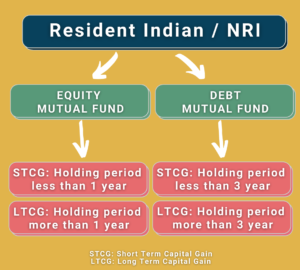
The holding period for Equity and Debt Funds will be different for taxation purposes. For equity funds, if the holding period is more than a year, then it is called the long term. If the holding period is less than a year, then such an equity mutual funds holding period is considered a short term. Whereas in

Whereas in the case of debt funds, a holding period of more than 3 years is considered as long-term. If the holding period of debt funds is less than 3 years, then it is considered short-term and taxed accordingly.

I will try to explain the same from the chart below.

The Capital Gain Mutual Fund Taxation FY 2021-22 / AY 2022-23 will be as per the below table.

Individuals

NRI

Stocks & equity oriented Mutual Funds

LTCG 10% above Rs 1 lakh gain 10% above Rs 1 lakh gain
STCG 15% 15%

Other than Stocks & equity oriented Mutual Funds

LTCG 20% with indexation Listed 20% (with indexation) & unlisted 10% (without indexation).
STCG Based on individual slabs Based on individual slabs


There is no change in Capital Gain Tax Rates from last year. Hence, the old rates will be applicable for FY 2021-22 also.

Note-Surcharge @ 15%, is applicable where the income of Individual/HUF unit holders exceeds Rs. 1 crore. Also, surcharge @10% to be levied in case of individual/ HUF unitholders where the income of such unitholders exceeds Rs.50 lakhs but does not exceed Rs.1 Cr. Further, Health and Education Cess @ 4% will continue to apply on the aggregate of tax and surcharge.

As you may be aware that during Budget 2018, LTCG was introduced again to Equity Funds. Hence, let me explain the same on how to calculate the LTCG on Equity Funds as below.

How to calculate LTCG on tax slabs & Equity Mutual Fund?

LTCG & STCG on Stocks & Mutual Funds (up to 31st January 2018)

Bought before 31st January 2018 10,000 stocks at INR 100
Sold within 365 days 10,000 stocks at INR 130
STCG Profit INR 130 15% STCG = INR 45,000
Sold after 365 days 10,000 stocks at INR 150
LTCG Higher of a) or b)

a)Actual cost (i.e INR 100)

b)Lower of the below

-The highest price of 31st Jan 2018 (Rs 120)

-Actual selling price (INR 150)

(Assumed that the highest price on 31st Jan 2018 is INR 120)

10% LTCG on INR 1,20,000

(10,000*Rs 120) - INR 1,00,000

INR 20,000

LTCG & STCG on Stocks &  Mutual Funds(from 1st February 2018)

Buy on 1st February 2018 10,000 stocks at INR 100
Sold within 365 days 10,000 stocks at INR 130
STCG Profit INR 3,00,000 5% STCG = INR 45,000
Sold after 365 days 10,000 stocks at INR 50
LTCG Profit INR 5,00,000 LTCG = Actual profit- INR 1,00,000

=INR 4,00,000

10% LTCG on INR 4,00,000 

=INR 40,000

Mutual Fund Taxation FY 2020-21 – Dividend Distribution Tax (DDT)

As I pointed above, effective from FY 2020-21, DDT was abolished in the hands of Mutual Fund Companies. Hence, any dividend you receive will be taxable for you as per your tax slab.

At the same time, if your such dividend income is more than Rs.5,000 in a Financial year, then there will be a TDS @ 10%.


Mutual Fund Taxation FY 2021-22: DDT Rates

Individual

NRI’s

Equity Oriented Schemes

As per the Tax slab As per the Tax Slab
Debt Oriented Schemes As per the Tax slab

As per the Tax slab


Security Transaction Tax (STT) for FY 2021-22

Security Transaction Charges or STT is the charges or tax when you buy or sell securities (excluding commodities and currency) through a recognized stock exchange. Therefore,

The definition of securities involves the below products.

  • Shares, scrips, stocks, bonds, debentures, debenture stock or other marketable securities of a like nature in or of any incorporated company or other body corporate;
  • Derivatives;
  • units or any other instrument issued by any collective investment scheme to the investors in such schemes;
  • Security receipt as defined in section 2(zg) of the Securitization and Reconstruction of Financial Assets and Enforcement of Security Interest Act, 2002;
  • Government securities of equity nature;
  • Rights or interest in securities;
  • Equity-oriented mutual funds

Therefore, whenever you buy and sell these securities through a recognized stock exchange, then you have to pay this STT.

Now let us understand the latest Security Transaction Tax (STT) applicable for FY 2021-22.

Security Transaction Tax (STT) Rates for FY-2021-22

Transaction Type Rates

Payable By

Purchase/ of equity shares (delivery Based) 0.1% Purchaser/ Seller
Purchase of units of equity-oriented mutual fund NIL Purchaser
Sale of units of equity-oriented Mutual fund 

(delivery Base)

0.001% Seller
Sale of equity shares, units of business trust, units of equity-oriented mutual fund 

(Non-Delivery Based)

0.025% Seller
Sale of an option in securities 0.05% Seller
Sale of an option in securities, where the option is exercised 0.125% Purchaser
Sale of future in securities 0.01% Seller
Sale of units of an equity-oriented fund to the mutual fund 0.001% Seller

Sale of unlisted equity shares & units of business trust under an initial offer

0.2%

Seller


TDS (Tax Deducted at Source) Rates for NRI Mutual Fund Investors 2021-22

Below are the applicable TDS rates for NRI Mutual Fund investors for FY 2021-22.

STCG Equity-The current TDS of 11.25% which was modified from 14th May 2020 to 31st March 2021 will I think continue for STCG-Equity Funds

STCG Other than Equity-The current TDS of 22.5% which was modified from 14th May 2020 to 31st March 2021 will I think continue for STCG-Other than equity.

LTCG Equity-The current TDS of 7.5% which was modified from 14th May 2020 to 31st March 2021 will I think continue for STCG-Equity Funds.

LTCG Other than Equity-The current TDS of 15% (for listed) and 7.5% (for unlisted) which was modified from 14th May 2020 to 31st March 2021 will I think continue for STCG-Other than equity.


Wealth Café Note: You pay taxes in a Mutual fund only when the gains are realized i.e. you redeem the funds and the proceeds of the same are credited to you. Now if there is a gain then the same is taxed as the taxation of mutual funds.

Hope now you got the clarity related to Mutual Fund Taxation FY 2021-22 / AY 2022-23.

Article Headers (10)-min

What is information bias in investing?

Information bias is the tendency to evaluate information even when it is useless in understanding a problem or issue. Today, investors had much more information than before, however, is it all good information? Can this be used to make smart money decisions?

Through social media, we are now being bombarded with new information almost every hour and sometimes every few minutes. Are you one of those who feel research means checking reels on top 3 funds to buy? Checking Youtube videos to confirm your understanding of various investments? Following twitter handles or paying 199 per month for telegram groups to know what is the next multi-bagger? Social media stalking is not detailed research that provides you all the information you need to make a smart investment decision. 

Where you are following people online who agree with your viewpoints and speak the things you believe in - you are already following an information bias. 

INFORMATION BIAS IN INVESTING
You should ask yourself if some of the information you are getting is relevant at all. Information like daily NAV movement, 52 weeks high or low NAVs, best performing funds of the month, etc. is useless in our view. Should you buy or sell a fund based on its last 7 days or 30 days' performance? However, with interesting captions, they are made to look as if it is very important information that you should pay attention to. But mostly they are irrelevant but excites you into buying a particular fund purely on its return number or performance of the past few months. In many instances, investors will make investment decisions to buy or sell an investment on the basis of short-term movements in the share price. 

Likewise, for mutual fund investors, top stocks bought or sold by fund managers every month is mostly not relevant. When you are investing in mutual funds, you rely on professional fund managers to do the stock selection because you do not have their expertise or experience. Top stocks bought or sold by fund managers can be an interesting article on the internet but should you invest in Direct Equity shares based on what a Mutual Fund manager is buying or selling?

The input of information has increased tremendously, now we have people dancing and explaining financial concepts on the net where capturing that information is easy and fun, we may miss out on the crux of the whole thing when learning about finance i..e it is very personal to you. You need to understand what works for your risk profile and your goals before investing in purely basis blogs/videos and others.

HOW TO AVOID INFORMATION BIAS

  • Financial planning: Financial planning with clearly defined financial goals and investment plans to achieve different goals can help you avoid information bias. Make sure that you are committed to your financial plan.
  • Know the fundamentals of investing: Know what is important and what is not. You need to understand what will make your financial goals successful and filter out the unimportant information.
  • Do not track your portfolio on a daily basis: It is important to monitor your portfolio regularly, but you do not need to track it on a daily basis. Short-term price movements have no impact on long-term portfolio returns. If you track your portfolio on a daily basis, then you are likely to be prone to information biases. Remember why you invested and for what goals. You must invest in equity for the long term - so checking it every day is not going to help get higher returns.
  • Seek counsel before you react to information: Information that you get every day or every hour usually has no bearing on long-term portfolio performance. If you want, you can seek more information about investments, but seek the guidance of a financial advisor before you act on the information you have. We are SEBI registered investment advisors and can help you make sound investment decisions - you can reach out to us at iplan@wealthcafe.in, in order to help you make a financial plan for yourself. A lot of information you get daily may be totally irrelevant and can harm your financial interests, if you act on it without considering other factors.

Common Retirement Planning Mistakes

Retirement planning used to be a lot easier. You worked your whole life for the same company and retired at age 65 with a gold watch and a company pension.

Today it’s more complicated. Most people will change employers many times over the course of their career or work for themselves at some point. At the same time, life expectancy is increasing. On one hand, that means more retirement years to enjoy. But the flip side is that you also have more retirement years to fund.

Living a retired life without enough savings can really be a dreadful experience. If you and your spouse don’t want to be a burden on your children after retirement, it is best to start retirement planning early and stick to the retirement plan by all means.

Don’t make the mistake of relying on others – even if they are your own children – to take care of you when you have reached your twilight years. Why should you rely on others post-retirement when you lived all your life on your own terms?

To live a comfortable retirement life on your own terms, you need proper retirement planning and to achieve that you need to avoid these common mistakes.

IGNORING PRICE RISE
Inflation is a demon that comes down hard on anyone who ignores it. "Since retirement is a long-term goal, it is important to understand the impact of inflation on your financial goal
If you ignored inflation while doing the maths, revisit the numbers. Always take the real rate of return (rate of return minus inflation) while doing the calculation. Also, use a realistic rate of inflation. You can take an average of the past few years. Lastly, don't underestimate inflation. It's better to err on the side of caution.
The only investment that will help you beat inflation and still make a corpus is equity. So you need a part of it in your portfolio. You can not plan for your retirement 20 years away by parking money in FDs only. However, EPF is a great debt portion of your retirement corpus mix.

CASHING OUT EPF MONEY
Many people withdraw money from their provident fund account. This is wrong as instruments such as the Employee Provident Fund (EPF) have been designed to provide financial security after retirement. These are highly useful for retirement planning, especially due to their tax-free status.
It is not good to withdraw money from the EPF, even if it is to make a big-ticket purchase such as a house. Instead, it is better to dip into other savings; EPF should be only for post-retirement years.
Basic of Employee Provident Fund (EPF)
Lesser known facts about Employee Provident Fund (EPF)
Step by Step Process for EPF withdrawal
What Should You Do With Your Old Inactive EPF Account?
When can you withdraw your EPF?

DELAYING HEALTH INSURANCE
Medical expenses rise as a person ages. Many people don't buy individual health plans during their working life as they are covered by employers. This is not advisable as most employers give the cover only till you are employed with them.
You also have the option of porting the employer's policy to individual cover at retirement. But do not depend on group policies after retirement as employers keep changing insurers and so you may miss out on benefits accumulated in the earlier policy such as waiver of waiting period for pre-existing diseases.
It is good to buy an individual health policy early in life. It is not only cheaper but also helps you cover pre-existing illnesses after completion of the waiting period. Moreover, it covers you even after you leave the job or your company curtails the benefits under the group plan to cut costs.
Health Insurance: What You Need To Know During COVID
6 things to note before buying a Health Insurance
Things To Do After You Buy A Health Insurance
Is your employer’s Health insurance sufficient?
Health Insurance: Single Plan or a Family Floater Plan?

NOT PLANNING FOR CONTINGENCIES
Your long-term investments are not for meeting contingencies. Hence, all people, irrespective of age and employment status, must build a contingency fund. Ideally, your savings should guarantee you a lifestyle after retirement which is the same as you enjoyed in your working years. This involves high-level contingency planning as your income streams dry up as you retire.

NOT HAVING ENOUGH MONEY FOR EARLY RETIREMENT
Stress is nowadays burning out people at a young age, making them think of retiring early. We come across many people who want to advance their retirement age. But most of the time we advise them to delay the plan if they do not have enough funds to last their lifetime. Early retirement requires rigorous planning for meeting life's goals.

Compounding is a powerful tool (the longer the period, the more the money will grow). If you think you will start saving later when your income rises, you may not be able to save enough. Therefore, enlist a financial advisor, start immediately, evaluate the available savings and protection instruments, calculate the funds required and get down to executing the plan

NOT HAVING ADEQUATE INSURANCE
When a bread earner dies, the whole family suffers a setback. A life insurance policy can take care of the family's well-being in such a case. The question is, how much cover one should have?

The ideal figure is at least 10 times the annual salary. This will give the family a cushion of ten years to adjust to the new financial reality. For example, if your salary is Rs 12 lakh a year, the cover should be at least Rs 1.2 crore.
Another approach is calculating the human life value, that is, the present value of your future income. Don't forget to factor in liabilities such as home loans while doing the calculation.

Buy a term insurance policy as soon as you can. Buy online to save on premium. And do not forget to increase or decrease the cover as your liabilities change.

Conclusion

Retirement is the next great stage in your life, and it can be just as fulfilling and exciting as your younger years. It’s your opportunity to do what you want when you want, whether that means relaxing at home, traveling the world, or reinventing yourself in a new career.  No matter where you are on the retirement continuum, you have likely made mistakes along the way. By focusing on retirement planning now, you can feel more confident about fulfilling your vision, whatever it may be. If you don’t have enough saved, it is never too late to start planning.

In addition to avoiding the problem areas above, seek advice from a trusted financial advisor to help you stay—or get back—on track. We are SEBI registered investment advisors and can help you make sound investment decisions - you can reach out to us at iplan@wealthcafe.in, to help you make a financial plan for yourself. A lot of information you get daily may be totally irrelevant and can harm your financial interests, if you act on it without considering other factors.

[mc4wp_form id="2150"]

WCafe Financial Services Pvt Ltd (formerly known as Wealth Cafe Financial Services Pvt Ltd) is a AMFI registered ARN holder with ARN-78274.

WCafe Financial Services Pvt Ltd (formerly known as Wealth Cafe Financial Services Pvt Ltd) is a SEBI registered Authorised Person (sub broker) of Sharekhan Limited with NSE Regn AP2069583763 and BSE Regn AP01074801170742.

Copyright 2010-20 Wealth Café ©  All Rights Reserved