Ways to reduce your capital gains while selling a house

Buying and owning real estate is an investment strategy that can be both satisfying and lucrative. It is said that one has to strip naked financially to invest in a house - and if you are going through the same - you can join us on 28th May 2022 where we shall help you in your dream of buying a house.

However, if you already own a house and wish to sell it - no matter what your reason is - tax is levied on the same depending on the asset type and the duration you hold it for. 

Firstly, let us understand which portion of the income is taxable on sale of real estate. Tax is payable on the profits you earn from selling the real estate - i.e. cost of acquisition - sales proceeds.

Nature of Tax Short-term capital gains Tax Long-term capital gains tax
Period of Holding  held for less than 24 months  held for  24 months or more
Tax applicable  as per the Income Tax Slab Rates   20%

Now before we jump directly on how you can save your taxes - let us first understand the various types of real estate that you can own:

  1. Residential Property: This is one of the most popular ones-such properties fill one of the basic human needs as well as reflect your dearest aspirations. Both reconstruction and resale homes are included in residential property. 
  2. Commercial Property:  Commercial property includes vacant land for commercial use or existing business buildings. Office spaces, showrooms, retail outlets and warehouses are just a few examples of such properties
  3. Agricultural/Open Land: Agricultural land is typically land devoted to agriculture - you cannot use this land to build residences unless the government grants you permission to do that. Under the provisions of the law in India, fertile agricultural land could only be used for agricultural purposes and nothing else.

Now that you understand the various type of property - let’s check some of the ways in which you can save your taxes from the sale of your property:

1. Under Section 54:

Section 54 of the Income Tax Act allows the lower of the two as exemption amount:

  • Amount of capital gains on transfer of residential property, or
  • The investment made for constructing or purchasing new residential property

You can avail this exemption by selling a residential property, which is a long term capital asset and buying another residential house property only. You cannot benefit from this in the case of the sale of commercial property or agricultural land. Only the balance amount from the capital gains (if any) will be taxable at 20%. However, you can save tax on that as well by reinvesting the remaining amount under section 54EC within six months of transfer subject to other conditions to save tax (discussed below).

Also, you should have necessarily purchased a residential house either two years after the date of transfer/sale or one year before the date of transfer/sale and in case the house is under construction – the time limit is 3 years from the date of sale. You cannot purchase any residential house out of India to claim an exemption under this section.

You can club capital gain from multiple properties to buy one property but you cannot invest capital gain from a single property to buy multiple properties. However, as an exception to this rule, the purchase or construction of two residential houses is allowed only if the gain is less than INR 2 crore. But, you can exercise this option only once in a lifetime.  For all other years, investment should be made in the construction/ purchase of 1 residential house only.

2. Under Section 54EC

Section 54EC states that if the profit made on the sale of Land or Building (whether Residential or Non-Residential) – is invested by you in ‘long-term specified assets within 6 months of the sale, then the capital gains are exempt from taxation. 

The ‘long-term specified assets’ referred to above are Capital Gain Bonds issued by the government organisations like the National Highway Authority of India and Rural Electrification Corporation. These bonds are AAA-rated with an interest rate of approx 5.25% p.a. The Principal invested becomes tax-free after the lock-in period but the interest continues to remain taxable.

The maximum that you can invest in these bonds is Rs. 50 lakhs and the investment comes with a lock-in period of five years.

You may want to buy capital gain bonds only if the amount you have made as capital gains is low. If the amount is large enough to buy or build a house, the residential property would be a better investment because of greater capital appreciation.

3. Under Section 54B 

No Capital Gains will arise on the sale of Agricultural Land situated in a Rural Area as it is specifically excluded from the definition of Capital Asset. However, Capital Gains will arise on the sale of Agricultural Land situated in a Non-Rural Area. Nevertheless, the exemption can be claimed from such Capital Gains under Section 54B. Under this section, capital gains, both short-term and long-term, that arise from the transfer of agricultural land into another agricultural land are exempt from Income Tax.

This benefit is available only to an individual or a HUF. Also, to benefit from this exemption the land should be used for the agricultural purpose at least for two years. If the cost of new Agricultural Land is equal to or greater than capital gains, then entire capital gains are exempt. Moreover, if the cost of new Agricultural Land is less than capital gains, capital gains to the extent of the cost of new agricultural land are exempt.

Can a capital gain tax exemption get reversed?

You can avoid paying the capital gains tax on the property if you reinvest the amount in a new property. But, the exemption will sustain if you hold the new property for at least two years. If you sell the property before 24 months, the exclusion will be reversed, and you would be liable to pay the capital gains tax that was exempted earlier.

Wealth  Cafe Advice:

If you are unable to reinvest the gains in another house or bonds before filing your tax return for the year in which the sale took place, deposit the balance in the Capital Gains Account Scheme so that you are eligible for the deduction. Capital Gains Account Scheme (CGAS) allows you to safeguard your long-term capital gains until you are unable to invest them in a house before the due date for filing an income tax. 

Talk to your mother about Money

My mother (and I am sure yours too)  has always been a support to me no matter what - whether it is my choice of clothes, my career decisions, relationships I should or should not be in, she has always been by my side. It is said a mother-child relationship is the most unconditional relationship ever.

This mother’s day, gift your mother (the love and support) she has given you in return by making her financially independent. She is the reason you can do whatever you want to in the world. Be her reason to be financially confident and be adaptable to what comes next. Whether your mother understands money, finances, English or just banking in general or not, this blog is to guide you on what kind of conversations & learnings you can have with your mother. 

As a step 1 - Understand where your mother is financially today and then guide her on what more she can learn to be financially secure and confident. Let's get started.

What are the financial things you can talk to your mother about?

1. Keep her informed about what you do

Before you tell her what she should do, it is important to tell her what you are currently doing. Discuss your job/work with her, explain to her your work profile, your salary, where you invest and why. We tend to discuss our expenses with our mother because she has some great answers on how to save better. Take it to the next step - discuss your investments with her. 


2. Where the money is Invested

Keep your mothers informed. How she knows about everyone’s health issues, food preferences and other things. Inform her about financial things as well. Whoever may be the decision-maker (you or your father or grandfather), get her involved in financial discussions of the family. Tell her where the family money is invested and how she can access it when and if the time arises.


3. Basics of banking 

One of the first things to make your mother confident about money is to guide her with banking work. Ask her to go to the bank and deposit cheques, visit the branch for any work that may need bank help, update the passbooks frequently and withdraw cash from the ATMs.

Explain to her how a credit card works and how she can make the best use of it, it will encourage her to use it to spend on her shopping and earn points too. You can buy things for her from the reward points earned on the card. 

These may seem very simple for us but for her, it means freedom and access to money without asking us or our father constantly. 


4. Guide her to be digitally smart

Gpay, paytm, phone pe is the way to go ahead and it only makes sense that your mom can shop by paying via gpay. I mean even our next-door sabji wala is now taking money on UPI payment apps. It may take time to explain to her how to do this, she may be scared, confused and ask you the same thing again and again. Do not lose hope and patience, explain to her slowly and trust me she would get it.

I now get shagun on gpay from my mom for festivals, so it is a win-win for everyone.

Where your mom has gotten the basics right, you can start by explaining her mobile banking and online shopping. Again 2 very important life skills are needed in today's time. Ask her to start with small ticket things and then move ahead. It will give her confidence and eventually reduce the calls to you about how to send money to someone, or buy a new dabba for the kitchen. She will do it all herself. 


5. Make her aware of financial fraud but don't scare her.

The reason our moms are not going and doing everything online is that financial frauds are scary and very much real. She must be knowing someone who has been a part of it and does not want to meddle with family’s or her money. Take it as your job to build her trust in the system, teach her how to do it right and never to do it around strangers.  


Most importantly make her feel secure that if anything does happen, you are there to take care of things.  One line will change her entire approach towards this process of learning UPI and more and she will do it overnight. 


6. Insurance - check if she has one and she is informed about others

Continuing from our earlier discussions on keeping her informed about the various financial situation of the family. You must inform her about insurance as well. Keep her informed about insurance you have/other members of the family have and where are the papers for the same.


Check if she is properly ensured (health insurance), if need be get a top-up for the same and also tell her where the documents are and how to access them. For example, my mother books her annual free health check-up (which is provided to her by her health insurance) by herself now and gets a check-up done. One thing she knows is that it is important and FREE. So she never misses it. Give your mother the incentive to learn and see her fly. 


Wealth Cafe Advice:

Do remember that it will take time, patience and a lot of arguments (I must have left it thrice and then gone back to explain her again), the end result is beautiful and it will make your mother confident and independent. Yes, loving your mom, cooking for her that one day or handholding her with different things does make us all happy. Along with this, work towards making her independent too.  The confidence she would feel when she goes to the bank or transfers that money to you cannot be compared to the best compliment ever given her.


Our mother may lack behind in investments, but you all may agree she is best at saving and budgeting. 

We need to motivate her and tell her how good she is managing her monthly budget, how good is she at bargaining and finding the best deal while buying groceries or shopping, and how well she has managed to teach herself to spend wisely. Just take it to the next level and teach her on how to do it all online and invest too.

You can enrol her to our Be a Fe-Money-ist Webinar that we are conducting this Saturday, i.e on 7th May - for more details - click here.

If you wish to learn more about the various asset classes you can learn more about it here. Use code SAVE20 for 20% off.

Blog Article 2022 (4)

Financial planning: Steps to take when you have a Newborn

It’s no secret that pregnancy comes with a long to-do list. There are the obvious tasks (setting up a nursery and baby proofing your home), and the less so (applying for baby’s aadhar card and opening a bank account). Things might get difficult to manage when the baby arrives but with a little bit of planning, you can get a head start on these crucial to-dos to save you time (and stress) once the baby arrives. 

So here is your handy guide to getting the baby's important documents – from where you can get them, to how to go about applying for it, and everything in between! But before you even plan to make any of the following documents, it is important to name your child. Always remember, to mention your child's name without any spelling errors - even a letter change or an extra space can make a huge difference.


1. Birth Certificate

Let’s start with the very first document you need- Baby’s Birth certificate. This is a vital and mandatory document that you would have to prepare for your child within the first 21 days of the child’s birth, by filling up the form prescribed by the Registrar. It contains details such as time and date of birth, location, gender and parents’ names. Most Birth Certificates today contain the name of the child unlike in earlier times, which makes it a valid Proof of Identity. It usually takes up to seven days for the authorities to issue a birth certificate. However, if due to some reason, you fail to register your child within the stipulated time, you will have to pay a late fee. 

Documents needed: Self-attested declaration stating the purpose to be submitted to the Corporation along with the form issued by the hospital. 


2. Aadhar Card 

Starting from gas subsidies to working as valid residence proof, the Aadhar Card has numerous benefits and it only takes a little time and effort to make one for your child. 

Getting an Aadhar card for a newborn involves no biometrics. You just need to book an appointment online by logging in to the official UIDAI website. Your child will be processed on the basis of demographic information and facial photographs linked with your UID. However, you need to update their biometrics of ten fingers, iris and facial photographs, when they turn 5 and 15.

Documents needed:

  • Child’s Birth certificate
  • Aadhar Card details of either/both parents of the child

Note: Original copies for both these documents will be required for the verification process.


3. Bank Account 

Opening a bank account is one of the most important steps to undertake. Once you have a kid you will start getting gifts on their birthday as well as at various festivals. Many times these gifts include cash which you tend to spend here and there. Instead, you can deposit all these gifts in cash in their savings account behalf of them.

Documents required to open a bank account for a minor:

  • Child’s Birth certificate
  • KYC documents of the parents/guardian.
  • Child’s Aadhaar card.
  • Specimen signature of a guardian. The minor's specimen signature if he/she is 10 years old or above.


4. Pan Card (optional)

Many people face the question - of whether a minor can apply for a PAN Card as it acts as an important identity proof. The answer is yes, it is possible and the procedure for applying it is a simple and streamlined one. You need to submit an application on the official website of NSDL. Upon submitting the application, you will get a receipt number using which you can track the PAN card application of your ward. Usually, the PAN card reaches your given address within 15 days of successful verification. 

Documents needed:

  • Child’s Certificate of Birth
  • Child’s Aadhaar card 
  • Child’s Photo
  • ID and address proof of the parents


5. Passport (Optional)

A valid Indian passport holds a lot of importance and is considered an accepted Proof of Identity and Proof of Address for procuring various other documents and even for school admission procedures. Thanks to simplified computerised procedures, getting a passport for your child is no longer a hurdle. 

You can book an online appointment at www.passportindia.gov.in and after booking an appointment on the website, you can reach the PSK (Passport Service Kendra) with your child at the allotted time slot to avoid unnecessary waiting.

Documents needed:

  • Child’s Certificate of Birth
  • Child’s Aadhar Card
  • Filled and signed Annexure H which can be procured from the Passport Seva Kendra website.
  • Identification photograph of the child against a white or light-coloured background.
  • Arrangement receipt
  • Marriage certificate if the spouse's name has not been endorsed on a parent's Passport


Now that all the documents are in place you need to start planning for their investments. In case you have a girl child you can open a Sukanya Samriddhi Account.

We hope this was useful for you. In case of any queries, you can reach out to us at iplan@wealthcafe.in

    Get your weekly dose of Money Masala from us.


    How is inflation affecting our everyday lives?

    Inflation can impact our finances in a number of ways – from the cost of our weekly shop to the value of our long-term savings – but what exactly does it mean?

    Inflation might be something that not many people understand. Yet, we all experience it and feel its effects. When you head to the store expecting to spend a budgeted amount of money on something, only to spend a lot more, you’ve experienced inflation. Of course, when a price rises on a product it’s not always due to inflation. Yet, inflation still affects your cost of living by increasing the cost of goods and services.

    This is why it’s so important to consider inflation when planning for the future, even if the future is as soon as next year. Especially when planning for retirement, you need to ask yourself what you want as your standard of living because inflation directly affects your lifestyle.

    Therefore, it’s important to understand how inflation works, as well as the effects it could have on your financial planning.


    What is Inflation? How does it personally affects you?

    Inflation is often referred to as a “measure of the increase in the price of goods and services over time”.

    Yes, it affects everyone. Yet, it affects everyone very differently. Your lifestyle is based on your income and your expenses. Sometimes, people who have a high standard of living but not a high enough income end up borrowing money to make up the difference.

    Inflation not only affects the cost of living – things such as transport, electricity, and food – but it also impacts interest rates on savings accounts, the performance of companies, and in turn, share prices.

    When inflation rises, borrowing money becomes very expensive. This means either people take out fewer loans or they’re unable to spend less money because it’s going towards debt payments. This reflects a reduction in the purchasing power of your money. In other words, this impacts your ‘buying power, as you’re now able to buy less with your money.

    For those people whose standard of living matches their income, inflation can be both a positive and a negative. Usually, when inflation rises, your income also rises as there are adjustments based on the cost of living. However, even with an increased income, expenses also rise. For those on a fixed income – like retirees – inflation can greatly affect their standard of living.


    Let me give you a few examples of where we were to where we are now when it comes to our spending habits or lifestyle expenses.


    Movie tickets: From 1975 to 2015

    Watching the latest flick, on opening day for just 3 rupees. Madness. Of course, while there are places where you can still get tickets for a tenner (DDLJ in Maratha Mandir), those places are few and far between.


    Coca-Cola: From 1965 to 2015

    This was before Coca-Cola was kicked out of the country in 1973. And here we thought a small Coke for 5 rupees was a big deal.


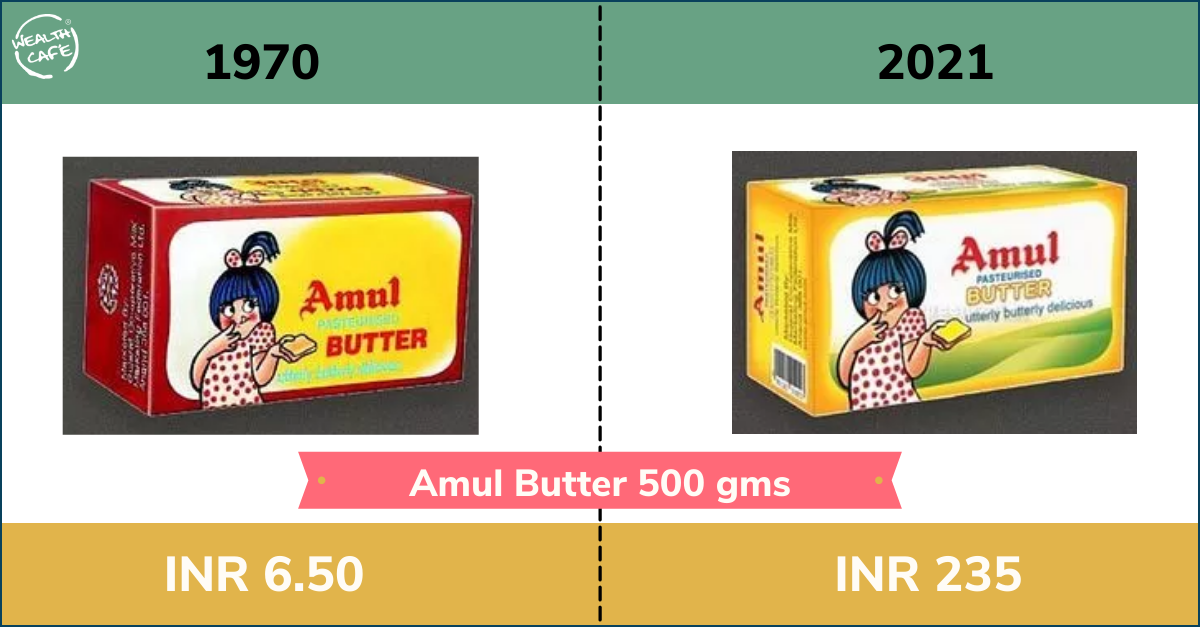
    Amul Butter 500 gms: From 1970 to 2015

    Guess those really were "butter" times, eh?


    Is Inflation bad for everyone?

    Inflation is perceived differently by everyone depending upon the kind of assets they possess. For someone with investments in real estate or stocked commodities, inflation means that the prices of their assets are set for a hike. Those who possess cash may be adversely affected by inflation as the value of their cash erodes. A higher rate of inflation can make repaying loans easier because they can end up paying back less money if the interest rate is lower than the rate of inflation.

    Therefore, Inflation influences all aspects of life. You’re going to have to navigate a variety of risks now and in the years ahead, no matter which direction inflation swings. Since everybody relies on goods and services in one way or another, inflation is felt by everybody – either negatively or positively. The best thing to do is to plan for it. If you are saving for the future, pay attention to inflation.

    Blog Article 2022 (2)

    Financial Planning for Siblings

    “Blood is thicker than water” we have all heard this growing up, in fact, experienced it as well with our siblings. Along with this, we have also heard stories in our families or otherwise where siblings ditched each other for ancestral property, did not pay back the loan or diss one another for having more money. Yes, Money is great when you start as you celebrate together, shop together and enjoy everything together but it could also turn into something very complicated. 

    Money discussions between siblings may not be the most common dinner conversation but it is a good practice to take some time out and start talking about money before things get sour. Here we are sharing our insights on how and what you can talk about: 

    WHERE YOU LIVE TOGETHER : 

    Money is obviously an important factor when you live together as there will be some shared expenses between you two. In some families, parents take care of expenses and there this might not be a major discussion. But as the year's pass, the responsibility would eventually fall on the children and it is best to be prepared for that discussion or maybe have it in advance. Usually, the elder sibling takes care of the family expenses (especially where there is a brother-sister equation). However, there may come a point where they would have more responsibility or may be strapped for cash or want to splurge on themselves and then it could end up getting ugly. Instead have a discussion and set certain things right:

    1. Talk about who will take care of what expenses. How will you split the bills?
    2. The person earning more can contribute higher but the other one should also contribute some money so there is parity.
    3. Include the other in your financial plans where you are planning to help the other with their goals like marriage, higher education or setting up a business. 

    WHERE YOU LIVE SEPARATELY:

    Money is not too much of a problem when you live on your own and both are taking care of their individual needs. Over the years though you could have some shared responsibilities like your parents and their retirement. 

    1. Understand from your parents how financially prepared they are for their own health concerns and retirement so you both know what and how much you need to take care of in future. 
    2. Decide how you will both(all) contribute and take care of the expenses of your parents.
    3. Where one sibling wishes to splurge on parents any financial need, the other should be accommodative and not jealous of the same. Have a talk!

    WHERE YOU HAVE AN INHERITANCE COMING:

    We could write pages and stories on what all can go wrong with inheritance but we are expecting better of our wealth cafe investors. Do not get carried away by greed to own everything that your parents do but understand what they wish for you and your siblings. 

    1. Have a discussion with your parents, and ask them to have a will in place so there is no fight tomorrow. 
    2. Talk to each other as well, if you feel you are comparatively better off than your sibling, let them have a bigger chunk of the inheritance.

    Remember that you are siblings before money. Do not lose your brother/sister for some money that may or may not come to you. Develop some money values between yourselves

    1. Talk and communicate with each other.
    2. Be honest. Contribute where you can.
    3. Do not take undue advantage of the one with more money or otherwise.
    4. Ask your parents to be a part of this discussion.
    5. Where you have sisters ensure she is included in discussions and financially aware of things the family is doing.
    6. When you give loans to each other, have proper documentation in place so you do not have a fight regarding it in future. 

    We have all seen situations where one brother defies another for a better inheritance or money, we are hoping that the coming generation will be better off. Money can be a major cause of families breaking - up. Hence, the best way to ensure that does not happen is to talk to each other. 

      Get your weekly dose of Money Masala from us.


      Blog Article 2022

      5 Insurances that every individual must have

      Insurance is your safety net, once it is built then you can invest comfortably without worrying about any contingency that may or may not dip into your savings. Insurance as the name suggests means protecting yourself and your family ‘financially’ from any contingent (things which may or may not happen) events.

      Let’s build this safety net for you and your family. The basic 5 insurances that you must have in place are as :

      1. Health Insurance- Insurance you absolutely need.

      With a steep rise in the medical cost and diseases not being age-specific, having a health insurance policy is a number 1 priority. Where most individuals would have health insurance from their employer, it is advisable to have your own mediclaim as well and where you are self-employed, health insurance becomes a must. You can opt for an individual policy or for the family, or opt for a family floater plan under which the whole family gets covered in one policy. Do remember to get health insurance that covers most of your health needs and also has a cashless claim in your neighbourhood hospital.

      You can know more about health insurance by going through these articles.

      2. Life Insurance - Term Insurance

      You obtain life insurance for the ones who continue to live after an untimely death and to secure them financially. Life Insurance must replace you financially and can be around 10 to 12 times your yearly income.

      Generally, investors end up looking at how much would you get in return from the insurance policy rather than the sum assured and for how long to have the insurance policy. A small reminder that term insurance is a must for everyone who has or would eventually have any dependents financially. And for returns and investments, you have many investment options available.

      You can know more about Life insurance here

      3. Personal Accidental Insurance

      Personal accidental insurance is the least opted insurance, especially in India - this is due to the lack of awareness of the various benefits accompanied with this insurance. It provides financial coverage against accidents that may cause bodily injury, permanent partial disability or permanent total disability and accidental death. It covers hospitalisation, pre and post hospitalisation, and offers a daily cash allowance of up to 30 days, depending on the insurer. In case of loss of income, it even covers you for a certain period, depending on the insurance you choose. Also, when it comes to the cost of premiums, this insurance has the least premiums against an exclusive range of coverage.

      Given the raging accidents, we see every day this policy becomes a must-have too.

      4. Critical Illness Insurance.

      Generally, health insurance plans do not provide cover for critical illness or life-threatening diseases such as cancer, tumours, paralysis, bypass surgery, heart disorders as well as organ transplants. Treatment for these illnesses is also quite expensive. With some of these illnesses, hospitalizations are not required, and regular hospital visits are required over a long period of time. Therefore, having critical illness insurance can help you stay financially equipped for such medical emergencies.

      However, these critical illness plans offer fixed benefits where a lump sum amount is paid to you for the treatment. The amount can be used not only towards treatment but towards your other financial responsibilities.

      5. Home Insurance

      A house is one of the most valuable and precious possessions that holds many priceless memories and belongings. Therefore, it is extremely essential to protect this prized possession against numerous unexpected damage that may not be in your control for eg, theft, natural calamities and so on.

      Property insurance is calculated based on the value of the objects insured. For a homeowner, it may be the current value of the house, and the furniture and other items that have to be insured whereas for a shopkeeper, it will be the value of goods that are currently lying in the shop.

      With the ever-increasing costs of electronics and other items at home, it is crucial you protect yourself financially from that extra loss, and obtain home insurance. Generally, for apartment societies, the co-operative buildings already cover the structure so your home insurance is only for the contents of the home. It would be a good practice to check with your society if the building and structure are insured or not.

      Wealth Cafe Advice

      Insurance policies work as a shield to protect you and your valuable possessions against numerous

      Fun is like Life Insurance, the older you get the more it costs - Kin Hubbard. Buying insurance today will not only protect your family & yourself from the contingent expenses and loss of income but also be cheaper for you. Make the shift in your understanding of insurance and take it to build your safety net.

      Where you wish to learn more about insurance - check out our course NM102: Build your Safety Net. You can use code SAVE20 for a 20% discount.

        Get your weekly dose of Money Masala from us.


        Blog Article 2022

        All about Advance Taxation

        Advance Tax Payment is a set up to pay a share of your taxes in installments on due dates decided by the income tax department. It is also known as the ‘Pay as you earn scheme’.

        What is Advance Tax Payment?

        Advance tax means income tax that should be paid in advance instead of lump sum payment at year-end. It helps the Govt. to receive a constant flow of tax receipts throughout the year so that the Govt can incur its expenses timely rather than receiving all tax payments at the end of the year. This keeps the government rolling

        Who is liable to pay Advance Tax?

        The eligibility criteria you will have to fulfill in order to pay advance tax are:

        • Your tax liability should be INR 10,000 and above.
        • You should be a salaried or a self-employed individual.
        • Income received via capital gains on shares.
        • Interest earned on fixed deposits.
        • Winnings earned from a lottery.
        • Rent or income earned from house property.

        Exemption in Advance Tax Payments

        • Senior citizens aged 60 years and above are exempted from paying the advance tax.
        • Salaried individuals falling under the TDS net are exempted from paying the advance tax.
        • However, any earnings from sources such as interest, capital gains, rent, and other non-salary income will attract advance tax.
        • If TDS deducted is more than the tax payable for the year, then one does not have to pay the advance tax.

        Payment of Advance Tax:

        You can choose to pay advance tax by any of the following modes:

        • Offline Mode: You can pay advance tax using Challan 280 just like any other regular tax payment at bank branches authorized by the Income Tax Department.
        • Online Mode: You can also pay it online through the official website of the Income Tax department.

        Due date and Penalty on late payment

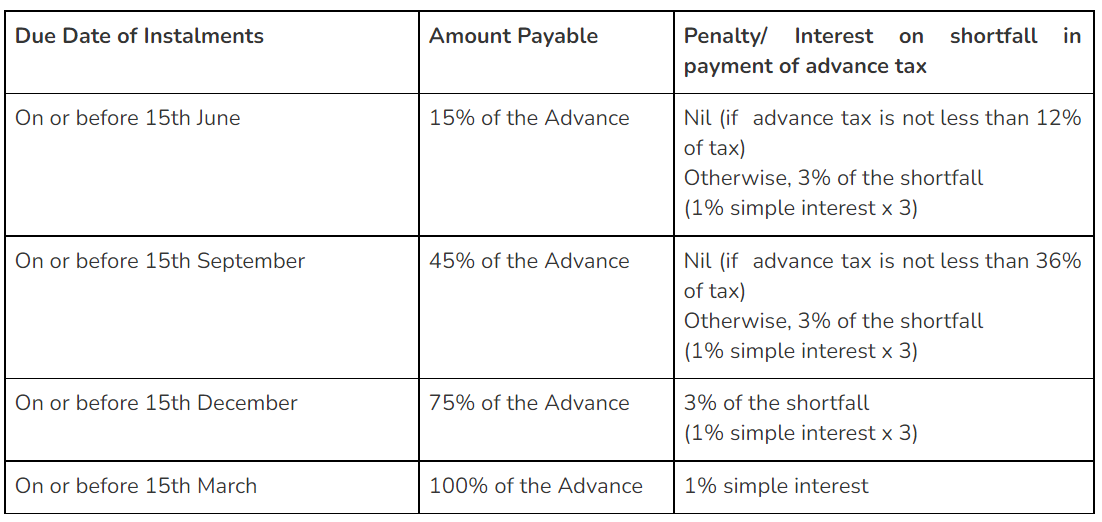
        Computing the exact advance tax liability sometimes gets very difficult and therefore the Income Tax Dept has released an Income Tax Calculator which is free to use by everyone. If your tax liability is more than INR 10,000- you should pay your taxes on or before the dates mentioned below. Also, you will need to pay a penalty in case you miss paying it.

        Screenshot 2022-03-09 220142

        Interest on late payment of Advance Tax is applicable as follows

        1. Interest under section 234C – Interest @ 1% per month is payable if the tax is not paid as per the above schedule i.e. for Deferment in Instalments of Advance Tax
        2. Interest under section 234B – Interest @ 1% is payable if 90% of the tax is not paid before the end of the financial year i.e. for Default in Payment of Advance Tax
        3. For computing Interest u/s 234A/B/C and any other Interest, Income Tax shall be rounded off to nearest hundred and fraction of hundred shall be ignored

        Refund in Advance Tax Payment

        At the end of the year, if the Income Tax Department finds out that you have paid more tax than you should have paid, then it will refund the excess amount. Taxpayers can claim a refund by filling out and submitting Form 30. They have to make the claim within a period of one year from the last year of the assessment year

        Wealth Cafe Advise

        Where you are earning any income on which taxes could be more than INR 10,000 and the same is not deducted as TDS, then you must compute the same and pay it as advance taxes. It is best to consult a chartered accountant before 31 March so in case there are any advance taxes to be paid, you can do so without levying any penalty.

          Get your weekly dose of Money Masala from us.


          Silver ETF

          Diversification is the soul of investing. It also helps you to reduce the risk of having all your eggs in one basket. However, when you plan to invest in commodities, the first thing that comes to your mind is gold. This is mostly because we did not have hassle-free access to invest in any other commodities through investment routes like mutual funds.

          In this article, we wish to introduce you to a new way of investing in silver and how to go about it.

          Why should you invest in Silver?

          ‘Sona’ and ‘Chandi’ have been the traditional best forms of Investments for Indian households. We have always looked at buying Chandi for everything auspicious. Silver also gets consumed irretrievably in traditional industrial and renewable energy and electronics. Demand for silver is expected to remain constant and in the long term, it is believed that there would be a mismatch between demand and supply of silver, resulting in higher appreciation in silver prices in the future.

          Therefore, silver is among the preferred option globally when it comes to investing in precious metals. Historically, in times of increasing inflation, the value of silver increases and vice versa. Interest rate hikes play a role in inflation, thereby increasing the attractiveness of silver while decreasing the attraction of other asset classes.

          How can silver be bought?

          Silver can be purchased in physical forms like bars, coins, and utensils. We can also take exposure to silver contracts on commodity exchanges but commodity exchanges offer you trading options rather than investing options in electronic form. As far as electronic options to invest in gold are concerned, there are plenty of options to invest in like gold ETF, gold saving funds, and Sovereign Gold Bonds, but till very recently there were no options available to invest electronically in silver. However, with SEBI permitting silver ETF in November 2021, investing in silver is also becoming easier and hassle-free. 

          What are Silver ETFs? 

          Like Gold ETFs, Silver ETFs track the prices of silver. These ETFs will invest at least 95% of net assets in silver and Exchange Traded  Commodity  Derivatives (ETCDs) having silver as the underlying. These funds are benchmarked against the price of silver (based on London Bullion Market Association, or LBMA, Silver daily spot-fixing price).

          Investing in silver through a silver ETF helps you save on costs of storage like locker rent as well as insurance premiums. Moreover, when you buy physical silver you have to pay the GST (Goods and Service Tax) but no credit is available to you for GST paid when you actually sell the physical silver. This actually reduces the overall return on your investments. Since the fund house though pays GST at the time of physical purchase of silver and gets the credit at the time of sale, effectively GST does not add to their cost of investment. It is just inconvenient to invest in physical silver because they turn grey and black in humidity as well.

          How to invest in Silver ETFs?

          Silver ETFs are traded on the stock exchanges so you need to have a Demat account as well as a trading account for investing in silver ETFs.  You can invest in silver ETFs like any other ETF. 

          To know more about ETFs - refer to our article here.

          Taxation 

          Gold and silver both are capital assets and are treated as debt products. Your investment in bullion, whether physical or electronic, becomes long-term after 36 months.

          So, Sold before three years: Taxed as per slab Rate

          Sold after three years: 20% LTCG with indexation benefits. 

          Wealthcafe Advice: 

          Silver does not need a special allocation in your portfolio. Like you do not have to go out of your way to make funds available to invest in silver ETF. It can form a part of the gold allocation of your asset allocation. Precious metals i.e. gold should be around 5% of your asset allocation. Your silver will also form a part of your existing gold allocation. Do note that gold should have a larger share as it has a better hedge and has a lower correlation to debt and equity. 

          Pradhan Mantri Jan Arogya Yojana (PMJAY)

          Pradhan Mantri Jan Arogya Yojana(PM-JAY) also known as Ayushman Bharat Yojana is a pioneering initiative of Prime Minister Modi to ensure that poor and vulnerable populations are provided health cover. This initiative is part of the Government’s vision to ensure that its citizens – especially the poor and vulnerable groups have universal access to good quality hospital services without anyone having to face financial hardship as a consequence of using health services.

          How does it work?

          The Ayushman Bharat Yojana scheme offers health insurance cover to beneficiaries without any premium cost, treatment cost during and after the hospitalization. Ayushman Bharat scheme covers both pre and post-hospitalization expenses in addition to the in-patient charges.

          And all the impaneled hospitals under PMJAY Scheme would have appointed Ayushman Mitra's, who will aid the patient by coordinating with the hospital’s beneficiary in order to cut the expenses. You will find these Ayushman Mitra at their help desk where they will be verifying the eligibility criteria, documents, and the enrolment process. They provide letters to all the beneficiaries with respective QR codes.

          Furthermore, this QR code is scanned and verified for authentication to check the eligibility for people to avail Ayushman Bharat Yojana benefits.

          And the best part about the Ayushman Bharat scheme is that it offers coverage across PAN India and offers cashless hospitalization benefits to the enrolled families in both public and private hospitals.

          What is Covered under Pradhan Mantri Jan Arogya Yojana?

          PMJAY covers the following expenses during the treatment:

          • Provides coverage for medical examination, treatment, and consultation fee
          • Pre-hospitalization expenses are covered 
          • Post-hospitalization expenses are covered for 15 days
          • The policy also covers the cost of medicine and medical consumables
          • Hospital accommodation charges are also covered
          • Non-intensive and ICU services
          • The expenses incurred on the Diagnostic procedures are also covered
          • Medical implantation services are covered where required
          • Expenses incurred on complications arising during the medical treatment
          • Food services

          List of Critical Diseases covered under PM Jan Arogya Yojana (PMJAY)

          PMJAY offers nearly 1,350 medical packages at any of the private network hospitals and all the public hospitals. Below are some of the critical illnesses that Pradhan Mantri Jan Arogya Yojana covers:

          • Carotid angioplasty with stent
          • Prostate cancer
          • Coronary artery bypass grafting
          • Skull base surgery
          • Pulmonary valve surgery
          • Double valve replacement surgery
          • Anterior spine fixation
          • Tissue expander for disfigurement following burns

          How to apply online?

          Here is a step by step guide on how you can apply for Pradhan Mantri Jan Arogya Yojana

          Step 1: Visit the official website, mera.pmjay.gov.in.

          Step 2: Now you have to log on to the government website.

          Step 3: On the homepage enter your mobile number.

          Step 4: Just below that you will see the captcha, enter the captcha in the empty box.

          Step 5: After that click on Generate OTP option.

          Step 6: An OTP number will be sent to your mobile, by which you can go to the website and verify.

          Complete the necessary details to get the most benefits out of this scheme. So, these were some initial steps you need to follow for Pradhan Mantri Jan Arogya Yojana registration.

          Documents Required to Apply For Ayushman Bharat Yojana Scheme

          • Age & Identity Proof (Aadhaar Card/PAN Card)
          • Contact details (mobile, address, email)
          • Caste certificate
          • Income certificate (maximum annual income to be only up to Rs. 5 lakh a year)
          • Document proof of the current status of the family to be covered (Joint or nuclear)

          Note: After your name is registered on the Pradhan Mantri Jan Arogya Yojana(PM-JAY) website, with the help of your ration card or mobile number, you can know that you are not getting the benefit of this scheme.

          How to Check your Name in Ayushman Bharat Yojana Scheme List?

          There are various methods to check your name in the PM Jan Arogya Yojana -PMJAY beneficiary list. Listed below are some of the ways that you can try:

          • Online Method- Ayushman Bharat online list can be checked by the beneficiaries. All you need to do is visit the official online site of the National Health Authority for Ayushman Bharat Yojana.
          • Common Service Centres (CSC)- If you are a beneficiary of Ayushman Yojna you can also visit the nearest Common Service Centres. If it is not possible to do so you can also visit any of the impaneled hospitals to collect the information form. You can check the Ayushman Bharat hospital list on their site or in your policy documents.
          • Contact their Helpline No.- You can call on any of the government of India provided helpline numbers (e.g. 1800111565) to contact their customer care and seek the information about PMJAY Scheme, Ayushman card/e-card, Ayushman card apply, Ayushman card download, and even Ayushman Bharat Scheme registration.

          If your name is there on the list, then only you will get the Ayushman Bharat Card.

          How to Download your Pradhan Mantri Jan Arogya Yojana Card Online?

          It is important to apply for the Ayushman card as it consists of a dedicated family identification number. AB-NHPM is provided to every beneficiary household. Below are the steps that you can follow to apply or download your Ayushman card online-

          • Firstly, visit Ayushman Bharat Yojana official website - https://pmjay.gov.in/
          • Now login with your email id and generate a password
          • Enter your Aadhaar number to proceed further
          • Click on the approved beneficiary option
          • It will be redirected to their help center
          • Now enter your password in CSC and the pin number
          • It will be redirected to the home page
          • You will see the download option form where you can download your Ayushman Bharat golden card

          Wealth Cafe Advice

          It is good to stay updated about this scheme where you or your family are eligible and could be a part of the scheme. As per the terms, you cannot apply for it on your own. Let's wait and see how it works out and soon most of the people would get covered under it. Until then apply for the other government schemes that are available to you. 

          1. Atal Pension Yojana
          2. Pradhan Mantri Jeevan Jyoti Bima Yojana (PMJJBY)
          3. Sukanya Samriddhi Yojana
          4. Pradhan Mantri Shram Yogi Maan-Dhan


          Pradhan Mantri Jeevan Jyoti Bima Yojana (PMJJBY)

          A large portion of India’s population (80%) is without insurance of any kind i.e health, accident, or life. Therefore in the year 2015, the Finance Minister announced PMJJBY along with 2 other schemes in his budget speech.

          Pradhan Mantri Jeevan Jyoti Bima Yojana (PMJJBY) is a life insurance scheme in India backed by the Government. The life insurance scheme is valid for one year and is renewable from year to year, offering coverage in case of sudden death.

          How does the scheme work?

          The scheme is applicable for a period of one year. The scheme will be offered by the LIC and all insurers who are willing to join the scheme. Bank will be the master policyholder and will execute the claim and issue the scheme on the insurance company’s behalf.

          This cover is only for death and hence the benefit will accrue to the nominee on death of the policyholder. Therefore, it covers morality and no investment component. 

          The current risk period is from the 1st of June to the 31st of May. . The same will be renewable yearly.  Delayed enrolment for prospective cover is possible with payment of pro-rata premium as described below;

          Simply put the premium amount that you have to pay will depend upon in which quarter you enroll for the scheme. Where you enroll in:

          • June, July & August: Annual Premium of INR 330 is payable
          • September, October & November: Annual Premium of INR 258 is payable
          • December, January & February: Annual Premium of INR 172 is payable
          • March, April & May: Annual Premium of INR 86 is payable

          A Lien period of 45 days shall be applicable from the date of enrolment. However, deaths due to accidents will be exempt from the lien clause, the Reserve Bank of India said in a note.

          The cover shall be for a one-year period stretching from 1st June to 31st May for which the option to join/pay by auto-debit from the designated individual bank / Post office account on the prescribed forms will be required to be given by 31st May of every year. Delayed enrollment for prospective cover is possible with payment of a pro-rata premium as laid down in the above parameter. 

          There is a waiting period of 30 days in the insurance policy when you first apply for it, which means, If you are enrolling for the first time on or after 1st June 2021, the insurance cover shall not be available for death (other than due to an accident) occurring during the first 30 days from the date of enrolment into the scheme (lien period) and in case of death (other than due to accident) during lien period, no claim would be admissible. 

          If you exit the scheme at any point you may rejoin the scheme in future years. 

          In future years, new entrants into the eligible category or currently eligible individuals who did not join earlier or discontinued their subscription shall be able to join while the scheme is continuing, subject to the 30 days lien period described above.

          Coverage

          The total death benefit provided is INR 2 Lakhs. In case of death of the insured, the nominee can claim the amount, which would be tax-free. The claim process is also simple and hassle-free. 

          Eligibility

          To avail of benefits, you must fulfill the below requirements:

          1. Must be a citizen of India.
          2. Must be between the age of 18-50
          3. Must have a bank account/post office account linked with your Aadhar
          4. Must have a valid mobile number

          Note: The PMJJBY may be terminated if:

          • An insured person crosses the age of 55 years
          • Closure of accounts with the Bank/ Post office or insufficiency of balance to keep the insurance in force.


          Pradhan Mantri Suraksha Bima Yojan (PMSBY)

          Pradhan Mantri Suraksha Bima Yojana offers a renewable one-year accidental death and disability cover of Rs 2 lakh at Rs 12 premium every year. You will get Rs 1 lakh in case of partial permanent disability.

          The entry age of the scheme ranges from a minimum of 18 to a maximum of 70 years old.

          How to apply?

          You can get PMJJBY as well as PMSBY via LIC or any other life insurance company in India. Also, many banks have the facility for PMJJBY & PMSBY at their branches. 

          The enrollment process is quite simple:

          1. Download the application form from jansuraksha.gov.in/FORMS.aspx 
          2. Submit the duly filled form with your bank
          3. Submit the necessary documents
          4. Upon verification, you will be successfully registered

          Most banks also offer an SMS-based enrollment process.  Check with your banks for the details on the same and proceed with the application. You can also apply for it from your bank's official website.

          How to get the benefit? 

          1. Nominee to approach the bank where the subscriber opened the scheme with a 'savings bank account' along with the death certificate of the member.
          2. Nominee to collect claim form, and discharge receipt from the bank or any designated source like insurance company branch, hospital, etc. including from designated website
          3. After that, the nominee will have to submit the filled claim form and the discharge receipt, along with the death certificate with a photocopy (Xerox copy) of the canceled cheque of the nominee's bank account or the subscriber's PMJJBY linked bank account. 

          Then the bank will start the procedure of insurance claim. The bank is expected to process it within 30 days to forward the completed claim form to the insurance company. 

          The union government has incorporated all the insurance-related information on this website - www.jansuraksha.gov.in

          Wealth Cafe Advice:

          Let us take an example of a regular life insurance scheme vs PMJJY and understand its benefits in a better way:

          Regular PMJJY
          Current Age 27 27
          Years of contribution until age  55 28 28
          Cover INR 5,00,000 INR 2,00,000
          Annual Contribution INR 5000 INR 330
          Total contribution INR 1,40,000 INR 9,240
          Annualized Return 5% 12%


          Please note that this to give you an idea that INR 2 lakhs may not seem enough for your insurance needs but the scheme is a very good scheme in perspective of the benefits it is providing to a larger section of the society who do not have any access to any insurance currently.  It is a great option to cover yourself and your loved ones, you must apply for it, in fact, ask your team member, help and other people around you to also apply for this scheme. 

          Having a government-backed scheme to financially protect your loved ones in case anything were to happen to you is a wise decision, especially if you belong to the low-income category. 

          You can also check for other 2 benefits provided by the government:

          1. Atal Pension Yojana
          2. Pradhan Mantri Jan Arogya Yojana (PMJAY)
          3. Sukanya Samriddhi Yojana
          4. Pradhan Mantri Shram Yogi Maan-Dhan

          [mc4wp_form id="2150"]

          WCafe Financial Services Pvt Ltd (formerly known as Wealth Cafe Financial Services Pvt Ltd) is a AMFI registered ARN holder with ARN-78274.

          WCafe Financial Services Pvt Ltd (formerly known as Wealth Cafe Financial Services Pvt Ltd) is a SEBI registered Authorised Person (sub broker) of Sharekhan Limited with NSE Regn AP2069583763 and BSE Regn AP01074801170742.

          Copyright 2010-20 Wealth Café ©  All Rights Reserved